Haor Region to Parliament: The Life, Politics and Controversies of Md. Fazlur Rahman**
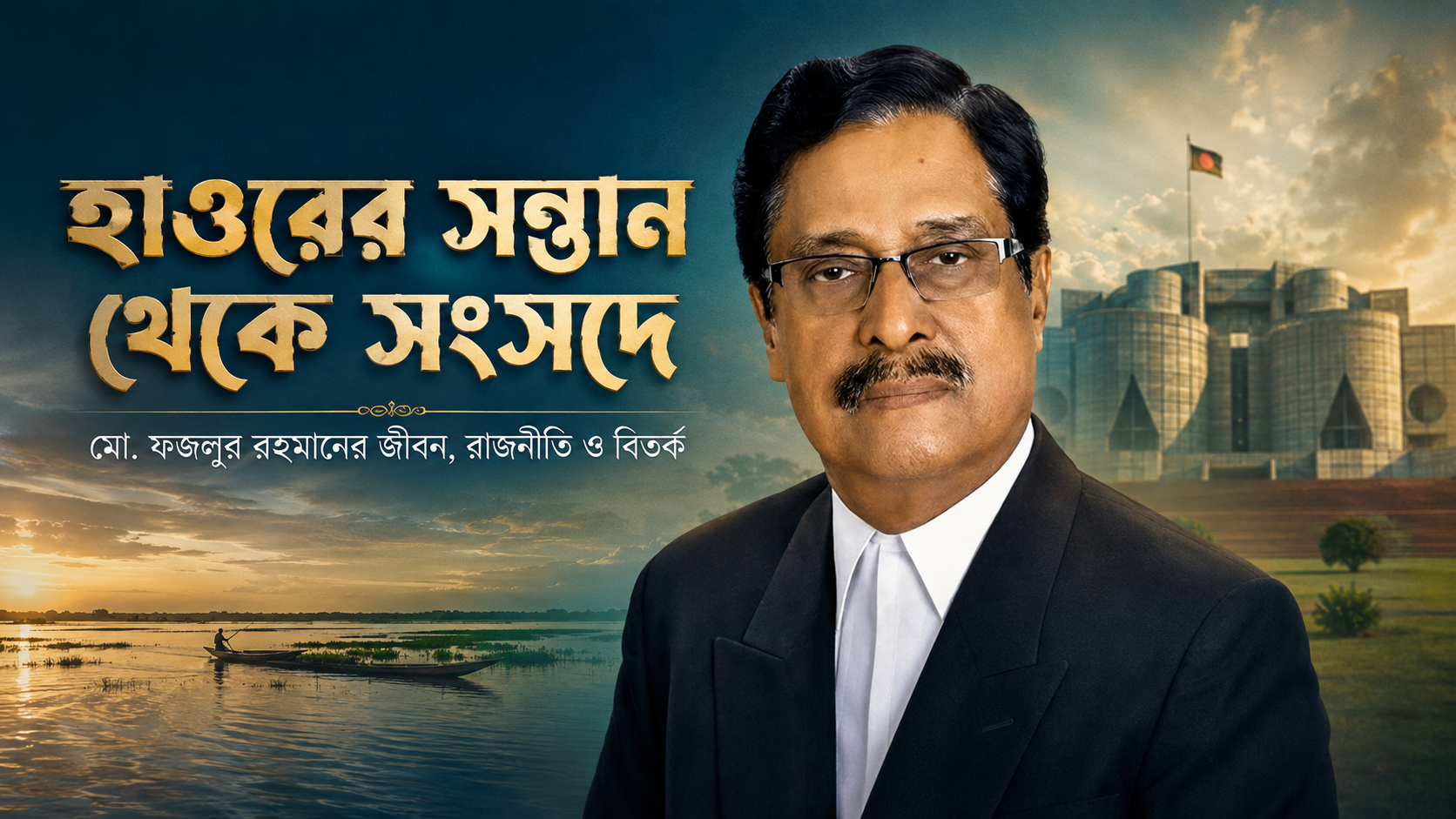
Haor Region to Parliament: The Life, Politics and Controversies of Md. Fazlur Rahman**

Published: 05:36 10 July 2026
Md. Fazlur Rahman is a unique figure in Bangladeshi politics whose life cannot be understood through only one political party, one election, or one controversial speech. His political career includes student movements during the Pakistan era, participation in the 1971 Liberation War, leadership in the Bangladesh Chhatra League, election to Parliament as an Awami League candidate, independent politics, involvement with the Krishak Sramik Janata League, senior leadership in the Bangladesh Nationalist Party, and a return to Parliament after almost four decades.
He is a lawyer by profession, a veteran politician by identity, and currently the Member of Parliament for the Kishoreganj-4 constituency. In recent years, however, he has become nationally known for his direct, emotional, and often forceful political speeches.
Some social media users began calling him “Foju Pagla” as a form of mockery. Instead of continuing to oppose the nickname, Fazlur Rahman later accepted it with humour. As a result, a name originally used by his opponents eventually became part of his political identity and public image.
In the 2026 national parliamentary election, Fazlur Rahman won the Kishoreganj-4 constituency, which consists of Itna, Mithamain, and Austagram, as a candidate of the Bangladesh Nationalist Party, or BNP. According to results released by the Election Commission’s result collection centre, he received 132,472 votes. His nearest rival, Jamaat-e-Islami candidate Md. Rokon Reza Sheikh, received 57,829 votes.
After years of political struggle, defeats, party changes, criticism, and organisational punishment, this victory brought Fazlur Rahman back to the centre of national politics.
Md. Fazlur Rahman at a Glance
Full Name: Md. Fazlur Rahman
Profession: Lawyer and politician
Current Position: Member of Parliament
Constituency: Kishoreganj-4, covering Itna, Mithamain, and Austagram
Current Political Party: Bangladesh Nationalist Party, BNP
Previous Political Affiliations: Bangladesh Awami League and Krishak Sramik Janata League
Education: Gurudayal Government College and the Department of Political Science at the University of Dhaka
Wife: Advocate Umme Kulsum Rekha
Known For: Veteran politician, former student leader, recognised freedom fighter, and being called “Foju Pagla” on social media
Date of Birth: A specific date of birth could not be confirmed from reliable publicly available sources.
Childhood in the Haor Region
Md. Fazlur Rahman was born in a village in the Jaysiddhi Union of Itna Upazila in Kishoreganj district. Different published biographies use slightly different spellings for his village, sometimes identifying it as Koronsi and sometimes referring more generally to the Jaysiddhi area. However, it is widely accepted that he grew up in the haor-surrounded region of Itna.
Life in Itna, Mithamain, and Austagram is different from life in many other parts of Bangladesh. During the monsoon season, large areas go underwater and boats become the main form of transportation. During the dry season, agriculture, fishing, and other haor-based economic activities become central to local life.
Growing up in this environment appears to have shaped Fazlur Rahman’s political outlook. Problems involving transportation, education, healthcare, employment, agriculture, and disaster management in the haor region have repeatedly appeared in his speeches and political commitments.
His connection with his home area can also be seen in his association with Jaysiddhi High School. Published reports have described him as one of the institution’s founders. During the school’s golden jubilee celebration, he spoke about efforts to establish a university in the haor region so that local students would not always have to travel to distant cities for higher education.
Education and the Beginning of Political Awareness
Fazlur Rahman studied at Itna High School and later earned a bachelor’s degree from Gurudayal Government College in Kishoreganj. According to published biographies, he enrolled in the Department of Political Science at the University of Dhaka in 1969.
His student life coincided with one of the most turbulent periods in the history of what was then East Pakistan. The demand for Bengali autonomy, the Six-Point Movement, the Agartala Conspiracy Case, the Mass Uprising of 1969, and the movement for independence deeply influenced the student community.
Fazlur Rahman became involved in student politics during this period.
In one of his personal recollections, he said he first saw Sheikh Mujibur Rahman closely in 1964 while studying at Gurudayal College. Although this is based on his own account, he has often mentioned the experience when explaining how Bangabandhu and the independence movement influenced his political thinking.
Different biographies and media reports have described Fazlur Rahman as a former central general secretary and president of the Bangladesh Chhatra League. However, publicly available sources do not always provide clear or consistent information about the exact periods in which he held these positions or the organisational structure involved.
For that reason, such positions should be mentioned carefully and attributed to published reports rather than presented without qualification.
Involvement in the Liberation War and the Mujib Bahini
The Liberation War is one of the most important parts of Fazlur Rahman’s political identity.
According to his own account, he became associated with the Bangladesh Liberation Force, or BLF, before the war began. He travelled to India, received military training, and later took part in organising the Mujib Bahini in the Kishoreganj region.
A number of national media reports and political profiles have also described him as the head of the Mujib Bahini in Kishoreganj district.
Memories of 1971 frequently appear in his speeches. He has spoken emotionally about losing fellow fighters, crossing rivers, moving through dangerous areas, facing gunfire, and witnessing the suffering of ordinary people.
However, many of these accounts come from his personal recollections, and independent public documentation is not available for every individual incident. Therefore, such details should be presented as Fazlur Rahman’s own description of his wartime experience.
Why Questions Were Raised About His Freedom Fighter Status
During recent political disputes, claims circulated on social media that Fazlur Rahman’s name could not be found on the list maintained by the National Freedom Fighters Council.
A fact-checking report described the claim as misleading. He has also been identified as a freedom fighter in BNP organisational documents, court-related discussions, and reports published by several national media organisations.
An important issue is that “Md. Fazlur Rahman” is a very common name in Bangladesh. A simple search using only that name may produce records belonging to several different people.
Without matching a person’s father’s name, village, gazette number, or other identifying information, a basic search result cannot conclusively prove or disprove someone’s status as a freedom fighter.
No government decision or court ruling cancelling Fazlur Rahman’s recognised freedom fighter status was found in the reliable sources reviewed for this biography. However, complete public documentation of his wartime responsibilities is not easily available.
This lack of easily accessible documentation has allowed political critics to raise questions. A fair assessment should therefore prioritise official records, gazettes, and verifiable historical documents over unverified social media claims.
Professional Career as a Lawyer
Alongside politics, Fazlur Rahman has worked in the legal profession.
Court-related reports have described him as a senior lawyer of the Supreme Court of Bangladesh. He has also said that politics is his main commitment, while legal practice provides his livelihood.
His knowledge of legal language, constitutional matters, and court procedures is often visible in his political speeches.
However, despite being an experienced lawyer, he was summoned to the International Crimes Tribunal in 2025 because of remarks made during a television discussion. He was accused of saying that he did not recognise or accept the tribunal.
He later appeared before the court, offered an unconditional apology, and explained that the remark may have been made unintentionally. The tribunal accepted his apology and discharged him from the matter.
The incident highlighted an important contradiction in his public life. On one hand, he is an experienced lawyer familiar with the judicial system. On the other hand, an emotionally delivered statement brought him close to a contempt-of-court controversy.
Critics described the incident as an example of irresponsible speech. Supporters pointed out that he admitted his mistake, apologised, and accepted the court’s authority.
Family and Personal Life
Fazlur Rahman’s wife, Advocate Umme Kulsum Rekha, is also a lawyer.
According to published biographical information, she studied political science and law at the University of Rajshahi. She has also served as a vice-president of the Bangladesh Supreme Court Bar Association.
She has been seen beside her husband at political, legal, and public events.
During the 2026 election, Fazlur Rahman reportedly went to vote with his wife and their son, Barrister Anik Rahman.
However, reliable public information about his total number of children, the private lives of his family members, and other personal family details remains limited.
In 2025, after protesters gathered outside his residence, Fazlur Rahman expressed concern about the safety of his wife and children. At the time, he said that he was living with his family in a rented apartment in Segunbagicha, Dhaka.
He presented the incident as both a matter of personal security and a question of freedom of expression, arguing that political disagreement should not place a politician’s family at risk.
Political Rise in the Awami League
Fazlur Rahman’s political rise began through the politics of the Bangladesh Chhatra League and the Awami League.
He was once a central leader of the Awami League. In the third national parliamentary election in 1986, he was elected as an Awami League candidate from the then Kishoreganj-3 constituency.
However, his position within the Awami League did not remain secure for long.
Different reports have discussed political disagreements between Fazlur Rahman and Md. Abdul Hamid, who was then an influential Awami League leader and later became President of Bangladesh.
The disagreements reportedly involved local leadership, party nominations, and political influence.
Fazlur Rahman has claimed that this conflict caused him political and personal harm for many years. However, all parts of these allegations have not been independently verified, and reports do not always include the response of Abdul Hamid or his associates.
In 1991, Fazlur Rahman again contested the parliamentary election as an Awami League candidate but lost.
In 1996, he contested as an independent candidate. In 2001, he participated in the election as a candidate of the Krishak Sramik Janata League, led by Kader Siddique.
Published political biographies also state that he served as general secretary of the Krishak Sramik Janata League.
From the Awami League to the BNP
Published sources provide different dates for Fazlur Rahman’s entry into the BNP. Some reports mention 2001, while others mention 2005.
What is clear is that after his involvement with the Krishak Sramik Janata League, he joined the Bangladesh Nationalist Party.
He later became president of the Kishoreganj district BNP and a member of the advisory council of BNP Chairperson Khaleda Zia.
His move to the BNP naturally raised political questions. He had previously been a central Awami League leader and an important figure in Chhatra League politics.
Critics described his change of party as political opportunism or convenience-based politics.
Fazlur Rahman, however, has argued that although he respects the historical role of the Awami League in the independence movement, he distanced himself from the party because of later irregularities, authoritarian practices, and problems in the electoral system.
In 2023, rumours circulated that he might return to the Awami League. He publicly rejected those claims.
He strongly criticised alleged election irregularities, overnight voting, and the conduct of Awami League leaders. He said there was no possibility of his returning to the contemporary Awami League.
His statements were praised by government critics, although his sharp and sarcastic choice of words also attracted criticism.
His Politics During the Awami League Government
From 2009 to 2024, Fazlur Rahman remained involved with BNP politics during the Awami League’s period in government.
Local reports claimed that he was unable to hold regular political programmes in his constituency for a long time. After the political change in August 2024, reports said that he held a major gathering in his area for the first time in nearly 15 years.
According to Fazlur Rahman, he faced political cases, harassment, and restrictions during the Awami League government. He also alleged that activists associated with him were subjected to attacks and legal cases.
He raised questions about the 2018 election and the political environment in his constituency.
However, many of these claims were reported without detailed responses from the government or the other parties involved. They should therefore be presented as his political allegations rather than as independently established facts.
During this period, Fazlur Rahman remained active through television talk shows, public meetings, and online discussions.
He regularly spoke in support of the BNP, demanded the release of Khaleda Zia, criticised the electoral system, and opposed the Awami League government.
In a written response submitted to the BNP, he claimed that after 28 October 2023, he regularly appeared on television and online programmes to encourage party activists during a difficult period.
This was his own claim, and independent evidence identifying him as a leading organiser of the movement remains limited.
Fazlur Rahman’s Role in the 2024 Movement
Fazlur Rahman has made several claims about his role in the July 2024 quota reform movement and the later student-led mass uprising.
In his response to a BNP show-cause notice, he said that from the beginning of the movement he encouraged students to raise democratic demands alongside their demands for employment reform.
He also claimed that he took personal risks and remained connected with different stages of the movement.
However, publicly available media reports do not regularly identify him as a field organiser, coordinator, or frontline participant in the July movement.
The most accurate description of his role would be that he supported the movement as a senior BNP leader and continued speaking against the government.
Independent and detailed information about his direct organisational leadership in the movement remains limited.
After the fall of the government on 5 August, Fazlur Rahman returned to Kishoreganj and instructed BNP activists not to engage in revenge, destruction, or violence.
Although he publicly expressed anger toward his local political rival, Abdul Hamid, he urged supporters not to attack Abdul Hamid’s house. He also declared that he had forgiven him.
Supporters viewed this as an example of political restraint. Critics argued that by publicly declaring that he had “forgiven” a rival, Fazlur Rahman placed himself in the position of a judge.
The Controversy Over His Comments on the July Movement
Fazlur Rahman’s biggest controversy after the 2024 movement concerned his assessment of the movement’s credit and political character.
He argued that the BNP had built the foundation of the anti-government movement through 15 years of struggle and that students entered during the final stage and secured the result.
He also described Jamaat-e-Islami and Islami Chhatra Shibir as a “dark force” and accused them of trying to take control of the movement’s achievements.
The BNP described some of his remarks as offensive, misleading, and contrary to party discipline.
In August 2025, the party issued him a show-cause notice. After considering his written response unsatisfactory, the BNP suspended his primary membership and all party positions for three months.
Party sources reportedly said that more severe action was not taken because of his role in the Liberation War.
In response, Fazlur Rahman said that he had not rejected the July movement as a whole. Instead, he argued that he opposed any single organisation taking all the credit.
He also said he would express regret if any of his statements were proven wrong.
This controversy reflects the central divide in public opinion about him.
Supporters believe he was defending the historical importance of the 1971 Liberation War.
Critics believe that while doing so, he reduced the independent contribution of students and ordinary citizens to the July movement.
The same speech was therefore viewed as courageous by one group and disrespectful by another.
How “Foju Pagla” Became a Political Identity
Fazlur Rahman’s direct speaking style, regional accent, expressive gestures, and use of strong words during emotional moments made his speeches highly shareable on social media.
Political opponents began calling him “Foju Pagla” as a form of ridicule.
At first, he objected to the nickname. Later, however, he changed his approach.
He referred to the historic Pagla Mosque in Kishoreganj and gave the word “Pagla” a positive meaning. He even thanked those who had given him the nickname.
From the perspective of political communication, this was an effective strategy.
If he had continued strongly rejecting the nickname, it might have remained a weapon against him. By accepting and redefining it, he reduced its insulting effect and increased his public visibility.
However, “Foju Pagla” is not his official or honorary title. It began as a political insult.
Professional news reporting should therefore use quotation marks around the term and explain its background rather than presenting it as his formal name.
Controversial Statements in Parliament
After being elected to Parliament in 2026, Fazlur Rahman continued his usual direct style of speaking.
During a parliamentary speech on the Liberation War, Jamaat-e-Islami, and political identity, he argued that a freedom fighter or a member of a martyr’s family could not be involved in Jamaat politics.
Jamaat-e-Islami Ameer and Leader of the Opposition Dr. Shafiqur Rahman objected to the statement, saying that Fazlur Rahman had questioned his family’s background.
Some members associated with the National Freedom Fighters Council also opposed Fazlur Rahman’s remarks.
They argued that freedom fighters joined different political parties after independence and that a person’s Liberation War identity should not be rejected solely because of later political affiliation.
The controversy highlighted a recurring weakness in Fazlur Rahman’s political speeches.
He often attempts to take a firm position on history and ideology, but sometimes makes broad or personal statements.
As a result, the discussion moves away from his main argument and becomes focused on his choice of words.
How People in His Constituency View Him
Fazlur Rahman has strong personal support in Itna, Mithamain, and Austagram. The 2026 election result is the clearest measurement of that support.
He remained ahead of his nearest rival across the three upazilas.
Local political reports suggest that his long-standing presence, recognised role in the Liberation War, public speaking style, and strong opposition to the Awami League contributed to his popularity.
When the BNP nominated him in 2025, supporters in Itna organised processions and distributed sweets.
Local BNP leaders said his nomination brought relief and enthusiasm among party activists in the haor region.
Even after his party positions were suspended, local supporters organised programmes demanding that the decision be reconsidered.
However, it would be inaccurate to claim that everyone in the constituency supports him.
Several BNP leaders also sought the party nomination against him. Some complained that the influence of senior leaders prevented younger and local activists from receiving proper recognition.
Jamaat-e-Islami also has an organised voter base in the area.
Although Fazlur Rahman won by a large margin, political competition and organisational divisions remain.
His Image Among the People of Bangladesh
At the national level, Fazlur Rahman has a divided public image.
One group sees him as a fearless and outspoken politician who refuses to compromise on the history of the Liberation War.
His strong criticism of Jamaat’s role in 1971 and his opposition to alleged electoral irregularities under the Awami League have earned him support from people belonging to different political traditions.
Another group views him as overly emotional and undisciplined in his public speeches.
Critics argue that he often begins with a reasonable political argument but weakens it through personal attacks, broad generalisations, or unnecessarily harsh language.
The BNP’s disciplinary action against him and his apology before the International Crimes Tribunal strengthened this criticism.
His language is also an important source of his popularity.
Instead of relying only on polished political terminology, he uses stories, comparisons, rural examples, humour, and the regional accent of Kishoreganj.
This makes his speeches easy to turn into short videos and share online.
The same style, however, also makes him a frequent target of political trolling.
Return to Parliament After Nearly 40 Years
Fazlur Rahman first became a Member of Parliament in 1986. He returned to Parliament in 2026, almost 40 years later.
During the intervening period, he contested several national elections but failed to win.
Returning to Parliament after such a long break is unusual in Bangladesh’s electoral history.
After his victory, he said that the people of his constituency had honoured him in the later stage of his life and that he would try to protect that trust.
His victory cannot be understood only as a result of party support.
It also reflected his local identity, long-term political presence, personal sympathy from voters, and visible position on Liberation War-related issues.
Current Life and Political Priorities
Fazlur Rahman’s main current identity is that of the Member of Parliament for Kishoreganj-4.
In Parliament, he has discussed not only national political history but also development in the haor region.
During the June 2026 budget discussion, he demanded the creation of a separate ministry for the haor region.
According to him, the area faces unique challenges involving agriculture, transportation, education, healthcare, flooding, and disaster management. He argued that these problems require a specialised administrative structure.
He also demanded an increase in the honorarium paid to freedom fighters, saying that the amount should be increased even if only symbolically.
His greatest challenge now is to move beyond being known only as a controversial or popular speaker and establish himself as an effective parliamentarian.
The people of Itna, Mithamain, and Austagram expect better healthcare, sustainable transportation, employment opportunities, educational institutions, fair prices for agricultural products, and safety during the monsoon season.
The final assessment of his current political chapter will depend on whether he can produce visible results for his constituency while continuing to participate in national debates.
Three Political Eras Within One Life
Fazlur Rahman’s political life is distinctive because it covers several different eras.
He experienced student politics during the Pakistan period, held leadership roles in the Awami League after independence, contested elections under military rule, changed political parties, participated in BNP opposition politics, and eventually became a viral speaker in the digital era.
Three political ages can be seen within his life.
The first is the period of the independence movement and the emotional legacy of the Liberation War.
The second is the era of party divisions, elections, political rivalry, and struggles for power.
The third is the age of social media, when a single speech can reach millions of people within minutes and a mocking nickname can become part of a politician’s identity.
This long journey has made Fazlur Rahman more than an ordinary party politician.
At the same time, decades of political experience have not placed him above controversy.
His party changes, harsh speeches, assessment of the July movement, comments about the judiciary, and language used against political rivals have all raised questions about his political judgement.
Conclusion
Md. Fazlur Rahman is simultaneously a veteran politician shaped by the memory of the Liberation War, a lawyer, a former student leader, a politician who has changed parties, a popular public speaker, and a controversial Member of Parliament.
His life reflects many of the political changes Bangladesh has experienced over the last six decades.
To his supporters, he is a courageous son of the haor region who refuses to compromise with injustice.
To his critics, he is an emotional veteran politician who often loses control of his language and creates unnecessary controversy.
There is some truth in both assessments.
The name “Foju Pagla” made him widely known across Bangladesh, but it is not the most important part of his identity.
His political significance comes from his long journey through student politics, the Liberation War, the legal profession, party politics, election campaigns, defeats, controversies, and his return to Parliament after nearly 40 years.
The final judgement of his political career will not depend on how loudly he speaks.
It will depend on how responsibly he performs in Parliament, how much restraint he shows during political disputes, and whether he can bring visible improvement to the lives of the people of the haor region.
Advertisement
Most Readed - Biography
- The Story of Hussain Muhammad Ershad’s Rule, Controversy Over Authoritarianism, and Fall from Power
- Hearing of corruption case against Tulip Siddique postponed to January
- Rapper Badshah announces separation after five months of marriage
- Jamaat-NCP announces long march to bring back Awami League in December: Rashed Khan
- Lamine Yamal breaks Barcelona's 91-year-old record
- Time has released a list of 100 influential people in the world of AI
- LGRD Minister hopes to further strengthen Bangladesh-India relations
- Human Chain Held Over Alleged Harassment, Extortion Over Compensation for Bormi Bridge Land Acquisition
- Main accused in Hadi murder Faisal and his wife banned from traveling abroad
- Rashmika to return to shooting soon
- Prime Minister Tarique Rahman to visit US for 10 days, address UN General Assembly in September
- Kangana Ranaut slams Naseeruddin Shah for calling him a 'fox'
- Who is Ruhul Kabir Rizvi? Education, political life and current responsibilities
- Two helicopters collide in mid-air while fighting wildfires in Greece, 2 killed
- Young man leaves weapon at opponent's house, calls police, hangs himself
- ‘BJP has turned West Bengal into a prison’, Mamata Banerjee alleges
- Where is Obaidul Quader who shouted 'I will not flee'? No trace
- If the referendum verdict is upheld, Oli Ahmed would have been the president: Jamaat
- BPL may not happen this year: Tamim Iqbal
- List of top drug dealers, strict action to be taken: Home Minister