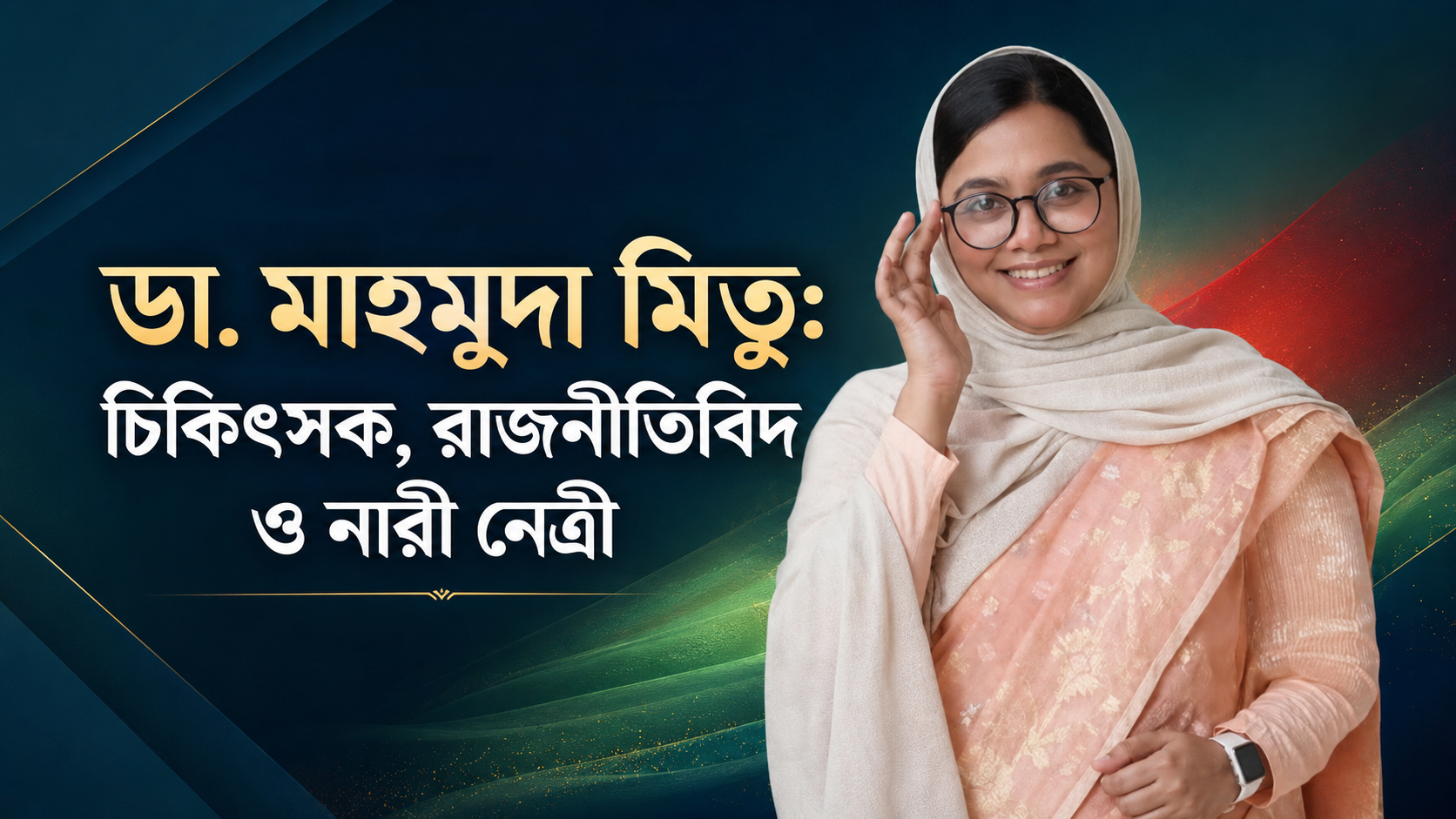
Dr. Mahmuda Mitu: Physician, Politician and Women's Leader

Published: 12:42 25 August 2026
Dr. Mahmuda Alam Mitu is a Bangladeshi physician and emerging female political leader who has gained national attention through her involvement in social activities, the July 2024 mass uprising, civic activism, and the National Citizen Party (NCP). Beginning her professional career as a doctor, she later became involved in social and political activities and eventually took on important responsibilities within the NCP.
Following the July 2024 uprising, she became involved in initiatives supporting injured protesters and the families of those killed during the movement. Her political activities expanded through the National Citizen Committee, and she later joined the National Citizen Party. In 2026, she entered parliament as a member of a reserved women’s seat.
Her journey from medicine to social activism, political organizing, women’s leadership, and parliamentary politics makes Dr. Mahmuda Mitu a notable figure in Bangladesh’s changing political landscape.
Introduction to Dr. Mahmuda Mitu
Full Name: Dr. Mahmuda Alam Mitu
Known As: Mahmuda Mitu
Profession: Physician and Politician
Political Party: National Citizen Party (NCP)
Political Identity: Central NCP leader and Member of Parliament
National Women’s Power: Member Secretary
Education: MBBS
Medical College: Shahabuddin Medical College, Dhaka
Birthplace: Betagi, Barguna
Family Roots: Shauljalia, Kathalia, Jhalokathi
Parliamentary Identity: Member of the 13th Jatiya Sangsad from a reserved women’s seat
Although Dr. Mahmuda Mitu began her professional life as a physician, her involvement in social and political activities gradually expanded. Her activities during and after the July 2024 uprising played a particularly important role in establishing her as a nationally recognized political figure.
Childhood and Family Background
Dr. Mahmuda Mitu spent an important part of her childhood and adolescence in the Barishal and Betagi regions. Her family has roots in Shauljalia village of Kathalia Upazila in Jhalokathi.
Various media reports have highlighted her family’s connection with local public service. Her grandfather, Amjad Hossain, was reportedly involved in local politics and served as a Union Parishad chairman multiple times.
Her family’s long-standing connection with local communities provided her with an early connection to grassroots society. This background later became relevant to her own social and political activities.
From an early age, she reportedly developed an interest in helping people. This interest eventually led her toward the medical profession.
Educational Life
A significant part of Mahmuda Mitu’s educational journey took place in the Barishal and Betagi regions. According to various reports, she studied at Shauljalia High School and received a scholarship in the eighth grade.
She later completed her higher secondary education from Betagi Degree College.
After completing higher secondary education, she moved to Dhaka to pursue medical studies. She earned her MBBS degree from Shahabuddin Medical College in Dhaka.
Her medical education gave her direct exposure to healthcare, medical treatment, and the everyday challenges faced by ordinary people.
This professional foundation later became an important part of her political identity, particularly when she began discussing healthcare and public welfare issues.
Career as a Physician
Before entering active politics, Dr. Mahmuda Mitu worked as a physician.
Her experience as a doctor allowed her to understand various social problems directly, particularly issues related to healthcare access, medical treatment, and the difficulties faced by lower- and middle-income communities.
Her professional background also influenced her later social and political activities.
Healthcare, public medical services, rural healthcare facilities, and women’s health have emerged as areas of interest associated with her public activities.
Her identity as a physician has remained an important part of her public profile even after entering politics.
Social Activities and ‘Care of Mitu’
Before becoming actively involved in politics, Dr. Mahmuda Mitu was associated with various social initiatives.
In Jhalokathi and surrounding areas, she reportedly worked through a social initiative known as ‘Care of Mitu’, which aimed to support disadvantaged and underprivileged people.
According to media reports, her social activities included areas such as youth employment, women’s safety, education, and rural healthcare.
These activities helped her establish connections with local communities and contributed to her growing public profile.
Her grassroots social involvement later became an important foundation for her political career.
Dr. Mahmuda Mitu’s Role in the July 2024 Mass Uprising
One of the most significant chapters of Dr. Mahmuda Mitu’s public life is connected to the July 2024 mass uprising in Bangladesh.
During the movement, she was involved in supporting injured protesters and providing assistance as a medical professional.
Following the movement, she remained involved with initiatives concerning injured protesters, families of those killed, and the broader demands associated with the uprising.
The political transformation following the July 2024 movement created a new environment for civic activism in Bangladesh. During this period, Mahmuda Mitu became increasingly involved in civic and political activities.
Her experience as a physician and her involvement with injured protesters contributed significantly to her public and political identity.
Supporting Those Injured During the July Movement
After the July uprising, the treatment and rehabilitation of injured protesters became an important national issue.
Dr. Mahmuda Mitu was involved in efforts concerning the treatment of injured individuals and support for families of those killed during the movement.
She participated in programs organized by the National Citizen Committee in Barishal and other areas.
During these activities, she emphasized the importance of prioritizing injured individuals and families of those who died during the movement.
Her involvement in these initiatives helped establish her as one of the emerging figures in post-uprising civic politics.
Joining the National Citizen Committee
Dr. Mahmuda Mitu became increasingly involved with the National Citizen Committee, a civic platform that emerged following the July 2024 movement.
She participated in various organizational programs, discussions, and grassroots activities.
She was seen participating in National Citizen Committee programs in Barishal and other parts of Bangladesh.
Issues including the rights of injured protesters, recognition of those killed during the movement, civic rights, and political reforms were among the themes associated with these activities.
Her work with the National Citizen Committee gradually strengthened her political profile.
Attack During a Program in Barishal
In December 2024, an incident involving an alleged attack took place during a National Citizen Committee program in Barishal, where Dr. Mahmuda Mitu was reportedly present.
She alleged that a group of people attacked a discussion and prayer program organized on Victory Day, damaging furniture and tearing down banners.
The incident generated political discussion at the local level. However, representatives of the opposing political side reportedly denied the allegations and presented a different account of the incident.
The event highlighted some of the political challenges faced by emerging civic and political organizations during the post-uprising period.
Joining the National Citizen Party
Following her involvement with the National Citizen Committee, Dr. Mahmuda Mitu joined the National Citizen Party (NCP).
In 2025, she received an important responsibility within the party’s central leadership. She later served as a Joint Member Secretary and became involved in organizational activities in the southern region of Bangladesh.
Her transition from physician to social activist and then to political leader represents an important part of her career development.
The experience she gained during the July movement also became an important element of her political identity.
Organizational Role in the NCP
After joining the NCP, Dr. Mahmuda Mitu became actively involved in the party’s organizational activities.
She participated in political programs, meetings, discussions, and organizational events in different parts of Bangladesh.
She also worked to strengthen the party’s organizational presence in southern Bangladesh and maintain communication with grassroots supporters.
As a prominent female leader within the NCP, she has participated in various important party programs and political activities.
Attempt to Contest the Jhalokathi-1 Constituency
An important chapter in Dr. Mahmuda Mitu’s political career came when she prepared to contest the Jhalokathi-1 (Rajapur-Kathalia) constituency.
Toward the end of 2025, she was nominated as an NCP candidate for the constituency.
The constituency has particular significance for her because of her family roots in the area.
During her campaign and political activities, she highlighted issues such as local development, healthcare, education, women’s safety, and employment opportunities for young people.
Withdrawal of Her Nomination
After receiving the NCP nomination for Jhalokathi-1, Dr. Mahmuda Mitu submitted her nomination papers. However, she later withdrew her candidacy.
In January 2026, reports emerged that she had withdrawn from the Jhalokathi-1 race.
Media reports linked the decision to political strategy and electoral calculations.
Although her attempt to enter parliament through a directly contested constituency did not materialize, her political career soon took another significant direction.
Member Secretary of National Women’s Power
One of the most important responsibilities in Dr. Mahmuda Mitu’s political career is her position as Member Secretary of National Women’s Power.
On International Women’s Day, March 8, 2026, the National Citizen Party launched its women’s organization, National Women’s Power.
Dr. Mahmuda Mitu was appointed as its Member Secretary.
The organization aims to increase women’s participation in politics and address issues such as violence against women, women’s safety, and cyber harassment.
Her position within the organization has strengthened her profile as an advocate of women’s political participation and leadership.
Nomination for a Reserved Women’s Parliamentary Seat
In 2026, Dr. Mahmuda Mitu reached another major milestone in her political career.
She was nominated by an 11-party alliance for a reserved women’s seat in the 13th Jatiya Sangsad.
This nomination provided her with a route to parliament without having to contest a general constituency directly.
Her journey from physician to social activist, July movement participant, civic organizer, NCP leader, and eventually parliamentary nominee represents a significant political progression.
Dr. Mahmuda Mitu as a Member of Parliament
In April 2026, her nomination for a reserved women’s parliamentary seat was finalized.
According to the relevant election process, she became a member of the 13th Jatiya Sangsad from a reserved women’s seat.
Her parliamentary role added a new dimension to her public identity.
Her journey from medicine and social work to political organizing and parliamentary politics has attracted attention as part of Bangladesh’s evolving political landscape.
Calls for Justice and Recognition of the July Movement in Parliament
The July 2024 movement has remained an important issue in Dr. Mahmuda Mitu’s political activities even after entering parliament.
In July 2026, a notice concerning justice for killings and crimes associated with the July movement was raised in parliament.
Dr. Mahmuda Mitu was among the lawmakers associated with the notice.
The issue reflects her continued focus on the rights of those injured or killed during the movement and the broader political demands that emerged from July 2024.
Political Controversies and Pressure
Dr. Mahmuda Mitu’s political career has not been without challenges.
Alongside her political activities, she has reportedly faced allegations involving threats, political opposition, harassment, and other pressures.
After becoming a candidate for Jhalokathi-1, she reportedly alleged that she received death threats from unidentified phone numbers.
As her political responsibilities increased, she also spoke publicly about the impact of political life on her personal life.
Her experience reflects some of the pressures faced by emerging political figures who become increasingly visible in national politics.
Political Activities in 2026
Even after becoming a member of parliament, Dr. Mahmuda Mitu has remained active in grassroots political activities.
In 2026, she participated in political programs in different parts of Bangladesh alongside other NCP leaders.
She was seen participating in political activities in the Sylhet and Moulvibazar regions.
Reports also mentioned her social media comments following an incident involving an NCP convoy in Golapganj, Sylhet.
She was also present during an incident in Sreemangal where an NCP convoy reportedly faced police obstruction.
These activities demonstrate that her parliamentary role has not prevented her from remaining involved in the party’s grassroots political activities.
Dr. Mahmuda Mitu’s Role in Women’s Leadership
Another important aspect of Dr. Mahmuda Mitu’s political career is her role in promoting women’s political participation.
As Member Secretary of National Women’s Power, she is part of the NCP’s central women’s leadership structure.
The organization focuses on increasing women’s participation in politics, opposing violence against women, promoting women’s safety, and creating greater opportunities for women in political leadership.
Her role therefore extends beyond being a physician and politician; she is also becoming increasingly associated with women’s political organization and leadership.
Personal Life and the Impact of Politics
Detailed information about Dr. Mahmuda Mitu’s private life is relatively limited in the public domain.
She has generally attracted public attention through her professional career, social activities, and political responsibilities rather than through her private life.
In 2026, she reportedly discussed the personal impact of entering politics through social media.
Her public comments indicated that political responsibilities had changed her previous lifestyle and reduced the amount of time available for a normal personal life.
Her experience illustrates how increasing political visibility can significantly affect the personal lives of public figures.
Major Themes in Dr. Mahmuda Mitu’s Political Work
Several themes can be identified from Dr. Mahmuda Mitu’s public activities and statements.
Civic Rights
Because of her involvement in post-July civic politics, civic rights have become an important part of her political identity.
Healthcare
As a physician, her professional background gives her particular experience in healthcare and medical services.
Women’s Rights
Through her leadership role in National Women’s Power, women’s safety, women’s rights, and political participation have become important areas of her public activities.
Rights of the Injured and Families of Those Killed
Her involvement with injured protesters and families affected by the July movement remains an important part of her political profile.
Education and Employment
Education, youth development, and employment have also featured among the issues associated with her local political activities.
From Physician to Member of Parliament: A Remarkable Journey
Dr. Mahmuda Mitu’s career can be divided into several major stages.
The first stage was her education, beginning in the Betagi and Barishal regions before moving to Dhaka to study medicine.
The second stage was her professional career as a physician, through which she became involved in serving people.
The third stage was her increasing involvement in social activities, including initiatives aimed at helping disadvantaged communities.
The fourth stage came with the July 2024 mass uprising, when she became involved in supporting injured protesters and later participated in post-uprising civic activities.
The fifth stage was her involvement with the National Citizen Committee.
The sixth stage was her entry into the National Citizen Party, where she took on central organizational responsibilities.
She subsequently became Member Secretary of National Women’s Power, giving her an important role in organizing women within the party.
Finally, in 2026, she entered parliament as a member of the 13th Jatiya Sangsad from a reserved women’s seat.
Dr. Mahmuda Mitu’s Future Political Role
As a member of parliament, Dr. Mahmuda Mitu now faces a new set of responsibilities.
Her experience as a physician, her role as a female political leader, her involvement in the July movement, and her organizational experience within the NCP could all influence her parliamentary activities.
Healthcare, women’s rights, youth employment, civic rights, and issues related to the July movement could become important areas of her future political work.
Her effectiveness in translating these experiences into parliamentary policy and legislation will be an important part of evaluating her future political career.
Conclusion
Dr. Mahmuda Alam Mitu’s life represents a journey closely connected to Bangladesh’s recent political transformation.
She began her professional career as a physician and later became involved in social activities. Her participation in the July 2024 mass uprising and her subsequent involvement with injured protesters and families of those killed helped establish her as a recognizable figure in post-uprising civic politics.
Through the National Citizen Committee, her political activities expanded, and she later joined the National Citizen Party, where she assumed important central responsibilities.
Although she initially sought to contest the Jhalokathi-1 constituency, she later withdrew her candidacy. In 2026, she entered parliament through a reserved women’s seat.
At the same time, she serves as Member Secretary of National Women’s Power, the NCP’s women’s organization.
Her journey from physician to social activist, movement participant, political organizer, women’s leader, and finally Member of Parliament makes Dr. Mahmuda Mitu an emerging figure in Bangladesh’s changing political landscape.
Her future political activities, particularly in healthcare, women’s rights, civic rights, parliamentary affairs, and issues related to the July movement, will determine the next chapter of her public career.
Advertisement
Most Readed - Biography



- Three-Day Mosquito Eradication Drive Begins in Savar's Bongaon
- Countless Decembers will come and go, but Sheikh Hasina will not return to the country: Rashed Khan
- Ronaldo faces risk of 6-month ban for leaving national team camp
- Houthis Claim Third Attack on Riyadh Airport; Aircraft Damaged
- Cybercriminals Claim to Possess Data of 19 Million Pathao Users; $400,000 Ransom Demanded
- Ronaldo shares emotional message upon Messi's retirement, expressing 'utmost respect'
- Nude Trump Sculpture ‘The Orange Plague’ at the European Parliament
- Jamuna Fertilizer Factory Shuts Down Again Just Two Days After Resuming Operations
- Over 100 minutes of footage cut from Rajinikanth’s ‘Jailer 2’
- Messi bids farewell with a goal and assists, showered with love by teammates
- No Relief in Fish, Chicken and Egg Prices, Low-Income People Under Pressure
- Price of Low-Tier Cigarettes Raised Again; 10 Sticks Now Cost Tk 65
- Love, Resentment and ‘Write to the Address of the Sky’: The Untold Story of Rudra and Taslima
- RAB Dissolved, SRB Begins Operations; Uniforms, Logos, and Vehicle Colors to Change
- Bangladesh Bank to provide up to Tk 20 lakh without collateral; here is which young entrepreneurs are eligible.
- "Jinnah's father sold fish; he was a Hindu": Fazlur Rahman's claim vs. historical records
- Sakib Ali: A Prominent Name in Bangladesh’s Diplomacy and Politics
- Raphinha Equals Messi's Record; Barcelona Makes History in 7-Goal Thriller
- Fuel for Rooppur Nuclear Power Plant Arriving in Bangladesh Today
- Major blow for international students: Australia limits opportunities to bring families