Monira Sharmin: Education, Political Career, July Uprising and Leadership of Jatiya Nari Shakti

Published: 04:42 26 August 2026
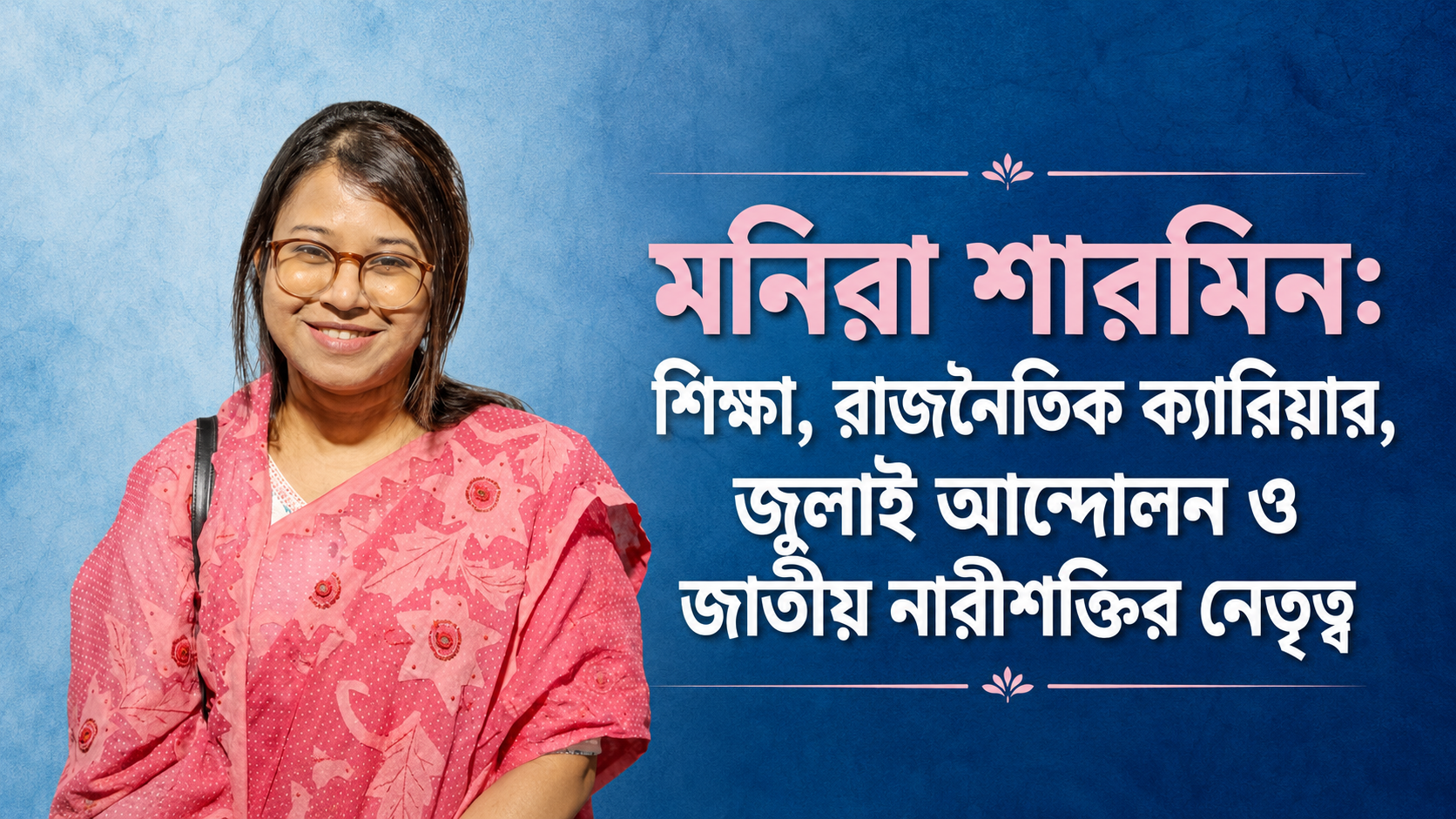
Monira Sharmin is one of the emerging women leaders in Bangladesh’s contemporary political landscape. She serves as a Joint Convener of the National Citizen Party (NCP) and is also the Convener of Jatiya Nari Shakti, the party’s women’s platform. Her involvement in the 2024 July Uprising, her student leadership at the University of Dhaka, her election as General Secretary (GS) of Kabi Sufia Kamal Hall Students’ Union in 2019, and her subsequent roles in the National Citizen Committee and NCP have contributed significantly to her public profile.
Today, Monira Sharmin is regarded as one of the prominent female faces of the NCP. Through Jatiya Nari Shakti, she has focused on increasing women’s participation in politics, developing women’s leadership and highlighting the contributions of women during the July movement.
Who Is Monira Sharmin?
Monira Sharmin is a Bangladeshi politician, organiser and civic movement activist. She serves as a Joint Convener of the National Citizen Party (NCP). She is also the Convener of Jatiya Nari Shakti, the party’s women’s organisation.
Her political journey has been closely connected with student politics, movements for citizens’ rights and the political developments that followed the July 2024 uprising.
Her career reflects a transition from student leadership to rights-based activism, civic organising, national politics and women’s political leadership.
Monira Sharmin’s Educational Background
Monira Sharmin’s academic life is closely associated with the University of Dhaka. She studied at the university’s Institute of Disaster Management and Vulnerability Studies (IDMVS).
Her academic background is connected with areas such as disaster management, climate change, risk management and social vulnerability. These subjects have also been relevant to some of the social and civic issues she has discussed in the public sphere.
During her university years, she became involved in student activities and organisational work. She was associated with Kabi Sufia Kamal Hall and gradually emerged as a student leader.
One of the most important milestones of her student life was her participation in the 2019 Dhaka University Central Students’ Union (DUCSU) and hall union elections.
Student Leadership at the University of Dhaka
Monira Sharmin’s early political journey developed significantly during her time at the University of Dhaka.
In the 2019 hall union election, she contested for the position of General Secretary (GS) of Kabi Sufia Kamal Hall. She was subsequently elected to the position.
Her victory was an important milestone in her student leadership career. The election was particularly significant because the DUCSU and hall elections were held after a long gap of around 28 years.
Her experience as a hall representative provided her with practical experience in student leadership, organisational management, public communication and representing students’ interests.
Involvement in Student Politics
Monira Sharmin was associated with student politics during her university years. Reports have mentioned her connection with the Bangladesh Chhatra League’s Sufia Kamal Hall unit at the University of Dhaka.
However, her political position later evolved. Her involvement in rights-based movements became increasingly important in shaping her political identity.
The 2018 quota reform movement was particularly significant in this regard.
Role in the 2018 Quota Reform Movement
The 2018 quota reform movement became one of the major youth-led movements in Bangladesh.
Monira Sharmin has spoken about her involvement with the movement and has described the issue of quota and merit as a question of fairness and equality.
According to her own statements, the experience of the 2018 movement later contributed to her involvement in the 2024 July movement.
The movement also became an important part of the political awakening of a generation of Bangladeshi students and young activists.
For Monira Sharmin, this period helped strengthen her interest in equality, citizens’ rights, youth participation and political reform.
2019 Kabi Sufia Kamal Hall Election Victory
The 2019 Kabi Sufia Kamal Hall election remains one of the most notable milestones in Monira Sharmin’s early public career.
She contested the position of General Secretary (GS) from an independent panel and won the election.
Her victory demonstrated her organisational ability and popularity among students at the hall.
The experience also helped her develop skills in public representation, communication, organising students and managing institutional responsibilities.
These experiences later became useful in her national-level political career.
Professional and Social Activities
Alongside politics and student leadership, Monira Sharmin has also been associated with professional and civic activities.
Her academic and professional interests have included issues connected with disaster management, climate change, social vulnerability and public concerns.
She has also been involved in public discussions surrounding political rights, social equality, women’s participation and the future of Bangladesh’s political system.
These experiences have contributed to the development of her identity as both a political organiser and civic activist.
Monira Sharmin and the July 2024 Uprising
One of the most important chapters of Monira Sharmin’s political life is her involvement in the July 2024 uprising.
She has described her participation in the July movement as being connected to her earlier experience with the 2018 quota reform movement.
The July movement initially centred around the quota issue but gradually expanded into a much broader movement involving equality, political rights, accountability and demands for structural change.
Monira Sharmin became involved in the movement and subsequently emerged as one of the young political organisers associated with the post-uprising political process.
Women’s Role in the July Movement
A major issue in Monira Sharmin’s public statements has been the role of women in the July movement.
She has argued that women played an important role in the movement and participated not simply as women but as citizens demanding rights and political change.
According to her position, women’s contributions during the movement should receive greater recognition in the political history of Bangladesh.
She has also spoken about the challenges faced by women activists after the movement, including online harassment, trolling and social pressure.
This perspective later became an important part of her involvement in building a dedicated women’s political platform.
Role in the National Citizen Committee
Following the July uprising, Monira Sharmin became involved with the National Citizen Committee, a civic platform formed during the post-uprising political transition.
She served in a leadership role within the organisation and participated in efforts to build an organisational network across different areas.
The National Citizen Committee became an important platform for young activists and organisers who were seeking a new political direction after the July movement.
Monira Sharmin’s involvement in the organisation helped strengthen her position within the emerging political leadership.
Joining the National Citizen Party
The National Citizen Party (NCP) was officially launched on 28 February 2025.
The party emerged from the political movement and organising efforts associated with the July uprising.
Monira Sharmin became part of the party’s central leadership as a Joint Convener.
Her appointment demonstrated the importance placed on young women leaders within the party’s organisational structure.
Since joining the NCP, she has participated in various political programmes, organisational activities, public discussions and media engagements.
Role in the NCP Election Management Committee
Monira Sharmin also held an important organisational position within the NCP’s election preparations.
She served as the Member Secretary of the party’s National Election Management Committee.
The position involved organisational responsibilities related to election preparation, candidate selection and broader electoral planning.
This role further demonstrated her importance within the party’s internal organisational structure.
NCP Candidate for Naogaon-5
Ahead of the 13th parliamentary election, Monira Sharmin was nominated by the NCP as a candidate for Naogaon-5 (Sadar) constituency.
Her nomination attracted considerable attention because she was already known as a central NCP leader and one of the prominent women organisers associated with the party.
However, due to political developments and electoral calculations, she later decided to withdraw her candidacy.
On 28 December 2025, she announced her withdrawal from the contest.
Although she did not ultimately contest the seat, she remained involved in the party’s broader electoral activities through her organisational responsibilities.
Convener of Jatiya Nari Shakti
One of the biggest developments in Monira Sharmin’s political career came in March 2026, when the NCP launched its women’s platform, Jatiya Nari Shakti.
Monira Sharmin was appointed as its Convener.
The organisation was launched on International Women’s Day, 8 March 2026.
Alongside her, Dr. Mahmuda Alam Mitu was appointed Member Secretary and Nusrat Tabassum was appointed Chief Organiser.
The formation of Jatiya Nari Shakti marked an important step in the NCP’s effort to build a dedicated organisational platform for women.
53-Member Jatiya Nari Shakti Committee
Following its launch, Jatiya Nari Shakti formed a 53-member central convening committee.
Monira Sharmin was retained as the Convener, while Dr. Mahmuda Alam Mitu served as Member Secretary.
The committee brought together women organisers from different backgrounds and regions.
Its formation provided a formal organisational structure through which women could participate more actively in political programmes and leadership development.
Monira Sharmin’s Focus on Women’s Political Empowerment
Women’s political empowerment has become one of the defining themes of Monira Sharmin’s current political activities.
She has repeatedly highlighted the contribution of women to the July movement and argued that women should have a stronger role in post-movement politics.
She has also raised concerns about the social and online harassment faced by women who become politically active.
Through Jatiya Nari Shakti, her political focus has increasingly included:
- Increasing women’s participation in politics
- Developing new women leaders
- Supporting women activists
- Recognising women’s contribution to the July movement
- Creating opportunities for women in political organisations
- Promoting women’s representation in decision-making
Demand for Recognition of July Martyrs
Another important part of Monira Sharmin’s political activities has been her position on the recognition of those who died during the July uprising.
She has called for state recognition of the martyrs of the July uprising.
She has also spoken about ensuring proper medical support and recognition for those who were injured during the movement.
For her, preserving the history of the movement and recognising the sacrifices of its participants are important parts of the post-uprising political process.
Views on Independent Journalism
Monira Sharmin has also spoken publicly about the importance of independent journalism and media freedom.
She has stated that political leaders should allow journalists to work independently.
Her statements on media freedom have been connected with broader issues of political accountability, freedom of expression and the relationship between political power and the media.
Views on the July Declaration and State Reform
Monira Sharmin has also participated in discussions concerning the July Declaration and state reform.
Her political statements have focused on maintaining the unity created during the July movement and translating the movement’s demands into institutional and political reforms.
Issues such as justice, reform, equality, accountability and building a new political system have been recurring themes in her public positions.
Bangladesh Krishi Bank Career
Politics is not the only professional chapter in Monira Sharmin’s life.
She also worked at Bangladesh Krishi Bank.
According to published reports, she joined the bank in November 2023 as an Officer General.
She continued working there until she resigned from the position in December 2025.
Her government-bank employment later became relevant to questions surrounding her eligibility for parliamentary nomination.
Reserved Women’s Seat Nomination in 2026
In 2026, Monira Sharmin was nominated by the NCP for a reserved women’s parliamentary seat.
The nomination was seen as another major step in her political career.
However, legal questions later emerged concerning the timing of her resignation from Bangladesh Krishi Bank and the statutory requirements relating to eligibility for parliamentary office.
The Election Commission subsequently cancelled her nomination.
Therefore, it would be inaccurate to describe Monira Sharmin as a current Member of Parliament on the basis of that nomination.
Instead, the episode should be described as an important and controversial chapter in her political career.
Controversies Surrounding Monira Sharmin
Like many emerging political figures, Monira Sharmin has also faced public criticism and controversy.
One issue concerned her involvement in political activities while she was employed at Bangladesh Krishi Bank, particularly because government employees are subject to restrictions concerning political activities.
Another major controversy concerned the cancellation of her nomination for the reserved parliamentary seat.
The issue involved the legal requirements relating to resignation from government employment and eligibility for parliamentary office.
These controversies have become part of the broader public discussion surrounding her political career.
Evolution of Monira Sharmin’s Political Career
Monira Sharmin’s political journey can broadly be divided into several stages.
First, she emerged as a student organiser and leader at the University of Dhaka.
Second, she became involved in the 2018 quota reform movement and issues surrounding student rights.
Third, she gained formal leadership experience after being elected GS of Kabi Sufia Kamal Hall in 2019.
Fourth, she became actively associated with the July 2024 uprising and its post-movement political process.
Fifth, she became involved in the National Citizen Committee.
Sixth, she joined the National Citizen Party as a Joint Convener.
Seventh, she took on an important role in the party’s National Election Management Committee.
Finally, she became the Convener of Jatiya Nari Shakti, placing women’s political empowerment at the centre of her current activities.
Her journey can therefore be summarised as:
Student Leadership → Rights Movement → Civic Activism → July Uprising → National Politics → Women’s Political Leadership
Leadership Characteristics
Several characteristics stand out in Monira Sharmin’s public and political activities.
Young Leadership
She represents a new generation of political leaders who emerged through student movements and the post-July political transformation.
Movement-Based Politics
Her political career has been strongly connected with movements concerning student rights, equality and political reform.
Women’s Leadership
Her role as Convener of Jatiya Nari Shakti has made women’s political participation and empowerment a central part of her political identity.
Organisational Experience
Her experience in student organisations, the National Citizen Committee, the NCP and its election management structure has given her considerable organisational exposure.
Public Communication
She has regularly participated in political discussions, interviews, public programmes and media engagements, helping her establish a visible presence in Bangladesh’s emerging political landscape.
Major Political Themes Associated With Monira Sharmin
Based on her public statements and political activities, several issues are closely associated with Monira Sharmin:
- Opposition to discrimination
- Youth political participation
- Women’s political empowerment
- Recognition of the July movement
- Recognition of July martyrs
- Rights of injured movement participants
- State reform
- Political accountability
- Independent journalism
- Citizen rights
- Development of new political leadership
- Greater participation of women in decision-making
Personal and Family Life
Detailed and reliable public information about Monira Sharmin’s date of birth, birthplace, parents, siblings, marital status and other family details is limited.
Therefore, these details should not be presented as facts without reliable sources.
The best-documented aspects of her life are her education at the University of Dhaka, student leadership, involvement in the quota reform movement, 2019 hall union election victory, participation in the July 2024 uprising, role in the National Citizen Committee, leadership in the NCP, professional experience at Bangladesh Krishi Bank and leadership of Jatiya Nari Shakti.
Monira Sharmin at a Glance
Name: Monira Sharmin
Nationality: Bangladeshi
Profession: Politician, organiser and civic activist
Political Party: National Citizen Party (NCP)
Central Position: Joint Convener
Women’s Organisation: Jatiya Nari Shakti
Position: Convener
University: University of Dhaka
Academic Institution: Institute of Disaster Management and Vulnerability Studies
Student Leadership: General Secretary (GS), Kabi Sufia Kamal Hall Students’ Union, 2019
Professional Experience: Officer General, Bangladesh Krishi Bank
Major Movements: 2018 Quota Reform Movement and 2024 July Uprising
National Citizen Committee: Leadership role
NCP Election Role: Member Secretary, National Election Management Committee
Parliamentary Election: NCP candidate for Naogaon-5 before withdrawing her candidacy
Reserved Women’s Seat: Nominated in 2026, but nomination was subsequently cancelled
Conclusion
Monira Sharmin’s political journey reflects the emergence of a new generation of women leaders in Bangladesh.
From her early days as a student leader at the University of Dhaka to her election as GS of Kabi Sufia Kamal Hall, her involvement in the 2018 quota reform movement, participation in the July 2024 uprising, role in the National Citizen Committee, and eventual rise to the position of Joint Convener of the National Citizen Party, her career has developed through several important stages.
Her appointment as Convener of Jatiya Nari Shakti in 2026 has added a new dimension to her political identity. Through this platform, she has placed greater emphasis on women’s political participation, leadership development and recognition of women’s contribution to the July movement.
At the same time, her career has included controversial chapters, particularly the questions surrounding her government-bank employment and the subsequent cancellation of her reserved parliamentary seat nomination.
Despite these challenges, Monira Sharmin remains one of the more visible young women leaders associated with Bangladesh’s emerging post-July political landscape. Her continued role in the NCP and Jatiya Nari Shakti is likely to keep her in the national political spotlight, particularly in discussions surrounding young leadership, women’s empowerment, political reform and the future direction of Bangladesh’s politics.
Advertisement
Most Readed - Biography



- Three-Day Mosquito Eradication Drive Begins in Savar's Bongaon
- Countless Decembers will come and go, but Sheikh Hasina will not return to the country: Rashed Khan
- Ronaldo faces risk of 6-month ban for leaving national team camp
- Houthis Claim Third Attack on Riyadh Airport; Aircraft Damaged
- Cybercriminals Claim to Possess Data of 19 Million Pathao Users; $400,000 Ransom Demanded
- Ronaldo shares emotional message upon Messi's retirement, expressing 'utmost respect'
- Nude Trump Sculpture ‘The Orange Plague’ at the European Parliament
- Jamuna Fertilizer Factory Shuts Down Again Just Two Days After Resuming Operations
- Over 100 minutes of footage cut from Rajinikanth’s ‘Jailer 2’
- Messi bids farewell with a goal and assists, showered with love by teammates
- No Relief in Fish, Chicken and Egg Prices, Low-Income People Under Pressure
- Price of Low-Tier Cigarettes Raised Again; 10 Sticks Now Cost Tk 65
- Love, Resentment and ‘Write to the Address of the Sky’: The Untold Story of Rudra and Taslima
- RAB Dissolved, SRB Begins Operations; Uniforms, Logos, and Vehicle Colors to Change
- Bangladesh Bank to provide up to Tk 20 lakh without collateral; here is which young entrepreneurs are eligible.
- "Jinnah's father sold fish; he was a Hindu": Fazlur Rahman's claim vs. historical records
- Sakib Ali: A Prominent Name in Bangladesh’s Diplomacy and Politics
- Fuel for Rooppur Nuclear Power Plant Arriving in Bangladesh Today
- Raphinha Equals Messi's Record; Barcelona Makes History in 7-Goal Thriller
- Major blow for international students: Australia limits opportunities to bring families