Waz Stage to Parliament: The Life, Education and Political Rise of Mufti Amir Hamza
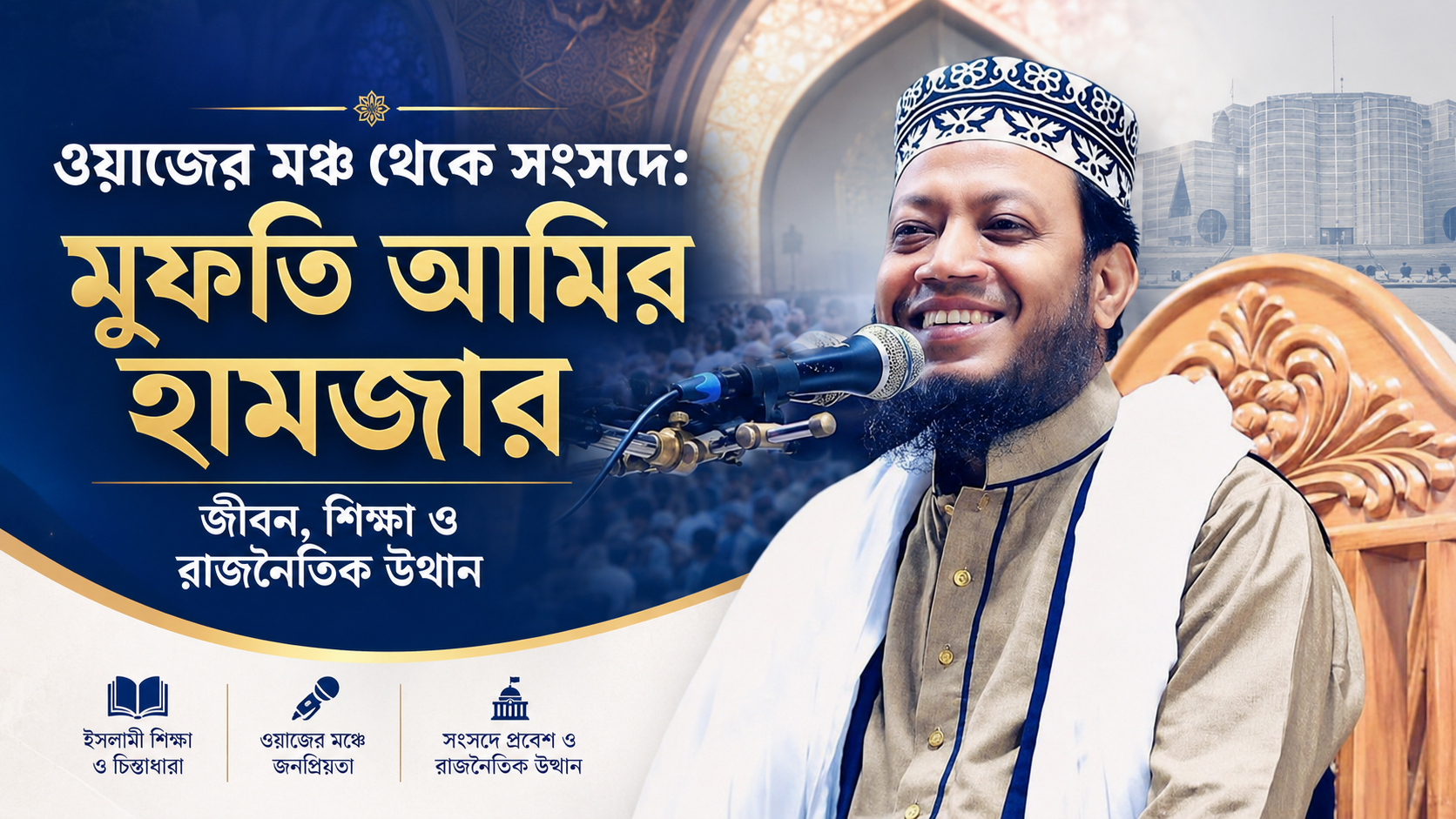
Waz Stage to Parliament: The Life, Education and Political Rise of Mufti Amir Hamza

Published: 02:46 11 July 2026
Mufti Amir Hamza is one of the most widely discussed figures in Bangladesh’s religious-speaking circuit and recent political landscape. At one time, large crowds gathered across the country to hear him speak at waz mahfils. His recorded sermons also reached millions of people through social media.
Alongside his popularity, however, he has repeatedly faced criticism over harsh language, unverified claims, political remarks and interpretations used in religious speeches. After being arrested in 2021 and spending a long period in prison, he returned to the religious stage. He later entered electoral politics as a Bangladesh Jamaat-e-Islami candidate and became the Member of Parliament for the Kushtia-3 constituency.
His life is therefore not simply the story of a religious speaker becoming popular. It includes a rural upbringing, Quranic and Islamic education, the rise of a new online audience for waz, a major criminal case, public apologies over disputed statements and a transition from religious influence to active party politics.
Birth and Childhood
According to publicly available biographical information, Amir Hamza was born on 28 October 1992 in Patikabari Union of Kushtia Sadar Upazila. He spent his childhood and adolescence in a rural environment.
Reliable media sources contain little detailed information about his exact village, family environment or daily childhood experiences. Kushtia’s rural communities have a strong tradition of mosque-, maktab- and madrasa-based religious education. Religious learning also became the foundation of Amir Hamza’s later public identity.
His involvement in Quranic education from an early age, followed by further Islamic studies, helped shape the direction of his future career.
However, there is no well-documented interview or authoritative biography explaining what kind of student he was as a child, who encouraged him most, or what his personality was like in his early years. It would therefore be inaccurate to describe him without evidence as exceptionally brilliant, mischievous, extremely poor or someone who had dreamed of becoming a famous speaker from childhood.
Parents and Family Background
The names and professions of Amir Hamza’s parents, the number of his siblings and the family’s financial background have not been documented in detail by reliable public sources.
Although many reports have covered his religious, political and electoral activities, he has generally kept his immediate family away from the media.
For this reason, family-related claims circulating on social media should not be used without verification. A professional biography can state with reasonable confidence that his family roots are in the Patikabari area of Kushtia Sadar and that his early life developed there.
It is not unusual for the parents of a public figure to remain outside public attention. Privacy concerns and a desire to keep family members away from political controversy may be possible reasons, but Amir Hamza has not publicly offered a detailed explanation.
The Path to Becoming a Hafiz
The title “Hafiz” is commonly used for a person who has memorised the entire Quran. Amir Hamza has long been introduced in public programmes and profiles as both a “Hafiz” and a “Mufti”.
However, reliable and consistent information is unavailable about the madrasa or hifz institution where he memorised the Quran, the age at which he completed hifz, or the identity of his teacher.
The long-standing use of the title “Hafiz” with his name indicates that memorising the Quran was an early and important stage of his religious education. After completing hifz, he is understood to have continued studying Quranic interpretation, Hadith, Islamic jurisprudence and Arabic.
A distinction is nevertheless important. Memorising the Quran, completing the highest level of a madrasa curriculum and receiving specialised training to issue fatwas are separate academic stages.
In Amir Hamza’s case, the specific institutions, periods of study and certificates connected with these stages are not clearly documented in publicly available sources.
Development as an Islamic Scholar and Mufti
Published biographical profiles have mentioned the Islamic University in Kushtia as one of Amir Hamza’s educational institutions.
However, reliable public sources do not provide complete information about his department, degree or academic session. For this reason, it is safer to state that he pursued higher Islamic education at Islamic University without making unsupported claims about a specific qualification.
The title “Mufti” is generally associated with specialised study in Islamic jurisprudence and the formal discipline of ifta. Amir Hamza is widely known by this title in public life.
Yet mainstream reports do not clearly identify the institution where he received ifta training or the body that awarded him a formal qualification.
There is also little reliable information about his examination results or academic achievements. His most visible demonstration of religious learning appeared later in his public speeches, where he combined Quranic verses, Hadith, history, social issues and contemporary politics.
His ability to speak for long periods in an engaging style helped him become widely known among ordinary listeners.
Rise on the Waz Stage
Amir Hamza’s main public rise came through his career as an Islamic speaker.
At religious gatherings across Bangladesh, his emotional delivery, rapid speaking style, storytelling, comparisons and references to contemporary issues attracted many young listeners.
Large audiences attended his events, while recordings of his speeches received hundreds of thousands and sometimes millions of views on YouTube and other social media platforms.
At the time of his arrest in 2021, Al Jazeera described him as one of the popular new-generation Islamic speakers in Bangladesh. The report noted that thousands attended his gatherings and that his online lectures received millions of views.
The simplicity of his language played an important role in his popularity. Instead of relying only on complex Arabic terminology, he used familiar examples, local expressions and dramatic presentation.
As a result, his influence extended beyond madrasa-educated audiences to young people from general educational backgrounds.
However, rapid popularity also created risks. Questions emerged about the accuracy of information used in his long speeches, the balance of his religious interpretations and the consequences of his political remarks.
Some statements that appealed to supporters also drew criticism from Islamic scholars, political activists, students and security agencies.
Standing Among Islamic Scholars and the General Public
Amir Hamza has a large following among audiences who regularly attend waz mahfils in Bangladesh.
His voice, emotional presentation and willingness to discuss contemporary issues are especially popular among sections of the younger generation.
Even after his release from prison, efforts to organise mahfils featuring him and the publicity surrounding those events suggested that public demand for his speeches remained strong.
His acceptance among Islamic scholars, however, is not uniform.
One section regards him as an influential preacher who presents religious teachings in language ordinary people can understand. Others have objected to factual errors, political comparisons and exaggeration in his speeches.
In 2025, former and current members of Islami Chhatra Shibir also criticised him after remarks involving the University of Dhaka and other subjects.
Amir Hamza later said that Jamaat officials had advised him to avoid controversial political matters and concentrate more closely on Quranic interpretation.
It would therefore be inaccurate to describe him as a universally accepted leader of Bangladesh’s Islamic scholarly community.
A more balanced description is that he is a highly popular and influential speaker whose methods and statements have also faced objections from a section of Islamic scholars.
Arrest in 2021
One of the biggest turning points in Amir Hamza’s life came in May 2021.
The Counter Terrorism and Transnational Crime unit of the Dhaka Metropolitan Police arrested him during an operation in Kushtia.
Police alleged that his interpretations of religion and public statements had influenced certain individuals towards extremist ideas. He was shown arrested in a case filed under antiterrorism law.
Investigators claimed that videos of Amir Hamza’s speeches had been found on the phone of a person accused of planning an attack on Parliament. A court also placed him on remand for questioning.
These were allegations made by the investigating authorities. They should not be presented as proven crimes without a final judicial verdict.
According to information later published by Singapore’s Ministry of Home Affairs, Amir Hamza was released on bail in December 2023 after spending time in prison.
Following his release, he again began accepting invitations to speak at religious programmes. However, some scheduled mahfils in Rajbari and Lalmonirhat were suspended in early 2024 because of security and administrative-permission issues.
His Role in the 2024 Movement
Reliable mainstream reports do not identify Amir Hamza as a field coordinator, frontline organiser or policymaker of the student-led July 2024 movement.
It would therefore be misleading to portray him as one of the movement’s principal leaders.
After his release from prison, his speeches frequently included criticism of the Awami League government and discussion of religious and political issues.
Four days after the fall of the government, he addressed an event for Bangladeshi migrants in Singapore on 9 August 2024.
Singapore’s Ministry of Home Affairs said that the programme was held without the required permission and that Amir Hamza discussed Bangladesh’s recently removed government and political developments. Authorities later began an investigation into the event.
The most careful description of his connection with the political changes of 2024 is therefore that he was a popular religious speaker known for anti-Awami League and political commentary, and that he became more active in the new political environment after the government’s fall.
Independent evidence of his direct organisational leadership in the July movement remains limited.
Investigation Over His Speech in Singapore
In August 2024, a speech delivered by Amir Hamza at a migrant workers’ residence in Singapore created an international controversy.
Singapore’s Ministry of Home Affairs stated that neither he nor the organisers had secured the necessary permission for the gathering.
The authorities alleged that some of his remarks were divisive and potentially harmful to communal harmony, and opened an investigation.
Singapore officials further stated that he entered the country on 9 August and left on 10 August after the programme.
Following a police complaint, the role of the organisers and participants was examined.
These were the official allegations and assessments of the Singapore government. No publicly available source confirms that Amir Hamza received a final criminal conviction there.
The episode demonstrated that the influence of his speeches had extended beyond Bangladesh. It also highlighted the importance of respecting local laws, permission requirements and social sensitivities when delivering religious or political speeches abroad.
Criticism of His Statements and Public Apology
After his release from prison, several of Amir Hamza’s speeches again created debate on social media.
He was criticised for claims about the Fajr call to prayer allegedly being restricted for many years at a University of Dhaka hall, comments regarding a residential hall at Jahangirnagar University and a comparison involving an Indian actress and the beauty of a religious figure.
In September 2025, he acknowledged that he had named the wrong University of Dhaka hall and that some remarks had come out unintentionally.
He expressed regret and said that he would avoid unverified political comparisons and concentrate more on explaining the Quran.
He also said that senior Jamaat officials had advised him to be more careful while speaking.
His apology became an important chapter of his public life.
It showed a willingness to acknowledge mistakes, but it also raised a broader question about how carefully a speaker with a large audience should verify information and choose words before making public claims.
Entry into Politics and Association With Jamaat-e-Islami
Political themes had appeared in Amir Hamza’s religious speeches for a long time.
His formal entry into open party politics became clear when he became associated with Bangladesh Jamaat-e-Islami and received the party’s parliamentary nomination.
In 2025, Jamaat nominated him as its candidate for the Kushtia-3 constituency.
His popularity as a religious speaker became a major asset during the election campaign.
At the same time, his old speeches, legal cases and political positions became subjects of criticism from opponents.
Publicly available sources do not fully explain how long he had maintained organisational connections with Jamaat, which level of the party he belonged to, or when he formally completed the membership process.
However, his nomination in 2025 and participation in the 2026 election as the party’s candidate confirmed his active political identity.
Election as Member of Parliament for Kushtia-3
In the 2026 parliamentary election, Amir Hamza contested the Kushtia-3 constituency as a Jamaat-e-Islami candidate.
According to published election-result compilations, he received 180,690 votes.
His nearest rival, Md. Zakir Hossain Sarker, received 126,909 votes, giving Amir Hamza a winning margin of 53,781 votes.
The Kushtia-3 constituency, covering Kushtia Sadar Upazila, had previously been widely associated with Awami League leader Mahbubul Alam Hanif.
Following the 2026 election, Amir Hamza entered Parliament for the first time.
Moving directly from the waz stage to the national legislature represented the biggest political change of his life.
Appealing to people’s religious emotions as a speaker and performing the duties of a Member of Parliament involving legislation, budgets, government accountability and constituency development are very different responsibilities.
His greatest test is now in the second role.
New Controversies After Becoming an MP
Controversy surrounding Amir Hamza’s statements did not end after he became a Member of Parliament.
In March 2026, a defamation case was filed against him in Sirajganj over comments concerning Power, Energy and Mineral Resources Minister Iqbal Hasan Mahmud Tuku.
A court later issued an arrest warrant in April after he did not appear before it.
Another case reportedly sought substantial compensation over the same remarks.
These remain pending allegations. He cannot be described as guilty unless a court reaches a final decision.
The incident nevertheless illustrates that the statements of an elected representative no longer remain limited to a waz audience. They can produce political, legal and institutional consequences.
One of his biggest challenges is therefore to adjust from the spontaneous and highly emotional language of a religious speaker to the more careful language expected from a parliamentarian.
Public Image in Bangladeshi Society
Amir Hamza has a divided public image in Bangladesh.
Supporters see him as a courageous speaker who uses simple language to promote Islamic values.
His imprisonment also led some followers to view him as a religious figure who had suffered political persecution.
Critics, on the other hand, describe him as a controversial speaker who sometimes makes unverified claims under emotional pressure, attacks political opponents harshly and introduces unnecessary comparisons into religious discussion.
The 2021 case, the Singapore investigation, suspension of several mahfils and his later apology have strengthened this criticism.
His actual public identity lies between these competing perceptions.
He has a large audience, but popularity does not necessarily mean universal acceptance.
In both religious and political circles, he has attracted committed followers as well as strong critics.
Patriotism and Political Philosophy
Patriotism cannot be measured conclusively through speeches or political affiliation alone.
Amir Hamza’s supporters view his religious teaching, emphasis on social justice and criticism of the previous government as evidence of his commitment to the country and its people.
In a religiously and politically diverse country, however, the patriotism of an elected representative will ultimately be judged by how effectively that person protects the rights, dignity and security of all citizens.
The Singapore authorities’ allegations about divisive remarks, along with criticism of several of his statements inside Bangladesh, show that inclusive language remains an important challenge for him.
The practical test of his political philosophy will now take place in Parliament.
His long-term public standing will depend on what role he plays in agriculture, education, healthcare, employment, transportation, law and order and development in Kushtia.
Current Life
Amir Hamza is currently the Member of Parliament for Kushtia-3 and is involved in the politics of Bangladesh Jamaat-e-Islami.
Alongside his activities as a religious speaker, his parliamentary responsibilities, communication with constituents and participation in party programmes now form the main part of his public life.
His life is in a period of transition.
Previously, his main audience consisted of people attending religious gatherings and online followers.
Now his words are connected with the voters of an entire constituency, the national legislature, state institutions and the broader political environment.
This transition has given him a major opportunity.
If he can use his religious popularity to address people’s practical problems, he may build a new identity as an effective public representative.
However, if unverified claims, careless remarks and personal attacks continue, his parliamentary contributions may repeatedly be overshadowed by controversy.
Conclusion
Mufti Amir Hamza’s journey from a rural community in Kushtia to becoming a Hafiz of the Quran, a popular Islamic speaker and eventually a Member of Parliament is a notable story within Bangladesh’s changing religious and political landscape.
His greatest strength is his ability to communicate with people in simple and accessible language.
His emotional delivery, familiar examples and ability to connect religious subjects with contemporary events brought him immense popularity.
The same qualities have also become his biggest weakness.
Unverified information, exaggerated comparisons and political attacks have led to legal cases, criticism and public apologies.
Supporters see him as a courageous Islamic speaker and representative of political change. Critics question him over irresponsible and divisive remarks.
Both images exist in the public sphere.
Becoming a Member of Parliament has opened a new chapter in Amir Hamza’s life.
His political future will no longer be judged mainly by the popularity of his waz speeches.
It will be determined by his responsibility in Parliament, respect for the law, tolerance of differing opinions and visible work for the people of Kushtia.
Advertisement
Most Readed - Biography



- The Story of Hussain Muhammad Ershad’s Rule, Controversy Over Authoritarianism, and Fall from Power
- Hearing of corruption case against Tulip Siddique postponed to January
- Rapper Badshah announces separation after five months of marriage
- Jamaat-NCP announces long march to bring back Awami League in December: Rashed Khan
- Lamine Yamal breaks Barcelona's 91-year-old record
- Time has released a list of 100 influential people in the world of AI
- LGRD Minister hopes to further strengthen Bangladesh-India relations
- Human Chain Held Over Alleged Harassment, Extortion Over Compensation for Bormi Bridge Land Acquisition
- Main accused in Hadi murder Faisal and his wife banned from traveling abroad
- Rashmika to return to shooting soon
- Prime Minister Tarique Rahman to visit US for 10 days, address UN General Assembly in September
- BPL may not happen this year: Tamim Iqbal
- Kangana Ranaut slams Naseeruddin Shah for calling him a 'fox'
- Who is Ruhul Kabir Rizvi? Education, political life and current responsibilities
- Young man leaves weapon at opponent's house, calls police, hangs himself
- ‘BJP has turned West Bengal into a prison’, Mamata Banerjee alleges
- If the referendum verdict is upheld, Oli Ahmed would have been the president: Jamaat
- 132 killed in strong earthquake in Colombia, state of emergency declared
- Umpire Sharfuddaula Saikat's resignation finally takes effect, contract with BCB ends
- List of top drug dealers, strict action to be taken: Home Minister