From Struggle to Parliament: The Story of Ali Nawaz Mahmud Khayyam
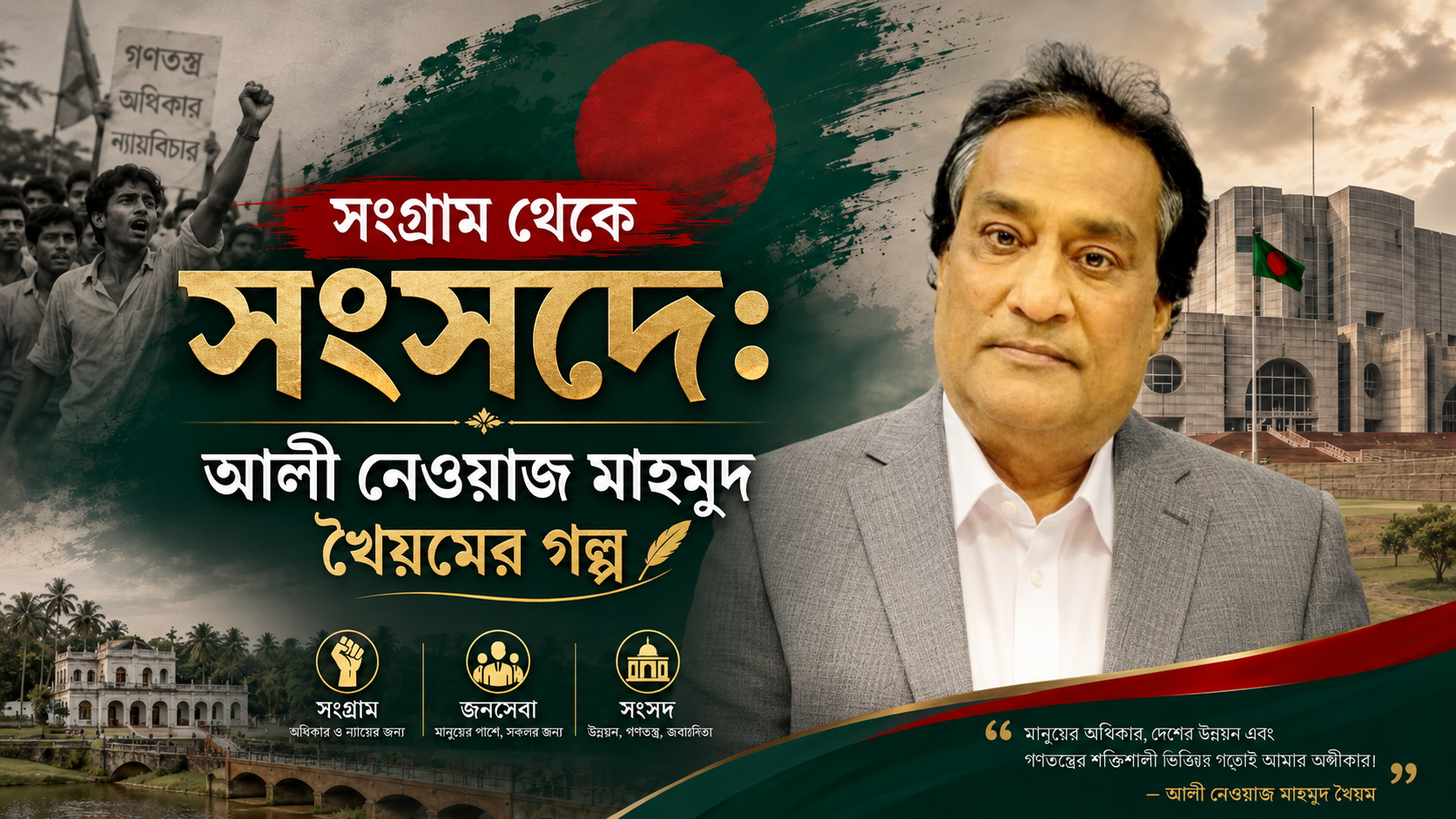

Published: 04:47 5 August 2026
Early Life, Birth, and Family Background
Ali Newaz Mahmud Khaiyam is a veteran politician from the Rajbari district of Bangladesh. Publicly available biographical sources mention that he was born in Rajbari on May 25, 1957. However, the official profile published by the Ministry of Cultural Affairs does not provide detailed information about his date of birth, educational background, or complete family history.
His late father, Dr. A. K. M. Wahid, was a homeopathic physician, while his late mother, Razia Begum, was a homemaker. The family consisted of four brothers and four sisters, and Ali Newaz Mahmud Khaiyam was the sixth among the eight siblings. According to published news reports, his parents are buried in a cemetery in the 28 Colony area of Rajbari municipality.
Growing up in the family of a physician may have exposed him to people from different social and economic backgrounds from an early age. His father’s profession likely created regular contact with patients, local families, and members of the wider community.
However, no sufficiently verifiable public documents are available regarding the specific events of his childhood, school life, early political influences, or possible involvement in student politics.
This limitation is important when presenting a complete biography. A detailed account of someone’s early life normally requires personal interviews, family archives, educational records, and statements from relatives or close associates. Most publicly available information about Ali Newaz Mahmud Khaiyam focuses on his local government leadership, party politics, elections, and public responsibilities.
Beginning His Political Journey in Left-Wing Politics
One of the distinctive features of Ali Newaz Mahmud Khaiyam’s political career is that he did not begin his journey as a politician of the Bangladesh Nationalist Party, commonly known as the BNP.
Before becoming nationally recognised as a BNP leader, he was involved in the politics of the Workers Party. During this period, he established the foundation of his leadership through local government and municipal politics.
While associated with the Workers Party, he was elected chairman of Rajbari Municipality for three consecutive terms. At that time, the head of a municipality was commonly known as the chairman, although the same position later became known as mayor.
According to media reports, he led Rajbari Municipality for an extended period before the 2001 general election.
His election as municipal chairman for three consecutive terms became one of the most important foundations of his political career. Leadership in local government places a politician in direct contact with people’s everyday concerns, including roads, drainage, sanitation, public services, marketplaces, urban planning, and municipal infrastructure.
As a result, Ali Newaz Mahmud Khaiyam had already become a familiar political figure among the people of Rajbari before entering the National Parliament.
This stage of his career also demonstrates an important ideological and organisational transition. His movement from a left-wing political organisation to the nationalist politics of the BNP reflects the changing nature of local and national political alliances in Bangladesh.
Joining the BNP and Entering National Politics
Ali Newaz Mahmud Khaiyam joined the BNP before the 2001 general election. After joining the party, he received the BNP nomination to contest the Rajbari-1 parliamentary constituency.
The Rajbari-1 constituency currently includes Rajbari Sadar and Goalanda upazilas.
His rise within the BNP was relatively rapid. His experience as a three-term municipal chairman, his strong local identity, organisational connections, and personal base of political supporters are believed to have contributed significantly to his progress within the party.
He later served as the general secretary of the Rajbari district BNP and subsequently became the district president. Multiple published reports state that he was elected president of the Rajbari district BNP in 2014.
He also served as a member of the BNP National Executive Committee. Therefore, his political influence was no longer limited to local politics in Rajbari; he became part of the party’s central organisational structure.
First Election to Parliament in 2001
The eighth parliamentary election in 2001 marked one of the most important turning points in Ali Newaz Mahmud Khaiyam’s political career.
He contested the Rajbari-1 constituency as a BNP candidate and defeated Awami League candidate Kazi Keramat Ali.
According to statistics from the Bangladesh Election Commission, Ali Newaz Mahmud Khaiyam received 95,266 votes. His nearest rival, Kazi Keramat Ali, received 85,057 votes. The winning margin was 10,209 votes.
Through this victory, he was elected to the National Parliament for the first time and represented the people of Rajbari-1 from 2001 to 2006.
His transition from municipal chairman to Member of Parliament represented national recognition of the political experience and public support he had developed through years of local leadership.
As a Member of Parliament, he also participated in national political debates. In 2005, the media reported his parliamentary remarks during a discussion concerning the investigation into the August 21 grenade attack.
This indicated that his parliamentary activities were not limited to constituency-based issues. He also participated in discussions surrounding major national political events of that period.
Reformist Controversy and the Political Crisis of 2007
Following the political crisis and the declaration of a state of emergency after 2006, serious divisions emerged within the BNP.
One section of the party supported reforms in the leadership structure and internal organisation. During this period, Ali Newaz Mahmud Khaiyam was associated with the group commonly described as the BNP’s reformist faction.
Published reports stated that he supported the reformist position of the BNP’s then secretary-general, Abdul Mannan Bhuiyan. This reportedly created distance between him and the party’s central leadership.
Reports also stated that in 2008, the BNP removed him and the then president of the Rajbari district BNP from their party positions and responsibilities.
In November 2007, a contractor at the Daulatdia ferry terminal filed an extortion case against him. Police arrested him from Kakrail in Dhaka, and he was later sent to prison through a court order.
He subsequently received interim bail in the case. These events were part of allegations and legal proceedings. Publicly available sources do not provide sufficiently clear information about the final judgment of the case or whether the allegations were ultimately proven.
This period became one of the most difficult chapters of his political career. He had to face internal party conflict and legal complications at the same time.
Defeat in the 2008 Parliamentary Election
Ali Newaz Mahmud Khaiyam again contested the Rajbari-1 constituency as a BNP candidate in the ninth parliamentary election in 2008.
However, this time he was defeated by Awami League candidate Kazi Keramat Ali.
According to published election statistics, Ali Newaz Mahmud Khaiyam received 83,933 votes, while Kazi Keramat Ali received 141,561 votes.
After his victory in 2001, the defeat in the 2008 election removed him from Parliament.
Despite the defeat, he did not withdraw from the politics of Rajbari. His political position had temporarily weakened because of internal disagreements and his association with the reformist faction, but he later became active again in both district-level and central BNP politics.
Boycott of the 2014 Election and Opposition Politics
The BNP and its allied parties boycotted the tenth parliamentary election in 2014.
In accordance with the party’s decision, Ali Newaz Mahmud Khaiyam did not contest the election. Therefore, he did not directly participate in the parliamentary contest for the Rajbari-1 constituency that year.
During this period, he was known as the president of the Rajbari district BNP and remained active in political programmes organised against the government.
The BNP’s boycott of the 2014 election further delayed his opportunity to return to parliamentary politics.
Participation in the 2018 Parliamentary Election
When the BNP returned to electoral politics in the eleventh parliamentary election in 2018, Ali Newaz Mahmud Khaiyam contested the Rajbari-1 constituency under the party’s paddy sheaf symbol.
According to the officially declared results, he received 33,000 votes. His opponent, Kazi Keramat Ali, received 238,914 votes.
Local media reports stated that Ali Newaz Mahmud Khaiyam announced his withdrawal from the election on polling day, alleging irregularities and vote manipulation. However, the officially declared results listed him as a defeated candidate.
After his first election to Parliament in 2001, he had to wait many more years for another opportunity to return.
Despite remaining outside Parliament, he continued to participate in political meetings, party programmes, and public activities.
Street Politics and Internal Party Disputes
During his years outside Parliament, Ali Newaz Mahmud Khaiyam participated in political programmes opposing rising commodity prices, political cases, and the arrest of opposition leaders and activists.
Reports stated that in 2022, he led a BNP programme in Rajbari protesting the increasing prices of essential goods.
His political career was not free from internal party conflict.
In 2024, a section of the Rajbari district BNP held a press conference and accused him of violating party discipline, organising meetings without proper permission, and attempting to exercise influence through his followers.
They demanded organisational action against him. However, these were allegations made by the concerned political leaders. The available reports did not provide independent proof of the allegations or information about a final decision from the party.
The dispute demonstrated that Ali Newaz Mahmud Khaiyam had developed a strong personal support base within Rajbari BNP politics. At the same time, it revealed competition over organisational leadership and political authority within the district unit.
Preparing for a New Election in 2025
In November 2025, the BNP announced Ali Newaz Mahmud Khaiyam as its candidate for the Rajbari-1 constituency in the thirteenth parliamentary election.
At that time, he was widely identified as a former Member of Parliament and a member of the BNP National Executive Committee.
During the election campaign, he highlighted infrastructure, employment, river erosion, and transportation as major issues affecting the people of Rajbari.
His publicly promoted priorities included the construction of a second Padma Bridge, the development of the Padma Barrage, permanent river management and erosion control, and the reduction of local unemployment.
His principal challenge was to recover the parliamentary seat after a long absence, manage internal divisions within the party, and re-establish his political appeal among a new generation of voters.
Returning to Parliament in 2026
In the thirteenth parliamentary election held on February 13, 2026, Ali Newaz Mahmud Khaiyam won the Rajbari-1 constituency by a significant margin.
Contesting with the paddy sheaf symbol, he received 154,541 votes. His nearest rival, Md. Nurul Islam of Bangladesh Jamaat-e-Islami, received 101,092 votes.
Ali Newaz Mahmud Khaiyam won the election by a margin of 53,449 votes.
Through this victory, he returned to the National Parliament after nearly two decades. It was his second parliamentary victory after his first success in 2001.
Following the election, he described the result as an expression of support for democracy, nationalist politics, and the unity of the people.
His return to Parliament after a long political absence, electoral defeats, internal party conflict, and legal challenges represented a significant political comeback at the district level in Bangladesh.
Responsibility as State Minister for Cultural Affairs
On February 17, 2026, Ali Newaz Mahmud Khaiyam took the oath of office as the State Minister for Cultural Affairs.
The official list published by the Cabinet Division mentioned February 17, 2026, as the date on which he assumed responsibility. The official website of the Ministry of Cultural Affairs also identified him as the serving state minister.
After taking office, he began working with institutions under the ministry, cultural organisations, artists, writers, and government officials.
He participated in events connected with the Ekushey Padak 2026 ceremony, the Bangla Academy, the Bangladesh Shilpakala Academy, and programmes honouring Bangladesh’s national poet, Kazi Nazrul Islam.
He spoke about freeing cultural institutions from partisan influence, restoring healthy cultural practices, and strengthening the regional and folk traditions of Bangladesh.
In June 2026, he stated that long-term politicisation had damaged the capacity and distinct identity of the country’s cultural sector.
Attention to His Constituency
During his first official visit to Rajbari after becoming a state minister, Ali Newaz Mahmud Khaiyam held meetings with the district administration, local government representatives, party leaders and activists, and people from different professional and social groups.
During the visit, he also paid respect at the graves of his parents.
At a meeting of the Rajbari Sadar Hospital Management Committee, he spoke about eliminating the influence of brokers, reducing the shortage of doctors, ending unnecessary suffering for patients, and improving hospital infrastructure.
He also mentioned sending a proposal for the establishment of a medical college in Rajbari.
These were publicly announced plans. Their implementation would depend on future government approval, resource allocation, administrative decisions, and budgetary support.
Recent Activities in 2026
On August 3, 2026, Ali Newaz Mahmud Khaiyam attended an event at Jagannath University organised in observance of Nazrul Year.
During the programme, he spoke about the decline of political culture in the country. He identified challenges affecting the economy, culture, politics, and institutional capacity as major concerns for the new government.
According to the latest information published by August 5, 2026, he was also involved in preparations for the inauguration of the July Memorial Museum.
He stated that the museum was planned to be opened to the public on August 6 and that its collection would be further enriched in the future.
Overall Assessment of His Political Identity
Ali Newaz Mahmud Khaiyam’s political career has not progressed in a straight or uninterrupted line.
He began his journey in left-wing politics, became chairman of Rajbari Municipality for three consecutive terms, joined the BNP, and was elected to the National Parliament.
He subsequently experienced internal party conflict, reformist controversy, arrest, electoral defeat, and a long period outside Parliament.
One of his primary political strengths has been his long presence in local politics. His experience in municipal administration, established personal network, grassroots connections, and determination to contest elections repeatedly have contributed to his political durability.
However, internal party divisions, his past association with the reformist faction, and opposition from a section of the local BNP have remained controversial aspects of his career.
Nearly 25 years after being elected to Parliament for the first time in 2001, his appointment as State Minister for Cultural Affairs in 2026 became the highest governmental responsibility of his political life.
His journey from municipal chairman to Member of Parliament and then to state minister has established him as one of the longest-serving and most recognisable political figures in Rajbari.
Nevertheless, the final assessment of his current responsibilities will depend on several important factors.
These include the institutional changes he can introduce within the Ministry of Cultural Affairs, the support provided to artists and cultural organisations, and the extent to which his commitments regarding healthcare, transportation, river erosion, education, employment, and infrastructure in Rajbari are implemented.
Conclusion
Ali Newaz Mahmud Khaiyam’s political life represents a long history of struggle, achievement, conflict, defeat, and return.
From serving in local government to becoming a Member of Parliament and later accepting a national governmental responsibility, he has remained connected with the politics and public life of the people of Rajbari throughout different stages of his career.
During his long political journey, he has received considerable public support. At the same time, he has faced internal party crises, electoral defeats, legal difficulties, and political controversies.
His ability to remain active in politics despite these challenges, and his return to Parliament after a long absence, demonstrate his political patience, resilience, and continued connection with a section of the electorate.
The expectations of the people of Rajbari-1 are no longer limited to political speeches and campaign promises. They want practical improvements in employment, healthcare, education, transportation, infrastructure, and permanent protection from river erosion.
A politician’s place in history is not determined only by the offices he holds or the elections he wins.
His true legacy depends on how effectively he improves people’s lives, protects public trust, strengthens institutions, and contributes to the wellbeing of future generations.
The final chapter of Ali Newaz Mahmud Khaiyam’s political career has not yet been written.
His present responsibilities, decisions, and actions will determine whether he is remembered merely as a long-serving politician from Rajbari or as a public-oriented and development-focused leader who created lasting change.
Ultimately, time and the people will deliver the final judgment on his political legacy.
As of August 5, 2026, Ali Newaz Mahmud Khaiyam is serving as the Member of Parliament for the Rajbari-1 constituency, a member of the BNP National Executive Committee, and the State Minister for Cultural Affairs of the Government of the People’s Republic of Bangladesh.
Advertisement
Most Readed - Biography

- From Struggle to Parliament: The Story of Ali Nawaz Mahmud Khayyam
- BSTI warns of dangerous levels of mercury detected in 8 skin cream brands
- The clock will strike and we will not suck our fingers’: Shafiqur Rahman
- Deepika practiced differently to prepare herself for the role of 'Ram Leela'
- Sabbir Rahman returns to BCB team after four years, will play in Malaysia series
- ‘BJP has turned West Bengal into a prison’, Mamata Banerjee alleges
- July Memorial Museum is a reflection of all democratic movements: Prime Minister
- Bangladesh proposes to import gas from Myanmar via pipeline
- New political platform named ‘Bangladesh Janarashtra Andolon’ launched
- Babita agrees to return to cinema at Shakib Khan's request, but there is one condition
- Sarjis Alam warns of strict resistance if there are irregularities in vote counting
- Supercomputer predicts France close to winning the World Cup
- Political crisis may worsen if referendum verdict is not implemented: Golam Parwar
- Patient's severed leg missing from operation theatre at Kushtia Hospital
- Government fertilizer and paddy seeds found at BNP leader's house, criticism in the area
- Aamir Khan-Gauri Spratt in Australia after marriage, personal vacation in between the festivities
- Ahmadinejad at Khamenei's funeral, dismissing rumors of death
- Major US strike on Iran amid Hormuz tensions, targeting 140 military installations
- Salahuddin Ahmed: A Story of Struggle, Leadership, and Return
- Shakira returns to Egypt after 19 years, will sing at the Pyramids of Giza