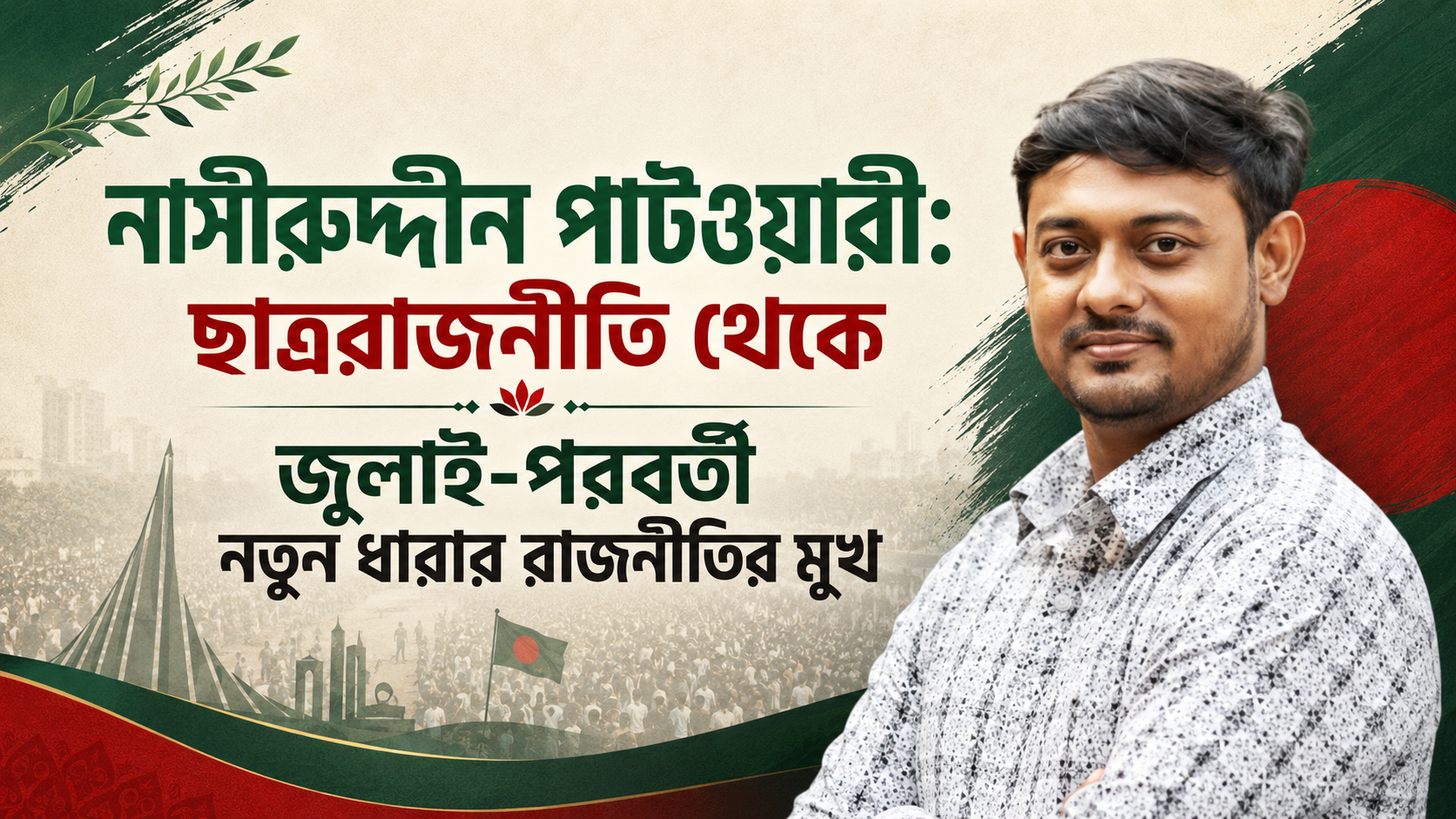
Nasiruddin Patwary: From Student Politics to a New Post-July Political Movement

Published: 03:27 20 July 2026
In Bangladesh’s recent political history, Nasiruddin Patwary is a young leader whose identity is not limited to a single event or political party. His political profile has developed through several chapters, including student politics, protests against border killings, the July 2024 mass uprising, the formation of the National Citizen Committee, and his leadership role in the National Citizen Party, or NCP.
He is not one of the country’s oldest or most established political leaders. To understand his political rise, it is necessary to examine why a section of Bangladesh’s younger generation is seeking new leadership, a new constitution, and a new political settlement outside the traditional political system.
Unlike Dr. Muhammad Yunus, however, Nasiruddin Patwary does not yet have an extensive and long-established public record. Much of the information about his childhood, family, and personal life is not publicly available. Therefore, this biography is based only on publicly available information, media reports, and details found in his own statements.
Childhood, Family Roots, and Identity
Nasiruddin Patwary’s family roots are in Shahrashti Upazila of Chandpur district. Published election-related profiles have identified him as a permanent resident of Shahrashti and a current resident of the Uttara area of Dhaka.
There is limited reliable information about his childhood or the professions of his family members. However, several published profiles suggest that he came from a rural, middle-class family background.
As he pursued higher education, professional work, and politics, much of his life became centred in Dhaka. Alongside politics, he has also identified himself as a marketing consultant. Election candidate profiles have listed his profession as marketing consultant and his educational qualification as an MBA from the University of Dhaka.
Educational Life
Nasiruddin Patwary studied at Darunnazat Siddikia Kamil Madrasa in Dhaka. After completing his higher secondary education, he was admitted to the Department of Marketing at the University of Dhaka.
He was a student of the 2013–14 academic session and later completed both his undergraduate degree and MBA in marketing.
His educational life was not limited to the classroom. After entering university, he became involved in issues related to student rights, border killings, democracy on campus, and the accountability of state institutions.
According to his own statements, he had limited political involvement during his teenage and higher secondary years. However, during university, he gradually moved away from traditional party politics and became more involved in rights-based and protest-oriented political activities.
The 2013 Arrest and His Political Realisation
An important change in Nasiruddin Patwary’s political thinking reportedly came after an incident in 2013.
According to his own account, after completing his higher secondary examinations, he was arrested by police from a student hostel in the Farmgate area of Dhaka. He claimed that he was not involved in any major political activity at the time.
While being held at the police station, he reportedly witnessed ordinary people being arrested, beaten, and harassed. This led him to question the relationship between state power and citizens’ rights.
He later described this experience as one of the major events behind his political awakening. According to his account, the question of why an ordinary student should be sent to prison without evidence of a crime encouraged him to think differently about the state, law, and the use of power.
Not every aspect of this incident has been independently verified. Therefore, it should be understood as his personal account of the experience. Nevertheless, questions concerning the accountability of the police, administration, and state institutions have repeatedly appeared in his later political speeches.
Student Politics at the University of Dhaka
While studying at the University of Dhaka, Nasiruddin Patwary became involved with the Bangladesh Students’ Federation.
At one stage, he served as the organising secretary of the organisation’s University of Dhaka branch.
During his involvement with the Students’ Federation, he participated in programmes concerning the university’s accommodation crisis, overcrowded dormitory rooms, student safety, administrative accountability, investigations into allegations of sexual harassment, and the democratic environment on campus.
In the 2019 Dhaka University Central Students’ Union election, commonly known as the DUCSU election, he contested for the position of social welfare secretary from the Students’ Federation panel.
He did not win the election, but his participation helped increase his visibility in student politics.
This stage of his political life was important because it gave him experience in public speaking, organisational management, programme planning, and working with people from different ideological backgrounds.
The 55-Day Protest Against Border Killings
Nasiruddin Patwary first gained wider public recognition through his protest against border killings.
At the beginning of 2020, he began a sit-in at the base of the Raju Memorial Sculpture at the University of Dhaka to protest the killing of Bangladeshi citizens by India’s Border Security Force.
According to various media reports, his protest continued for approximately 55 days.
The programme was not organised by a major political party. He demanded an end to border killings, greater protection for Bangladeshi citizens, and a stronger diplomatic position from the state.
Because he continued the protest for an extended period, either alone or with limited support, he became known as a committed young protest leader.
Border killings were not a temporary issue in his political life. In later years, he continued to speak about border violence, alleged illegal push-ins, Bangladesh’s sovereignty, and the need for relations with India to be based on equality and mutual respect.
From the Students’ Federation to the AB Party
After his involvement with the Students’ Federation, Nasiruddin Patwary joined Amar Bangladesh Party, commonly known as the AB Party.
He served there as assistant secretary for information and research.
His work in the AB Party mainly focused on political research, information, policy discussions, and organisational activities. However, he resigned from the party before the major political changes of 2024.
When the National Citizen Committee was formed, media reports referred to his previous roles as organising secretary of the University of Dhaka branch of the Students’ Federation and assistant information and research secretary of the AB Party.
His political journey shows that he gained experience from multiple political and ideological platforms before joining a new organisation that emerged after the July mass uprising.
Role in the July 2024 Mass Uprising
In July 2024, a student movement demanding reform of the government job quota system quickly developed into a broader student-led public uprising.
Compared with visible coordinators such as Nahid Islam, Asif Mahmud, Sarjis Alam, and Hasnat Abdullah, Nasiruddin Patwary was not always seen publicly at the front of the movement.
However, different media reports have described him as an important strategic organiser behind the uprising.
His reported role included maintaining communication among political and civic groups, contributing to discussions about the broader political direction of the movement, and participating in conversations about the political structure that would follow the uprising.
An important distinction should be maintained. It would not be accurate to describe Nasiruddin Patwary as the sole leader or principal coordinator of the 2024 movement.
The movement developed through the combined participation of many students, organisers, citizens, and members of the general public.
However, he played a significant role in attempting to transform the energy of the uprising into a more organised political and institutional structure.
Convener of the National Citizen Committee
After the fall of Sheikh Hasina’s government on 5 August 2024, discussions began regarding how the political strength and public aspirations of the uprising could be preserved.
With the aim of pursuing institutional reform and creating a new political settlement rather than limiting the movement to a change of government, the National Citizen Committee was formed on 8 September 2024.
Nasiruddin Patwary was appointed convener of the 55-member committee. Akhtar Hossain became the member secretary, while Samantha Sharmin was appointed spokesperson.
The National Citizen Committee did not initially begin its journey as a political party.
It was created as a platform to advance the aspirations of the July mass uprising, promote state reform, organise citizens, and build public discussion around the country’s future political structure.
As convener, Nasiruddin Patwary played a leading role in developing the organisation’s structures at district, police-station, and upazila levels.
Within a few months, the National Citizen Committee began forming representative committees in different police-station and upazila areas across the country.
Demand for Reform and a New Constitution
One of the central themes of Nasiruddin Patwary’s political statements is the demand for a new constitution and a new political settlement.
In his view, simply holding an election or replacing one ruler with another is not enough.
He argues that state institutions weakened by years of partisan control, concentration of power, and lack of accountability require structural reform.
He has called for a constituent assembly election, the rewriting of the constitution, a better balance of power, judicial independence, and stronger accountability within state institutions.
He has also taken a critical position toward some of the fundamental structures of Bangladesh’s 1972 Constitution.
His supporters believe that these proposals represent an attempt to find structural solutions to Bangladesh’s long-standing political problems.
Critics, however, argue that demands for a complete constitutional transformation could increase political uncertainty and risk weakening historical and constitutional continuity.
Formation of the National Citizen Party
The National Citizen Party, or NCP, formally began its political journey on 28 February 2025 through initiatives connected with the National Citizen Committee and the Anti-Discrimination Student Movement.
Nahid Islam became the party’s convener, Akhtar Hossain became its member secretary, and Nasiruddin Patwary was appointed chief coordinator.
Hasnat Abdullah and Sarjis Alam were given responsibilities as chief organisers for separate regions.
NCP leaders presented the party as a youth-led, reform-oriented, and centrist political force that aimed to move beyond traditional left-wing and right-wing divisions.
Nasiruddin Patwary has also said that they want to build a party capable of offering an effective alternative outside the competition between Bangladesh’s established political parties.
As chief coordinator, his main responsibility is to create coordination among the party’s leaders, organisational branches, political programmes, and grassroots activities.
The “King’s Party” Controversy and Political Criticism
Several controversies emerged after the formation of the NCP.
Some critics described the party as a beneficiary of the interim government or as a so-called “king’s party.”
They argued that some leaders of the July movement had taken positions within the interim government, while other leaders from the same movement were forming a new political party.
This created questions about the relationship and political distance between the government and the new party.
Nasiruddin Patwary rejected the allegation.
According to him, the NCP was not created by the government. Rather, it was an independent political initiative born from the student-led public uprising.
There were also media reports of internal disagreements during the party’s early leadership-selection process.
According to these reports, different groups competed over who would receive important positions within the organisation.
Such disagreements are not unusual in a newly formed political party.
However, the main test for the NCP is whether it can practise the same democratic and accountable principles within its internal structure that it promotes publicly.
Political Language, Public Statements, and Controversy
Nasiruddin Patwary is known as a direct and, in many cases, aggressive public speaker.
At different times, he has made strong statements regarding the Awami League, the BNP, the administration, the Election Commission, and law-enforcement agencies.
His supporters view this style as evidence of courage and an uncompromising political position.
His critics, however, argue that some of his statements are excessively provocative and confrontational.
Although he speaks about building a new political culture, some critics believe his language occasionally resembles Bangladesh’s traditional politics of confrontation and hostility toward opponents.
His political future should therefore be assessed not only by the strength of his speeches but also by his consistency in policy, tolerance toward opposing views, and conduct within his organisation.
Electoral Politics and the Challenge of Public Representation
After entering national politics, Nasiruddin Patwary faced the challenge of proving his public acceptance through electoral politics.
Leading a movement, delivering political speeches, and building an organisation are different from winning the trust of voters in a particular constituency.
Voters do not only want to hear about national reform. They also expect practical solutions concerning local safety, healthcare, traffic congestion, employment, the business environment, extortion, education, and public services.
For young leaders such as Nasiruddin Patwary, the central challenge is therefore to convert national political ideas into practical, locally relevant policies.
The Political Importance of Nasiruddin Patwary
Nasiruddin Patwary’s greatest political strength is his organisational experience.
He has participated in student politics, contested elections, carried out long-term protest programmes, worked with different political organisations, led a citizen-based platform, and later taken responsibility as the chief coordinator of a new political party.
His political journey contains both continuity and change.
His positions on border killings, state accountability, and political reform have appeared consistently in his public statements.
At the same time, his organisational and ideological positions have evolved over the years.
His greatest limitation is that he has not yet gained extensive experience in long-term governance or public representation.
Protesting against a system and developing effective policies to govern a country are not the same thing.
Similarly, criticising older political parties is comparatively easy. Building a party that is more democratic, transparent, and effective than those parties is far more difficult.
The Main Challenges Ahead
Nasiruddin Patwary now faces several important challenges.
First, the NCP must be transformed from a movement-based organisation into a permanent, democratic, and policy-driven political institution.
Second, the emotions and political language of the July mass uprising must be translated into practical economic, administrative, and social policies.
Third, the party must establish internal democracy, financial transparency, accountable leadership-selection procedures, and organisational responsibility.
Fourth, it must demonstrate tolerance toward opposition parties and people with different political views.
Fifth, alongside the emotions and aspirations of young people, it must present practical plans for farmers, workers, business owners, women, minority communities, the middle class, and marginalised groups.
Conclusion
The biography of Nasiruddin Patwary reflects a period of political transformation in Bangladesh.
He has said that, as a student, he experienced the harsh use of state power. He later became involved in student politics at the University of Dhaka.
He contested the DUCSU election, participated in a 55-day sit-in against border killings, and worked with both the Students’ Federation and the AB Party.
Following the 2024 mass uprising, he became convener of the National Citizen Committee and later assumed responsibility as chief coordinator of the National Citizen Party.
His political journey demonstrates that part of Bangladesh’s new generation is attempting to create a political space outside the country’s traditional system.
However, his political career is still developing. The time has not yet come for a final historical assessment of his role.
His future importance will not depend only on the strength of his speeches. It will depend on whether he can build a democratic organisation, respect opposing views, establish accountability within his own party, and present realistic policies capable of improving the lives of ordinary people.
From protests at the Raju Memorial Sculpture to the centre of national politics, Nasiruddin Patwary’s journey raises an important question:
Will the young leadership that emerged from the July mass uprising merely oppose the old political system, or will it genuinely create a new and better political culture?
Advertisement
Most Readed - Biography
- Nasiruddin Patwary: From Student Politics to a New Post-July Political Movement
- Allegations of extremist activities under the guise of martial arts training, confessions of 2 accused
- Deepika in action scenes even while seven months pregnant
- Extortion and terrorism cannot be stopped without reforms: Nasiruddin Patwari
- Chinese cars are becoming popular in the UK market, the reasons behind it
- Golden Boot for Mbappe, Golden Ball for Spain, Silver Ball for Messi
- Putin thanks North Korea for cooperation in Ukraine war
- 4 arrested for joining Ministry of Public Administration, accused of giving viva with fake candidates
- Dr. Muhammad Yunus: From the Fight Against Poverty to the Responsibility of Governing the State
- Temporary outage on Facebook, login and usage problems
- Shamim Kaisar Lincoln: A People’s Representative and His Political Journey
- Dr. Shafiqur Rahman: Life, Medical Profession, and Political Journey
- Mosque imam arrested on charges of child rape in Trishal
- Once a street sleeper, now a World Cup hero
- Hollywood actor Giancarlo Esposito converts to Islam while filming in Saudi Arabia
- Ecuador knocks out Germany, declares national holiday in celebration
- Local government elections to be held in phases, may end in 2027
- Bangla QR payment to be mandatory across the country from July 1
- Yamal's ideal is Neymar, despite considering Messi the best in the world
- Bangladesh seeks Malaysian investment in oil and gas exploration