Shei Tumi in Millions of Hearts Immortal Through the Silver Guitar
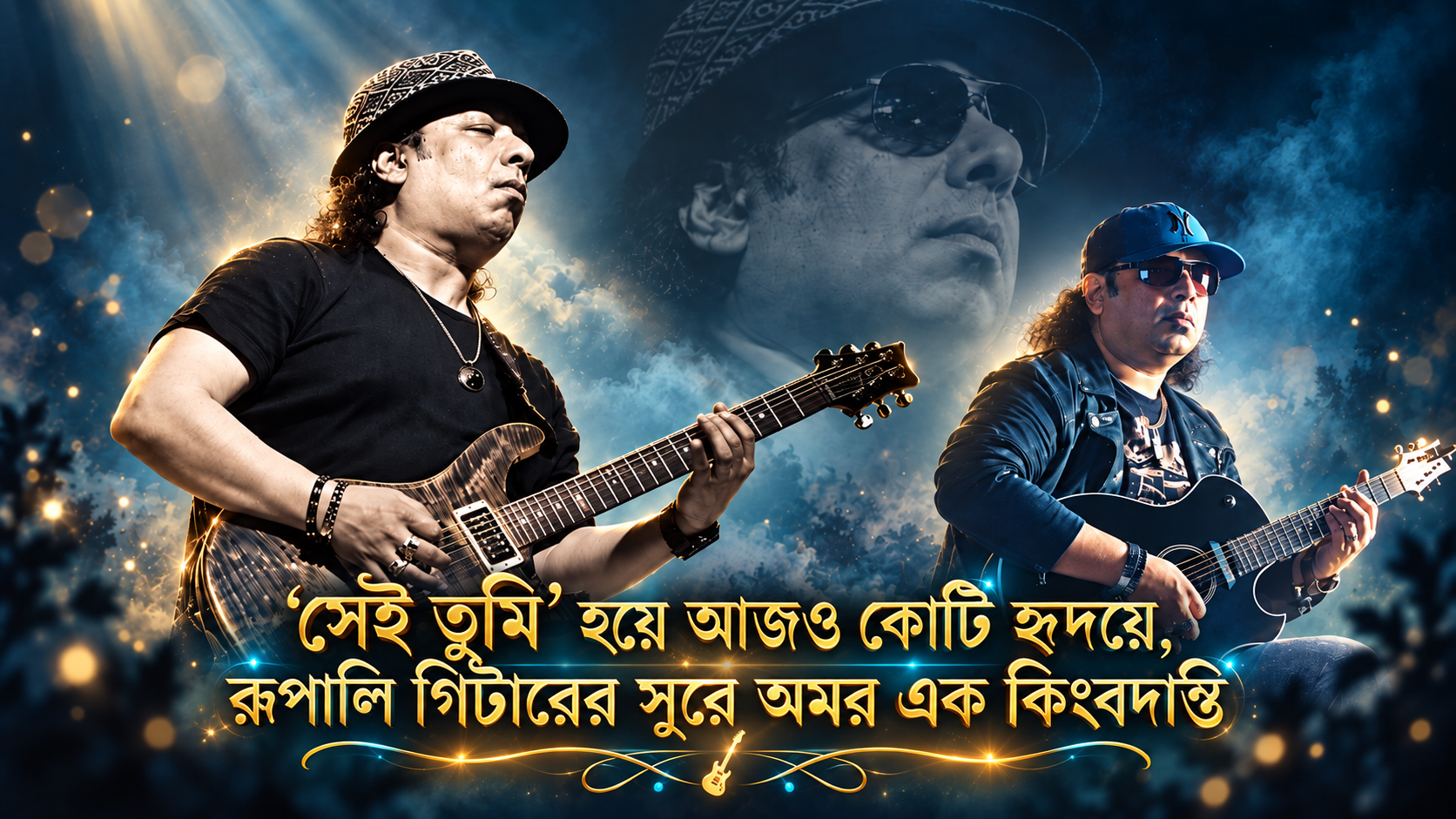

Published: 12:34 19 October 2026
Some people are born into this world not merely to build a remarkable life for themselves, but to enrich the history, culture, and hearts of an entire nation. When they leave, it is not just their families who feel the loss. It is as though an entire generation loses a part of itself.
In the history of Bangladeshi music, Ayub Bachchu was one of those extraordinary people.
A guitar in one hand, a microphone in the other. His familiar black sunglasses, a gentle smile on his face. The moment he stepped onto the stage, he seemed to transform into someone else. As soon as his fingers touched the guitar strings, the entire atmosphere changed. Thousands of people listened in wonder to melodies filled with love, separation, longing, heartbreak, and a profound affection for his homeland.
But was the beginning of this legendary musician's life just as extraordinary?
Not at all.
The man who would eventually own numerous guitars from some of the world's most famous brands once had to borrow guitars from other people. Sometimes he even rented a guitar for a small amount of money just to perform at an event. There is also the remarkable story of his early struggle, when he reportedly arrived in Dhaka with only 600 taka in his pocket.
Yet he never stopped.
Because he understood that truly loving a dream means being willing to wait, struggle, and sacrifice for it.
Looking back at his extraordinary life, we realize that Ayub Bachchu was far more than a popular singer. He was one of the most influential pioneers of Bangladeshi rock music, an exceptional guitarist, and a source of inspiration for generations of aspiring musicians.
October 18, 2026, marked the eighth anniversary of his death. On this occasion, let us revisit the life of a man who illuminated an entire era of Bangladeshi music through his talent, dedication, and dreams.
The Dreamer From Chattogram
Ayub Bachchu was born on August 16, 1962, in Chattogram, Bangladesh. His father was Mohammad Ishaq Chowdhury, and his mother was Nurjahan Parveen. Among his family members, he was also affectionately known as Robin.
He spent an important part of his childhood around Jubilee Road and its surrounding neighborhoods in Chattogram. He attended Government Muslim High School.
From an early age, his interests were somewhat different from those of other children. He possessed an unusual fascination with music, particularly the sound of the guitar, which seemed to transport him into an entirely different world.
At that time, learning the guitar in Bangladesh was nothing like it is today. There were no YouTube tutorials, online courses, or easily accessible modern music schools.
Learning required guidance from someone experienced, access to a guitar, and countless hours of practice.
During the early 1970s, Ayub Bachchu received his first acoustic guitar from his father. Different recollections place this event around 1973 or 1974.
That guitar became one of the most meaningful gifts of his life.
He also had the opportunity to learn guitar from Jacob Dias, a musician from Chattogram.
Perhaps nobody imagined that this young boy would one day create a chapter in Bangladesh's musical history that would remain alive in people's hearts for generations.
But a great dream was already taking shape within Ayub Bachchu.
He wanted to play the guitar in a way that would allow people not only to hear melodies but also to discover their own emotions within them.
Dreams on a Borrowed Guitar
The beginning of Ayub Bachchu's musical journey was filled with hardship.
Today, his name brings to mind expensive guitars, enormous concerts, and performances on international stages. But during the early years of his life, simply obtaining a good guitar was a major challenge.
He often had to borrow guitars from his friends.
Sometimes he even rented a guitar to perform at events.
According to published recollections of his early career, he once rented a guitar for 30 taka a day to perform onstage. After paying the rental fee from his performance earnings, he would have only a little money left.
Just imagine that.
The man who would later inspire countless young Bangladeshis to learn guitar once could not even afford a guitar of his own.
Yet he refused to give up.
Instead, the more obstacles he faced, the more time he devoted to practice.
For him, the guitar was never simply a musical instrument. It was a language through which he could express his emotions and build his identity.
He drew inspiration from legendary international guitarists, including Jimi Hendrix. He studied their playing styles, but eventually developed a musical identity of his own.
His life reminds us that becoming a great artist does not necessarily begin with owning the most expensive instrument. It begins with a willingness to learn, a passion for practice, and an unwavering belief in one's dreams.
A Friendship With Kumar Bishwajit
Ayub Bachchu shared an exceptionally close relationship with another celebrated Bangladeshi musician, Kumar Bishwajit.
They were not merely two colleagues in the music industry. They were childhood friends, companions through hardship, and young dreamers walking along the same path.
Their family homes in Chattogram were close to one another.
Both possessed an extraordinary love for music.
At that time, choosing music as a profession was not an easy decision. Many families wanted their children to complete their education and pursue a stable career.
But these two young men were fascinated by guitars, songs, rehearsals, and the dream of performing onstage.
Kumar Bishwajit later recalled that they sometimes used each other's names to convince their families to let them go out and practice music.
These small incidents reveal how sincere and intimate their friendship was.
Another remarkable event illustrates how one friend supported the other's dream.
When Ayub Bachchu did not have a good guitar of his own, he borrowed a Teisco guitar from Kumar Bishwajit.
Later, seeing Bachchu's deep passion for the instrument, Bishwajit gave him the guitar.
The gift might not have been financially extraordinary, but to an ambitious young musician, its emotional value was immeasurable.
Because it was more than a guitar.
It was a symbol of faith in a friend's dream.
Two Friends in Dhaka
There are also cherished memories of Ayub Bachchu and Kumar Bishwajit living together after moving to Dhaka.
According to Kumar Bishwajit, they once shared a rented apartment with two rooms.
It was a place filled with conversations about music, dreams of creating new songs, plans for the future, and the daily struggle to establish themselves.
When we look at successful artists today, we often fail to see the hardships behind their achievements.
But there was a time when they were ordinary young men chasing extraordinary dreams.
Their friendship may have been one of their greatest sources of strength during those years.
After Ayub Bachchu's death, Kumar Bishwajit spoke about his friend with profound emotion.
He considered Bachchu much more than a friend. To him, Bachchu was like a brother.
Their years together carried countless memories of happiness, sorrow, struggle, and companionship.
On October 18, 2018, an important chapter of that friendship came to an end.
One friend departed forever, while the other was left holding a lifetime of memories.
Their friendship reminds us that success is not measured only by individual achievements. It is also found in the love of those who accompany us through life's most difficult journeys.
From Ugly Boys to Feelings
Ayub Bachchu began his professional musical journey by working with local bands in Chattogram.
His early involvement with a band called Spider has been mentioned in published accounts. He later became associated with Golden Boys and Ugly Boys.
At the time, musicians primarily performed at small gatherings, clubs, social functions, and wedding celebrations.
There were no enormous lighting arrangements, sophisticated sound systems, or social media platforms to promote their performances as there are today.
Yet those small stages became his training ground.
During the late 1970s, he became associated with the band Feelings, whose history would later be closely connected with another Bangladeshi rock legend, James.
Through these experiences, Bachchu gained important knowledge about live performance, collaboration with fellow musicians, and the realities of pursuing music professionally.
Gradually, he began earning recognition as a skilled guitarist.
That experience eventually led him to one of Bangladesh's most historic bands: Souls.
Becoming a Legend at Souls
In 1980, Ayub Bachchu joined the band Souls.
Souls holds an important position in the history of Bangladeshi band music. Bachchu spent approximately a decade with the group.
During this period, his abilities as a guitarist became increasingly refined.
Working with Souls helped him gain valuable experience in songwriting, composition, arrangement, live performance, and band management.
Albums such as Super Souls, College Er Corridore, Manush Matir Kachakachi, and East and West became associated with this period of his musical career.
These years did more than establish him as a talented guitarist. They helped him develop into a complete musician.
But somewhere within him, another dream was growing.
He wanted greater freedom to express his personal musical vision.
He dreamed of forming a band through which he could fully explore his melodies, ideas, and philosophy of music.
That desire eventually gave birth to one of the most significant chapters in Bangladeshi rock history.
LRB: The Birth of an Era
In 1991, Ayub Bachchu left Souls and established his own band.
The band's name was LRB.
The name was initially associated with Little River Band, but the group later became known as Love Runs Blind.
Leaving an established band to form a new one was a courageous decision.
Starting a new band meant building an audience from the beginning, releasing new music, and struggling to establish a new identity.
But Ayub Bachchu was ready to take that risk.
In 1992, LRB released its first double album.
It was an unusual and ambitious initiative in the Bangladeshi band music industry.
Over time, LRB became one of the most beloved bands among young listeners.
Its powerful guitar arrangements, emotionally expressive Bengali lyrics, and Bachchu's distinctive voice created a new musical experience.
LRB demonstrated that rock music performed in Bengali could carry the strength, depth, and energy associated with international rock music.
Its songs explored love, heartbreak, friendship, disappointment, ambition, and the countless emotions of ordinary life.
As a result, LRB became more than a band.
It became part of the memories and emotions of several generations of Bangladeshis.
Shei Tumi: An Immortal Love
In the history of Bangladeshi band music, Shei Tumi is one of those rare songs that has become deeply connected with the love, heartbreak, and personal memories of several generations.
The song is also known as Cholo Bodle Jai.
Released on LRB's 1993 album Sukh, it became one of Ayub Bachchu's most memorable musical creations.
Some people first heard it during their first experience of love.
Others listened to it after losing someone dear.
Still others returned to the song years later, remembering a beautiful chapter of their past.
The song's uniqueness lies not only in its lyrics.
Ayub Bachchu's voice and guitar melodies blend so naturally that every note seems to carry an emotion of its own.
One does not need any technical understanding of the guitar to appreciate it.
Even an ordinary listener can recognize a fragment of their own life within the song.
One of an artist's greatest achievements is creating music that becomes part of people's personal experiences.
The song became so deeply loved that it has even been described in music writing as the “unofficial national anthem of Bangladeshi band music.”
This is an affectionate cultural description rather than an official title.
Shei Tumi earned that special place in the hearts of listeners.
Even today, the song is performed at concerts, university cultural programs, and private musical gatherings throughout Bangladesh.
Many young guitarists attempt to learn its melody during the early stages of their musical education.
When a song continues to live through the hands and voices of younger generations long after its creator has passed away, it becomes a form of artistic immortality.
The Silver Guitar's Eternal Tears
Another unforgettable Ayub Bachchu song is Ei Rupali Guitar.
The song seems almost inseparable from his own life.
The guitar was one of his most beloved companions.
He spent a substantial part of his life holding and playing it.
Through this remarkable song, the guitar became a symbol of farewell, memory, and the temporary nature of human existence.
After his death on October 18, 2018, the song returned to listeners with an even deeper emotional meaning.
Because the man who had sung about the silver guitar had truly left behind his guitars, his stage, and his countless admirers.
Even today, listening to the song brings back a familiar image.
An enormous stage.
Thousands of people.
A man standing in the center, playing his guitar.
Sometimes with his eyes closed, sometimes looking toward the audience.
At the end of the song, the entire venue erupts in applause.
But reality reminds us that this man will never return for another concert.
That is one of the deepest emotions left behind through his music.
People depart from this world, but certain melodies remain forever.
The Immortal Voice of Ammajan
Whenever Ayub Bachchu's name is mentioned in the history of Bangladeshi band music, people immediately remember LRB, his extraordinary guitar playing, and his unforgettable live performances.
But another important chapter of his musical career was playback singing for films.
The musician who conquered the hearts of young listeners through rock music also sang a song expressing a child's profound love for their mother—a song that still brings tears to countless eyes.
The song was Ammajan.
It was featured in the 1999 film Ammajan, directed by Kazi Hayat. The film starred popular performers including the late actor Manna, Shabnam, and Moushumi.
The song was written and composed by the legendary music director Ahmed Imtiaz Bulbul. Ayub Bachchu brought those words to life through his deeply emotional voice.
What makes this particularly remarkable is that an artist widely recognized for powerful rock performances and electric guitar solos could also express the tenderness and longing of a child for their mother.
Manna appeared on the screen, but the voice belonged to Ayub Bachchu.
Together, their performances made the song one of the memorable creations of Bangladeshi film music.
Just imagine how versatile an artist must be to perform a song about love and separation like Shei Tumi and a deeply emotional tribute to motherhood like Ammajan with equal sincerity.
Ayub Bachchu demonstrated that extraordinary versatility.
In his voice, Ammajan became more than a film song. For many listeners, it became a way to remember their mothers and express their deepest affection for them.
But Ammajan was not his only playback achievement.
He also lent his voice to other film songs, including Ononto Prem Tumi Dao Amake with Kanak Chapa in Lut Toraj, Ami To Preme Porini in Bachelor, Swami Ar Stri in Ammajan, and Bhule Gechi Jutor Fitao Badhte in Chorabali.
His voice was also featured in songs associated with films such as Lal Badshah, Teji, Sagarika, Miss Diana, Moger Mulluk, Kalo Choshma, and Bilat Ferot Meye.
One of his greatest strengths as an artist was his refusal to limit himself to a single musical genre.
From the intensity of rock music to the tenderness of a song dedicated to a mother, he could express remarkably different emotions through his voice.
Ayub Bachchu was therefore not merely a rock legend. He was also a memorable voice in the history of Bangladeshi film music.
A Dream Worth 600 Taka
One of the most frequently remembered stories of Ayub Bachchu's early struggles is that he arrived in Dhaka with only 600 taka in his pocket.
Published recollections describe the financial difficulties he experienced during the beginning of his musical career.
Today, that amount may seem small.
But at the time, building a professional music career was far from easy for a young musician.
Finding accommodation, paying for food and transportation, obtaining musical instruments, attending rehearsals, and dedicating enough time to music involved considerable uncertainty.
Many people might have abandoned their dreams under such circumstances and chosen a different profession.
Ayub Bachchu did not.
He chose music as the central purpose of his life.
He did not know how successful he would eventually become.
He did not know how many people would one day listen to his songs.
He did not know that a giant guitar sculpture would eventually be erected in Chattogram to honor his memory.
Yet he refused to abandon his chosen path.
That is what makes his story so beautiful.
A person may have very little money.
They may have limited opportunities.
But there is no rule that says their dreams must be small.
Through his life, Ayub Bachchu seemed to prove exactly that.
Humiliation at an American Guitar Shop
One of the most widely discussed incidents from Ayub Bachchu's life reportedly took place during his visit to the United States in 1998.
The incident was described in a recollection by his band's manager, Shamim, published in Prothom Alo.
After a concert in New York, Ayub Bachchu visited a guitar store with fellow band members.
While examining different instruments, he noticed an expensive Ibanez guitar displayed inside a glass case.
He wanted to hold it and play it.
But the store manager asked him which country he came from.
Ayub Bachchu replied that he was from Bangladesh.
According to the recollection, after hearing the name of his country, the manager advised him not to touch the guitar.
Bachchu felt humiliated by this treatment.
He believed that the manager was not only looking down on him as an individual but also showing disrespect toward his country.
Nevertheless, he requested permission to play the guitar.
Eventually, permission was granted.
The Bangladeshi musician picked up the instrument.
Then he began playing.
The people inside the shop were reportedly amazed by his performance.
Gradually, a crowd gathered around him.
The very guitar he had initially been discouraged from touching became the instrument through which he demonstrated his extraordinary skill.
After the performance, the store manager was reportedly so impressed that he offered to sell the guitar to him at half its original price.
But Ayub Bachchu refused.
His position was that he did not want to accept a guitar associated, in his mind, with disrespect toward his homeland.
This story comes from a published personal recollection; independent confirmation from the store itself has not been established.
Still, the central theme of the account is his profound sense of self-respect.
He wanted to demonstrate more than his musical ability.
He also wanted to carry his country's identity with dignity.
A Guitar Miracle in Japan
Another memorable story involving Ayub Bachchu and a foreign music store was shared by television personality Abdun Noor Tushar.
During a visit to Japan, they entered a musical instrument shop.
According to Tushar's recollection, they initially received little attention.
Later, Ayub Bachchu requested permission to play a guitar.
Once he had the instrument in his hands, he began demonstrating styles associated with internationally celebrated guitarists.
He performed musical passages inspired by legends such as Jimi Hendrix, Carlos Santana, and Eric Clapton.
As he played, people reportedly began gathering to listen.
Toward the end, he also performed the national anthem of Bangladesh on guitar.
According to Abdun Noor Tushar, the store owner was so impressed that he invited Bachchu to take a guitar.
This was not simply a story about musical skill.
It was a memorable example of a Bangladeshi musician showcasing his talent in an international setting.
In a place where language and culture were different, he managed to move people through the sound of his guitar.
That is the beauty of music.
Sometimes words are unnecessary.
Sometimes a melody is enough.
Bangladesh's Rockstar on Global Stages
Ayub Bachchu enjoyed an extensive international performing career.
According to LRB's published biography and various reports, the band performed in several countries, including the United States, the United Kingdom, Germany, Austria, Singapore, Qatar, the United Arab Emirates, and Hong Kong.
LRB's performances have also been associated with well-known venues such as Madison Square Garden in New York and Wembley Arena in London.
Although the nature and scale of the events held at these venues varied, such performances were significant in introducing Bangladeshi rock music to international audiences.
When an artist performs songs in their native language on foreign soil, they carry much more than their personal identity.
They bring the culture, language, and emotions of their homeland.
For Bangladeshis living abroad, LRB concerts often became special occasions.
Hearing familiar songs from home while living thousands of miles away could awaken powerful memories.
Ayub Bachchu helped bring these feelings to audiences around the world.
The sound of his guitar did not remain confined within Bangladesh's borders.
That is why he also became a familiar and beloved figure among music enthusiasts living outside the country.
A New Identity for Bengali Rock
The history of modern Bangladeshi band music was not created by a single artist.
Musicians and bands such as Azam Khan, Souls, Feedback, and Miles all made important contributions to this long journey.
However, Ayub Bachchu was one of its most influential figures.
His role in popularizing the guitar was particularly significant.
There were accomplished Bangladeshi guitarists before and during his era. But in Bachchu's performances, the guitar frequently became the main attraction of the song itself.
His powerful guitar solos, fast-moving notes, emotional melodies, and commanding stage presence captivated audiences.
He repeatedly demonstrated that rock music was not simply about loud sounds or fast instrumental performances.
His songs contained deep emotions.
They told stories about ordinary people.
Those who had experienced heartbreak discovered reflections of their sorrow in his music, while happy listeners could also find excitement and energy in his performances.
Another major reason for his popularity was his use of the Bengali language.
He combined the powerful instruments of international rock music with the emotional richness of Bengali songs.
As a result, his music appealed even to listeners who had not previously been regular followers of rock music.
His influence was also important in encouraging young Bangladeshis to learn guitar.
Many aspiring musicians first dreamed of picking up a guitar after hearing Ayub Bachchu's songs.
That remains one of the greatest legacies of his musical career.
A Guitar Legend of Asia
Many music lovers regard Ayub Bachchu as one of the most influential guitarists in South Asian Bengali rock music.
His technical ability, long musical career, extensive repertoire, and influence on younger musicians earned him considerable respect.
However, there is no reliably established international ranking proving that he was officially Asia's number-one guitarist or held a particular formal position across the continent.
An artist's importance does not always depend on an official ranking.
Their true influence can often be seen in the generations that follow them.
The fact that countless young Bangladeshis still learn his songs on guitar illustrates his lasting impact.
Some try to reproduce his playing style.
Others study his arrangements.
Still others find courage in the story of his struggles.
When an artist's work inspires new generations of musicians, their influence extends far beyond their lifetime.
That is exactly what happened with Ayub Bachchu.
Beyond the Guitar: Many Talents
When people hear the name Ayub Bachchu, the image of a guitar often comes to mind first.
But he was much more than a guitarist.
He was a singer, composer, songwriter, and music director.
Alongside his work with LRB, he also composed and arranged music for other artists.
His musical work has been associated with performers including Tapan Chowdhury, Khalid Hasan Milu, Sheikh Ishtiaque, and S I Tutul.
He also worked on music for advertisements and served as a judge in music-related programs.
Becoming a skilled guitarist requires regular practice, while becoming a successful composer requires a deep understanding of musical structure.
A music director, meanwhile, must coordinate melody, instruments, rhythm, and vocals into a complete composition.
Ayub Bachchu incorporated these different responsibilities into his artistic career.
His talent should therefore never be judged solely by his guitar performances onstage.
He was also deeply involved in the creation and development of modern Bangladeshi music.
Songs That Still Live On
Ayub Bachchu created and performed numerous memorable songs throughout his career.
Songs such as Shei Tumi, Ei Rupali Guitar, Ferari Mon, Hashte Dekho Gaite Dekho, Ek Akasher Tara, Ekhon Onek Raat, Koshto, Ghumonto Shohore, and Bangladesh remain close to the hearts of listeners.
Each carries a different emotional atmosphere.
Some bring back memories of love.
Others remind us of lost relationships.
Some express the pain hidden behind an ordinary person's smile.
Others awaken affection for one's country.
One of the greatest reasons for Ayub Bachchu's popularity was his ability to transform human emotions into music.
His songs do not belong to a single age group.
People who grew up listening to him in the 1990s still love his songs, while younger generations continue discovering them.
The way people listen to music has changed—from cassettes to CDs, and from CDs to online streaming.
But the emotional appeal of his songs has endured.
That is one of an artist's greatest achievements.
A Remarkable Collection of Guitars
The man who once struggled to afford a good guitar eventually owned instruments produced by some of the most famous guitar manufacturers in the world.
His collection included guitars from brands such as Ibanez and Fender.
As his career developed, he had opportunities to acquire instruments during performances and visits both at home and abroad.
However, the value of a guitar to Bachchu was not always determined by its price.
Some guitars were connected with special concerts.
Others had been used during album recordings.
Still others reminded him of important periods in his life.
Published reports have discussed plans to establish a museum featuring approximately 50 guitars from his collection.
The Ibanez JEM series was among the instruments most closely associated with his public image.
Yet despite acquiring so many guitars, he reportedly never forgot the pain of losing the first guitar his father had given him.
That memory reveals something deeply human about him.
No matter how successful a person becomes, the emotional value of the things connected with their earliest dreams can remain unmatched.
A new guitar can be purchased.
An even more expensive instrument can be collected.
But the memories attached to a father's first gift can never truly be replaced.
The Dream of Gifting Guitars
Ayub Bachchu did not want his guitar collection to exist solely for his personal satisfaction.
He dreamed that one day his beloved instruments might help young musicians fulfill their ambitions.
Published reports indicate that he wanted to organize a competition for talented young guitarists.
He reportedly planned to present guitars from his own collection to outstanding participants.
Just imagine that.
An artist wanted to give away instruments he had used and cherished for years.
Behind that plan was his belief in the next generation.
He knew that Bangladesh had many talented young people.
But not everyone could afford a high-quality guitar.
Not everyone had access to an experienced teacher.
That was why he wanted to create opportunities for young musicians.
Unfortunately, the plan was not fully realized during his lifetime because adequate sponsorship and organizational support were unavailable.
Nevertheless, the intention itself reveals much about his character.
He thought not only about his own success but also about the future of the musicians who would come after him.
His Unfinished Guitar School Dream
One of Ayub Bachchu's greatest unfulfilled ambitions was to establish a comprehensive guitar school.
He wanted to create an institution where young Bangladeshis could receive high-quality musical training.
His vision also included opportunities to learn musical instruments beyond the guitar.
Through his own experiences, he understood that talent alone was not enough to become a successful musician.
Proper training was essential.
A supportive practice environment was essential.
Access to good instruments and experienced teachers was essential.
Many young Bangladeshis dream of becoming musicians, but financial difficulties and a lack of opportunities force some to abandon their ambitions.
Ayub Bachchu wanted to build a place where young artists could learn, practice, and develop their abilities.
He wanted music education in Bangladesh to become more organized and professional.
However, his planned guitar school was not established during his lifetime.
It remained an unfinished dream.
After his death, the Ayub Bachchu Foundation began pursuing initiatives related to music education and the establishment of a cultural center.
The plans include opportunities to learn various musical instruments, practice music, train aspiring artists, and preserve Bachchu's personal memorabilia.
There is no reliable evidence that such a school had already been established as Asia's first or largest guitar school.
But the importance of his dream never depended on a ranking.
He wanted to create a place where another young Ayub Bachchu might find the opportunity to develop their talent.
The Dream of 1.5 Million Fans
Ayub Bachchu was a man whose dreams extended far beyond ordinary expectations.
At one point, he envisioned organizing an enormous concert on Manik Mia Avenue in Dhaka.
He imagined an audience of approximately 1.5 million people.
His plan involved a large-scale musical event featuring Bangladeshi and international performers.
This figure did not represent the actual attendance at a concert he had already performed. It was the audience size he dreamed of attracting to a future event.
Unfortunately, the concert never took place during his lifetime.
Still, the ambition helps us understand the scale of his musical imagination.
He did not think only about his next album or personal performance.
He also considered how Bangladeshi music could reach larger audiences.
The dream of millions of people gathering to enjoy music together reflected his profound love for his country's musical culture.
His Love for Young Musicians
Ayub Bachchu never completely forgot the difficulties of his early career.
He knew how challenging the journey could be for an aspiring musician.
Not having enough money for a good guitar, struggling to find a rehearsal space, lacking access to experienced teachers, and having limited opportunities to perform were problems he understood personally.
That was why he repeatedly spoke about the importance of supporting younger artists.
His comments on creating opportunities for young guitarists, drummers, and keyboard players appeared in published reports.
He believed that Bangladesh did not lack talented young musicians.
What was often missing were opportunities and sponsorship.
The greatness of an artist is not measured only by personal achievements.
What they hope to leave for others is equally meaningful.
Ayub Bachchu established an important legacy in this respect as well.
James Remembers His Beloved Friend
Ayub Bachchu and James are two of the most significant names in the history of Bangladeshi band music.
Their voices were different, their musical styles were different, and their stage performances had distinct identities.
Yet both made remarkable contributions to bringing Bengali rock music to a wider audience.
Although their fans sometimes compared them, the two artists also shared professional respect.
The news of Ayub Bachchu's death on October 18, 2018, deeply affected James.
During a performance that day, James reportedly recalled memories associated with Bachchu.
Reports also described how he became emotional while playing guitar and left the stage.
The grief of one artist over the death of another reminds us that their relationship was not simply a matter of competition or popularity.
It was also shaped by shared musical experiences, years of acquaintance, and mutual respect.
Artists may leave this world.
But the musical eras they helped create remain alive in people's memories.
Robin: The Family Man
Onstage, he was Bangladesh's rock legend.
But to his family, he was a husband, a father, and a beloved companion.
Ayub Bachchu's wife is Ferdous Akhtar Chandana.
They have two children: a son, Tajwar Ayub, and a daughter, Fairuz Ayub.
Beyond the demands of his musical career, his family remained an important part of his personal life.
After his death, Chandana became involved in initiatives aimed at preserving his memories and musical legacy.
For his family, his guitars, clothes, and personal belongings possess more than historical significance.
They carry intimate memories of love and companionship.
To his fans, Ayub Bachchu's death meant losing a beloved musician.
But to his family, it meant losing one of the most important people in their lives.
That distinction is worth remembering.
Because behind the shining identity of every legend is also an ordinary human being with a personal life.
The Heartbreak of His Final Concert
On October 16, 2018, Ayub Bachchu performed at a concert in Rangpur.
That day, he still had his guitar in his hands.
He still had his familiar voice.
And he still had the love of his audience.
He sang, played guitar, and entertained those who had gathered to hear him.
Fellow artist Kona later recalled that he did not appear visibly unwell during the event.
After the performance, he also took photographs with other performers.
But nobody knew that it would be the final concert of his life.
Those who attended that evening may have returned home carrying the happiness of hearing their favorite artist perform.
Only two days later, that happiness turned into profound grief.
On the morning of October 18, the heartbreaking news arrived.
Ayub Bachchu was no more.
How unpredictable life can be.
The man who had devoted his life to the guitar remained connected to music almost until his final moments.
The Day Bangladesh Fell Silent
On the morning of October 18, 2018, Ayub Bachchu died in Dhaka following a heart attack.
He was only 56 years old.
As the news spread, a wave of sorrow passed through Bangladesh's music community.
It was not only fellow musicians who grieved. Countless ordinary listeners were deeply affected.
Photographs, concert recordings, and his most beloved songs began circulating across social media.
Many people struggled to believe the news.
How could a man whose guitar had carried so much energy and whose voice had contained so much life suddenly be gone?
Countless admirers gathered at the Central Shaheed Minar in Dhaka to pay their final respects.
Fellow artists, cultural personalities, music enthusiasts, and ordinary fans came together to remember him.
His body was later taken to his beloved Chattogram.
On October 20, 2018, he was laid to rest beside his mother's grave at the family cemetery in Chaitanya Goli.
There was no concert that day.
There were no energetic guitar solos.
But there was the love of thousands of people.
Perhaps that is one of the greatest achievements of an artist's life.
Even after leaving this world, they remain alive in the hearts of others.
Chattogram's Immortal Silver Guitar
Chattogram was Ayub Bachchu's birthplace.
It was where he spent his childhood.
It was where he first began dreaming with a guitar in his hands.
Naturally, initiatives to preserve his memory in the city carried special significance after his death.
In 2019, a guitar-shaped memorial sculpture approximately 18 feet tall was installed at Probortok Mor in Chattogram.
It was named Rupali Guitar, meaning the Silver Guitar.
The intersection was also renamed Ayub Bachchu Chattar in his honor.
The sculpture has become one of the city's recognizable tributes to the legendary musician.
There is a profound emotional meaning behind it.
The boy who once struggled to purchase his own guitar is now remembered through an enormous guitar sculpture in an important public location in his hometown.
It is almost as though one of his dreams has been fulfilled symbolically.
However, concerns have been raised at different times regarding the maintenance of the memorial.
Honoring an artist requires more than constructing a monument.
It also requires proper care, preservation, and efforts to introduce their contributions to younger generations.
Because this silver guitar is not merely a memorial to one artist.
It is also a symbol of the history of modern Bangladeshi music.
A New Dream: The Guitar Museum
After Ayub Bachchu's death, initiatives emerged to preserve his guitars and personal memorabilia.
Every guitar in his collection seemed to carry a story.
Some had been used to record beloved songs.
Others had accompanied him onto international stages.
Still others reminded him of difficult periods in his life.
These instruments were not simply private family possessions. They could also be regarded as important historical artifacts of modern Bangladeshi music.
The Ayub Bachchu Foundation has discussed plans to preserve his guitars, clothes, personal belongings, and music-related documents.
The foundation has also proposed initiatives to create learning and performance opportunities for younger musicians.
Published reports have described plans for a comprehensive cultural center, museum, music auditorium, and training facilities.
However, there is insufficient verified information to conclude that every proposed facility has already become fully operational.
Nevertheless, the initiative is important.
Preserving a country's musical history means more than displaying old instruments.
It allows younger generations to understand how an artist overcame the limitations of his time and helped create a new direction in music.
National Recognition Through Ekushey Padak
In 2026, Ayub Bachchu's contribution to Bangladeshi music received another important form of state recognition.
He was posthumously awarded the Ekushey Padak for his contribution to music.
His wife, Ferdous Akhtar Chandana, accepted the award on his behalf at the ceremony held on February 26.
The Ekushey Padak is one of Bangladesh's most prestigious civilian honors.
Throughout his long musical career, Ayub Bachchu had already earned the affection of countless listeners.
Eight years after his death, this national recognition brought renewed attention to his contribution to Bangladeshi music.
Following the announcement, Chandana reportedly expressed the sadness of knowing how different the moment would have felt if Bachchu had been alive to receive the award himself.
There is profound sorrow in that thought.
The man whose music was being honored was no longer present.
The person receiving recognition could no longer step onto the stage and share his feelings with the audience.
Still, the award became a memorable recognition for his family and an important moment in the history of Bangladeshi band music.
Why Ayub Bachchu Remains Immortal
How does an artist continue living in people's hearts long after death?
To understand the answer in Ayub Bachchu's case, we must return to his music.
His songs are connected with people's lives.
For some, Shei Tumi is a memory of first love.
For others, Ferari Mon represents a time that can never return.
To some, Ei Rupali Guitar carries the pain of saying goodbye to a beloved musician.
For others, Bangladesh awakens a deep sense of affection for their homeland.
When someone living abroad listens to his music and remembers the country of their childhood, the song becomes more than entertainment.
It becomes a bridge to memory.
Ayub Bachchu's music achieved that kind of emotional connection.
His songs are not loved only by the generation that listened to cassettes.
Even in today's digital era, younger listeners continue discovering his music.
New artists perform his songs.
Aspiring guitarists attempt to learn his melodies and solos.
This is how an artist's creations continue living beyond the artist's own lifetime.
His legacy is therefore not limited to the number of albums he released or the concerts he performed.
His true influence lives in the hearts of countless music lovers across Bangladesh.
Lessons for the Next Generation
There is much that younger generations can learn from Ayub Bachchu's life.
His journey teaches us that financial limitations do not have to prevent a person from dreaming.
His transformation from a young musician practicing on borrowed guitars into an internationally recognized performer is a powerful example.
His life also reminds us that talent must be supported by consistent practice.
Loving something is not enough to become truly skilled at it.
One must be prepared to work for that passion over many years.
His friendship with Kumar Bishwajit teaches us to appreciate the people who stand beside us during difficult times.
The recollections of his experiences in foreign guitar shops remind us of the importance of maintaining dignity and self-respect in relation to our identity and homeland.
His dreams of giving guitars to young musicians and establishing a guitar school reveal how an accomplished artist can think about creating opportunities for future generations.
Taken together, his life is much more than a story of success.
It is a story of struggle, confidence, friendship, love, dedication, and unfinished dreams.
The Silver Guitar Remains
When a person leaves this world, what ultimately remains?
A few photographs?
Some memories?
A collection of old belongings?
In Ayub Bachchu's case, he left behind far more.
He left behind countless songs.
He left behind generations of youth shaped by the sound of his guitar.
He left behind the silver guitar memorial at Probortok Mor in Chattogram.
He left behind stories of his friendship with Kumar Bishwajit.
He left behind the memories of a young musician who once performed with rented guitars.
He left behind the remarkable story of preserving his dignity in a New York guitar shop.
And he left behind an unfinished dream of building a place where the next generation could learn music.
Countless talented musicians will be born in Bangladesh in the years to come.
New bands will emerge.
Musical styles will change.
Technology will evolve.
But Ayub Bachchu's name will not easily disappear from the history of Bangladeshi music.
Because he did more than play guitar.
He inspired young people across an entire country to dream.
The boy who once borrowed guitars from others eventually became the reason thousands of young people dreamed of holding guitars themselves.
The man who began his journey with very little money eventually carried Bangladeshi music onto stages around the world.
And the musician who once dreamed of owning a good guitar eventually wanted to place guitars in the hands of aspiring young artists.
That is the beauty of his life.
He thought beyond his own success.
He also thought about the future of music.
His story reminds us that becoming successful does not require forgetting one's roots.
Sometimes, love for those roots is precisely what makes a person greater.
Even today, when his music begins playing on a quiet night, it feels as though that familiar musician is still somewhere close to us.
Standing beneath the stage lights.
His beloved guitar in his hands.
Black sunglasses over his eyes.
That familiar smile on his face.
But then reality returns.
The man is no longer here.
His melodies remain.
His love remains.
His dreams remain.
Ayub Bachchu was never merely a name. He was an era of Bangladeshi music, an emotion shared by generations, and a priceless treasure of the nation.
The man with the silver guitar has departed, but his music continues to live in the heart of Bangladesh.
Advertisement
Most Readed - Biography





- Ishraq Has Fallen into a Trap Due to the Home Minister’s Failure: Nasiruddin Patwary
- Bollywood in a state of panic: Threats of attacks against those working with Salman Khan
- Traveling 1,900 km in Search of His Dream Woman—Only to Discover She’s AI!
- Shei Tumi in Millions of Hearts Immortal Through the Silver Guitar
- Misuse of Legally Owned Firearms Can Lead to Imprisonment, Fines, and License Revocation
- Dates Set for Appeal Hearings in 'Seven Murders', Major Sinha, and Abrar Murder Cases
- Nearly Half of Households in the Country Are in Debt; Expenses Exceed Income: BBS Survey
- Journalist Sued: Zahirul Calls for Impartial Investigation and End to Harassment
- Earning Crores from Flat Rentals: A Look at Ranbir Kapoor’s Real Estate Assets
- Opposition acting irresponsibly after securing votes with promises of 'paradise': State Minister
- Fuel for Rooppur Nuclear Power Plant Arriving in Bangladesh Today
- Cybercriminals Claim to Possess Data of 19 Million Pathao Users; $400,000 Ransom Demanded
- Jamuna Fertilizer Factory Shuts Down Again Just Two Days After Resuming Operations
- Ronaldo faces risk of 6-month ban for leaving national team camp
- Messi bids farewell with a goal and assists, showered with love by teammates
- Ronaldo shares emotional message upon Messi's retirement, expressing 'utmost respect'
- Hasnat Questions the Source of Salahuddin’s Wealth, Demands Transparent Accounting
- Countless Decembers will come and go, but Sheikh Hasina will not return to the country: Rashed Khan
- Three-Day Mosquito Eradication Drive Begins in Savar's Bongaon
- Hashmatullah leaves the field after injury while batting against Bangladesh