More than 700 families in Sharsha of Jessore live by selling snails
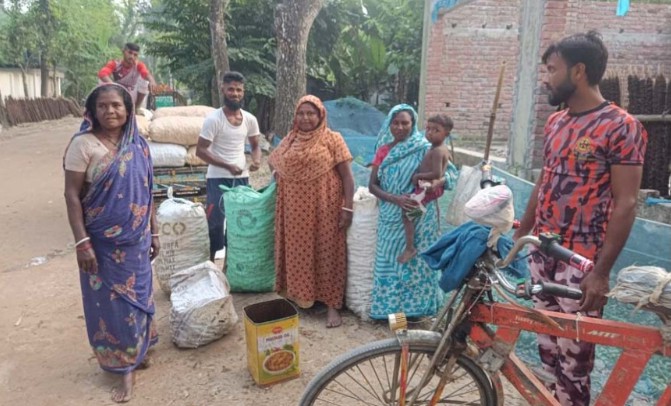

In Jessore's Sharsha upazila, more than 700 low income family members are making a living by collecting snails from the reservoir. At present, as there is no work in the rural areas, the members of those low-income unemployed families are forced to earn a living in different ways.
It has been found that women, men and children of more than 700 unemployed families of Dihi, Laxmanpur, Bahadurpur, Sharsha Sadar and Nizampur Union of Upazila collect snails all day in different rivers, canals, canals, ponds and water bodies of the area. The collected snails of the whole day are brought and collected in the afternoon at different places determined by the union. Then sell the snail to the merchant (buyer). Everyone is running the household with the income of selling snails at the current rate of 6 rupees per kg. The collection of snails takes place from Ashad to Kartik of the year. Many snail collectors said that the water in the reservoir is very toxic this year. As a result, the body itches when it gets into the water. Despite that, many people are forced to do this work for the sake of livelihood.
Asim Tarafdar of Potapara of Nizampur Union, Pawan Biswas, Alo Biswas, Milan Rani, Nalita Rani, Swaroop of Gorpara, Anita, Pushp, Uttam, Ghiber Manto of Bahadurpur Union, Santo, Sakhi, Purni, Arjun of Swarupdah Wapadah resident of Sharsha, Santhosh of Tebaria Fisherman Village of Dihi Union, Many people, including Shankar, said that they collect snails from different reservoirs from early morning to noon every day for the purpose of livelihood. Individually they all get 20-50 kg of snails per day. At the rate of 6 taka per kg, everyone is making a living in the current booming market.
They also said that now there is no such activity in the field. Therefore, they are forced to collect snails every day from dawn to noon in different reservoirs for their livelihood in the market of rising commodity prices. He said, poor people eat day by day. Collecting snails to run the family. But this year, everyone is itching to get into the water. But grandfather is forced to do this work.
Talked with Sohag, Ibrahim and Akram Hossain of Wapda Khalpara who is the snail trader Sharsha. They said that Sharsha buys approximately 80-100 maunds of snails daily from more than 700 low-income families in several unions. They sold these snails to the owner of the fish enclosure at Manirampur Satnal Kumarghata. Snails are machine processed and used as fish feed.
Advertisement
- Kareena Kapoor Khan is firmly against using injections to maintain her beauty—here’s why!
- Bangladesh to Play a Test Against Ireland Before England Tour
- 80% of Britons View Israel as a Threat to World Peace
- 36 Platoons of BGB Deployed in Dhaka, Gazipur, and Narayanganj
- Democracy Damaged During 17-Year Rule, Says Speaker in Parliament
- Formal Request to India for Sheikh Hasina’s Return; Law, Not Emotion, Is Paramount: Law Minister
- A Major Opportunity to Oust Netanyahu: Gadi Eizenkot Tasked with Forming a Government in Israel
- BUET Admission Test Set for January 16; Applications Open November 21
- Why Samanta Left the NCP: Alliance with Jamaat, Discrimination in Female Leadership, and More
- Shiba Shanu condemns Pori Moni’s conduct in incident involving harassment of a journalist
- Rice prices rise by up to Tk 3 per kg; no relief in egg and chicken markets either
- Dilip Ghosh Alleges Bangladesh's Involvement in Indian Protests
- Bangladesh Bank Offers Special Loan Facilities and Opportunities for Small Entrepreneurs
- Bangladesh Inspires India's Gen Z Movement: Student Leader Neha Bora
- Hashmatullah leaves the field after injury while batting against Bangladesh
- Messi Picks 10 Future Football Stars: Who Made the List?
- Rashed Khan Accuses Jamaat Leader’s Advisor Over Defacement of Rabindranath Graffiti
- Government Working on Training and Rehabilitation of Expatriates Returning Home: Nur
- Bangladesh Seeks Long-Term Energy Security Support from Saudi Arabia
- Salman Khan Reveals Desire to Become a Father at 60