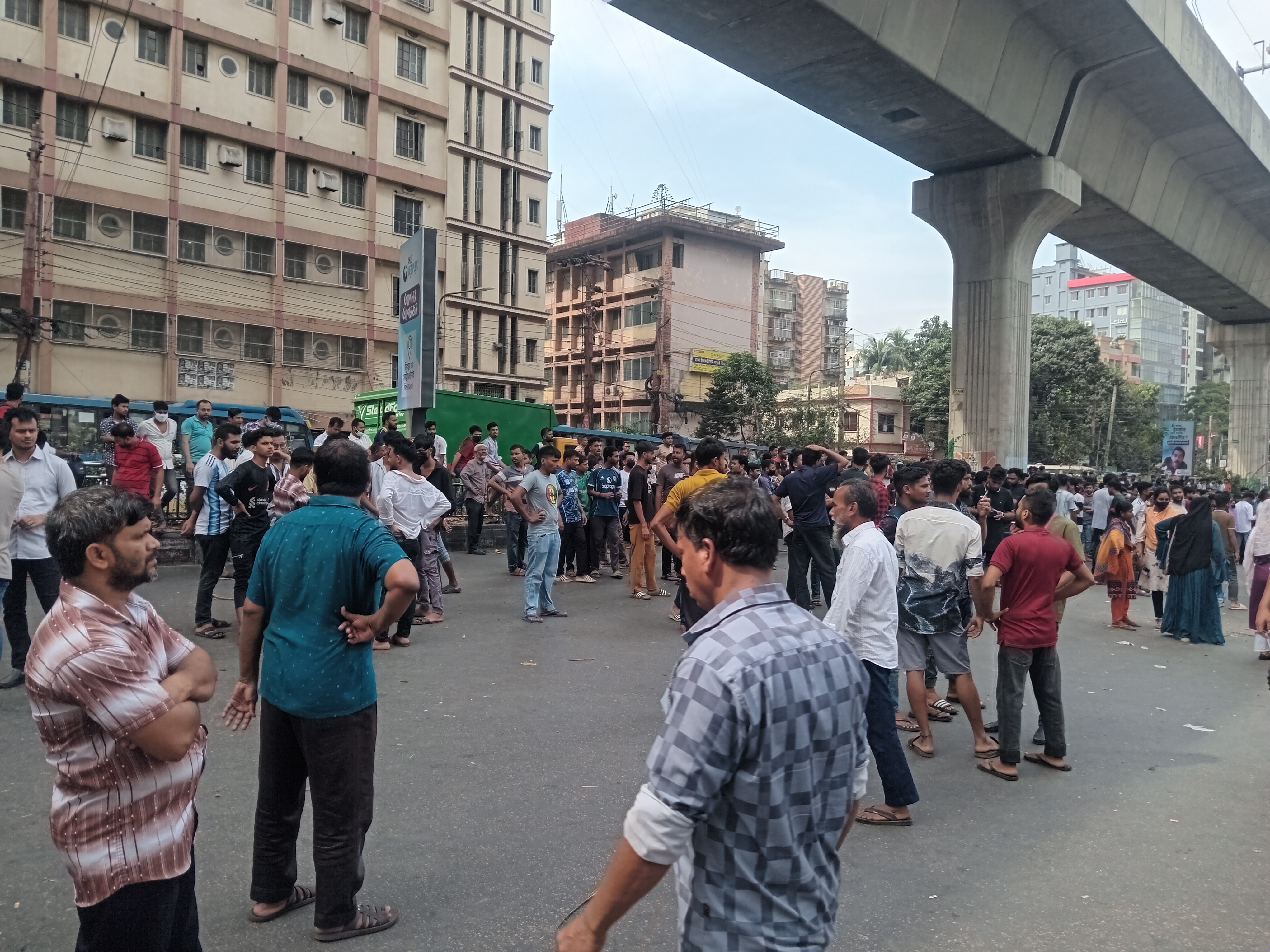
Garment workers block roads once again, demanding fair wages

Published: 03:01 29 October 2026
The Garment Industry’s Enormous Contribution to the National Economy, Yet Questions Remain About Workers’ Living Conditions, Their Children’s Future, and Their Residential Environment
We take pride in the contribution of the garment industry to Bangladesh’s economy. According to the World Trade Organization’s (WTO) published data for 2024, Bangladesh ranked second after China in clothing exports. In that year, China exported approximately $165.24 billion worth of clothing, while Bangladesh’s exports amounted to around $38.48 billion. This demonstrates that Bangladesh holds an important position in the global market. But the question is: how much of this success is reflected in the lives of the workers whose hard work sustains this industry?
Even today, workers have to take to the streets to demand fair wages. On October 29, reports emerged that workers had blocked roads in the Mirpur-10 area of Dhaka, demanding a minimum monthly wage of Tk 30,000. This caused traffic congestion and inconvenienced ordinary people. But should we focus only on the traffic congestion, or should we also try to understand the reasons behind it?
When workers are repeatedly compelled to take to the streets to demand fair wages, questions arise: Where does the problem lie? Why do workers in an industry of such significance have to protest repeatedly just to secure a minimum standard of living for themselves and their families?
China Ranks First and Bangladesh Second—So Why Is There Such a Significant Wage Gap?
In Bangladesh, the statutory minimum monthly wage for entry-level garment workers was set at Tk 12,500 in 2023. At the current exchange rate, this is approximately equivalent to $100. However, actual earnings may vary depending on workers’ grades, experience, overtime, and other allowances.
In China, on the other hand, minimum wages are determined according to the region. An industry report published in 2025 cited examples of monthly minimum wages of approximately $262 in relatively lower-cost regions such as Guangxi and around $385 in Shanghai. These figures represent minimum wages in specific regions of China, not the actual salaries of all garment workers.
The question, therefore, is this: if Bangladesh is also the world’s second-largest clothing exporter, why do its garment workers continue to receive comparatively low wages?
Several factors contribute to this situation, including the country’s economic capacity, productivity, investment in technology, workers’ bargaining power, enforcement of labour laws, and the prices set by international buyers. China’s industrial system, infrastructure, and domestic supply chains have developed over many decades. Bangladesh, meanwhile, still relies heavily on low production costs to compete in international markets.
However, if the cost of this competition is repeatedly imposed on workers, the country’s exports may continue to grow without a corresponding improvement in workers’ living standards.
One factual point also needs clarification: it would be inaccurate to claim that garment workers in Bangladesh receive the lowest wages in the entire world. Nevertheless, various international comparisons place Bangladesh among the lowest-wage countries among the major clothing-exporting nations. The findings depend on which countries are compared and which year’s data are used.
The Conflict Between Owners and Workers Through the Lens of Karl Marx’s Theory
Let us now examine the issue through the lens of sociologist Karl Marx’s theory of class conflict. Analysing the situation through this theory reveals a fundamental distinction between ownership of the means of production and capital, on the one hand, and selling one’s labour to earn a living, on the other.
In the garment industry, factory owners control the factories, capital, production systems, and business decisions. Workers, meanwhile, produce garments through their labour and time. However, they generally do not control the selling prices of products, contractual negotiations with international buyers, or decisions regarding the distribution of corporate profits.
International buyers want to purchase products at lower prices, factories want to retain their orders, and owners want to control production costs. This competitive environment can create pressure to keep workers’ wages low. As a result, even when workers produce enormous quantities of goods through their labour, the benefits of that economic success are not distributed equally among everyone involved.
This does not mean that every factory owner personally wants to keep workers poor. Rather, the question is whether the overall economic structure is designed to ensure workers a fair standard of living.
If a worker’s income is entirely consumed by the cost of basic survival, it becomes difficult for them to save money, improve their skills, provide better education for their children, or build assets for the future. In this way, economic inequality can persist from one generation to the next.
Will Workers’ Children Remain Trapped in This Cycle of Inequality?
Consider a family in which both the husband and wife work in garment factories. They have to work long hours every day. At the end of the month, their earnings must cover food, rent, transportation, healthcare, electricity, water, and their children’s educational expenses.
When meeting these expenses is already difficult at current market prices, how can they provide their children with nutritious food, an adequate learning environment, necessary technology, additional educational support, and opportunities for psychological development?
A child’s education is not complete simply because they have been enrolled in school. Children also need nutritious food, a suitable place to study, their parents’ time and guidance, and financial security. However, when both parents return home exhausted after long working hours and their income is limited, providing these opportunities becomes even more difficult.
This does not mean that the children of workers cannot succeed. Rather, despite having the same intelligence and willingness to work hard, they may be deprived of opportunities that children from financially secure families enjoy.
The question now is: what kinds of employment opportunities will be available to children who do not receive adequate educational and developmental support? If they are eventually compelled to enter similarly low-paid jobs, how will their families’ financial circumstances improve?
The goal of a country’s economic development should not simply be to produce more goods or increase exports. Economic progress should also improve people’s living standards, expand educational opportunities, and create a better future for the next generation.
Slum Living, Environmental Pollution, and Environmental Inequality
Let us now turn to the living conditions of garment workers.
Because of their low incomes, many workers have to live in densely populated, low-income neighbourhoods or slums near their factories. Not everyone lives under the same conditions, but those residing in such areas often face small and overcrowded rooms, inadequate ventilation and natural light, poor sewage systems, waterlogging, inadequate waste management, and difficulties accessing safe drinking water.
Why are families compelled to live in such environments? In many cases, the reason is that finding safe and healthy housing within their financial means is difficult.
There is a direct relationship between the environment and economic inequality. People with greater financial resources can choose comparatively better housing, cleaner surroundings, and improved urban amenities. Low-income people, however, have far fewer alternatives.
Environmental sociology teaches us that environmental pollution and environmental risks do not affect all social classes equally. Poor people often bear the consequences of living in polluted or unhealthy environments while having less power to influence the decisions needed to change those conditions.
Another important point must be considered. Inadequate waste management, dirty drains, waterlogging, and unplanned settlements can all contribute to environmental degradation. However, the responsibility cannot be placed solely on workers. Local authorities, urban planners, landlords, and relevant institutions also have a responsibility to ensure adequate drainage, waste collection, sanitation, and safe drinking water in workers’ residential areas.
Similarly, responsibility for pollution caused by industrial chemicals, untreated wastewater, or production processes must be assessed separately by examining the roles of the relevant industrial establishments and regulatory authorities.
In other words, low wages do not merely create problems with food and housing. They are part of a broader set of challenges affecting workers’ health, their children’s futures, and the environment in which they live.
For people who struggle every day to afford food and rent, environmentally friendly living can sometimes seem like a luxury they cannot prioritise. Therefore, protecting the environment requires first ensuring the necessary infrastructure and practical opportunities for people to live in a healthy and sustainable manner.
Workers’ Protests, Traffic Congestion, and the Burden on the General Public: Who Is Responsible?
When roads are blocked because of workers’ protests, ordinary people can become trapped in traffic for hours. Employees may be unable to reach their workplaces on time, students may face difficulties, businesses may suffer losses, and the movement of emergency patients and ambulances may also be disrupted.
This inconvenience cannot be denied. At the same time, dismissing workers’ demands as unreasonable simply because protests cause traffic congestion would fail to consider the full picture.
When workers’ legitimate demands remain unresolved for a long time, protests can emerge. Ineffective negotiations with factory owners, delays in wage reviews, weak representation of workers, and political complications can make the situation even more difficult.
However, the methods of protest also carry responsibilities. Completely blocking public movement or obstructing emergency services is not a solution. Protest organisers, the administration, and relevant authorities should establish arrangements that allow workers to express their demands without unnecessarily disrupting the lives of ordinary people.
The central question is why this situation repeatedly arises: one group of low-income people takes to the streets to secure its legitimate demands, while another group of ordinary citizens suffers because of the resulting disruption.
If we blame only one side, we will not achieve a lasting solution. Ensuring fair wages, defining the responsibilities of factory owners, strengthening effective government oversight, and establishing peaceful negotiation mechanisms must all be addressed together.
What Is the Solution? Should All Factories Be Under Government Control?
These problems cannot be resolved without effective government regulation and accountability. However, there is no guarantee that nationalising all garment factories would eliminate every problem faced by workers. Whether factories operate under public or private ownership, the fundamental objective must be to protect workers’ legitimate rights.
First, wage determination must consider not only factory production costs but also the costs of food, housing, transportation, healthcare, education, and other essential living expenses.
Second, wages should be reviewed regularly through a transparent and independent wage board that includes effective worker representation. Once a minimum wage has been established, its proper implementation must also be ensured.
Third, international buyers, clothing brands, factory owners, and the government must work towards balancing production costs with fair wages for workers. An industry cannot remain sustainable in the long term if its competitiveness depends solely on producing goods at the lowest possible cost.
Fourth, affordable and healthy housing, workers’ residential colonies or dormitories, quality public schools, childcare facilities, healthcare, safe drinking water, improved drainage, and effective waste management must be ensured for workers.
Fifth, effective negotiation and dispute-resolution mechanisms must be established before workers are driven to protest. This would help prevent prolonged disputes over wages and other rights while reducing inconvenience to the general public.
Final Thoughts: Should a Country’s Development Be Measured Solely by Its Export Figures?
My question is this: if Bangladesh can rank second in the world in clothing exports, why can it not ensure a dignified standard of living for the workers who sustain this industry?
If workers whose labour drives the national economy cannot provide their families with safe housing, nutritious food, quality education, and healthcare, how much of the benefits of economic progress are actually reaching the people?
If workers’ children lack adequate educational opportunities, workers are compelled to live in unhealthy environments, and protests repeatedly emerge over demands for fair wages, then a country’s development cannot be fully assessed through export statistics alone.
A country’s development becomes truly meaningful when economic growth is accompanied by improvements in people’s living standards, reductions in inequality, better opportunities for children to build their futures, and protection of the environment.
The success of Bangladesh’s garment industry should not be measured solely by the dollar value of the clothing it sells abroad. It should also be measured by how well the workers who produce those garments are able to live, how many opportunities their children have to grow and develop, and how safely and healthily their families can live in their communities.
Advertisement
Most Readed - National

- Garment workers block roads once again, demanding fair wages
- Body of former Flight Lieutenant—who released a video of Sheikh Hasina’s departure recovered!
- Chatra Dal Leader Tamiz Uddin Extends a Helping Hand Through Humanitarian Work in Savar
- Eliza Zaman Set to Become Member of Parliament Uncontested
- The behavior of Shah Rukh that once led Gauri Khan to consider ending their relationship
- Harry Kane Overcome with Emotion After Winning His First Ballon d’Or
- India’s Siang Project: A Response to China’s Mega-Dam Sparks Unrest in Arunachal Pradesh
- Sagar-Runi Murder Case: High Court Summons Task Force Chief with Documents
- Allegations of Obstruction at Manik Pashari’s Burial; Rashed Khan Criticizes Jamaat and NCP
- Jaya Ahsan turns heads in a pink satin ensemble
- Fuel for Rooppur Nuclear Power Plant Arriving in Bangladesh Today
- Cybercriminals Claim to Possess Data of 19 Million Pathao Users; $400,000 Ransom Demanded
- Jamuna Fertilizer Factory Shuts Down Again Just Two Days After Resuming Operations
- Hasnat Questions the Source of Salahuddin’s Wealth, Demands Transparent Accounting
- Countless Decembers will come and go, but Sheikh Hasina will not return to the country: Rashed Khan
- Ronaldo faces risk of 6-month ban for leaving national team camp
- Messi bids farewell with a goal and assists, showered with love by teammates
- Ronaldo shares emotional message upon Messi's retirement, expressing 'utmost respect'
- Houthis Claim Third Attack on Riyadh Airport; Aircraft Damaged
- Three-Day Mosquito Eradication Drive Begins in Savar's Bongaon