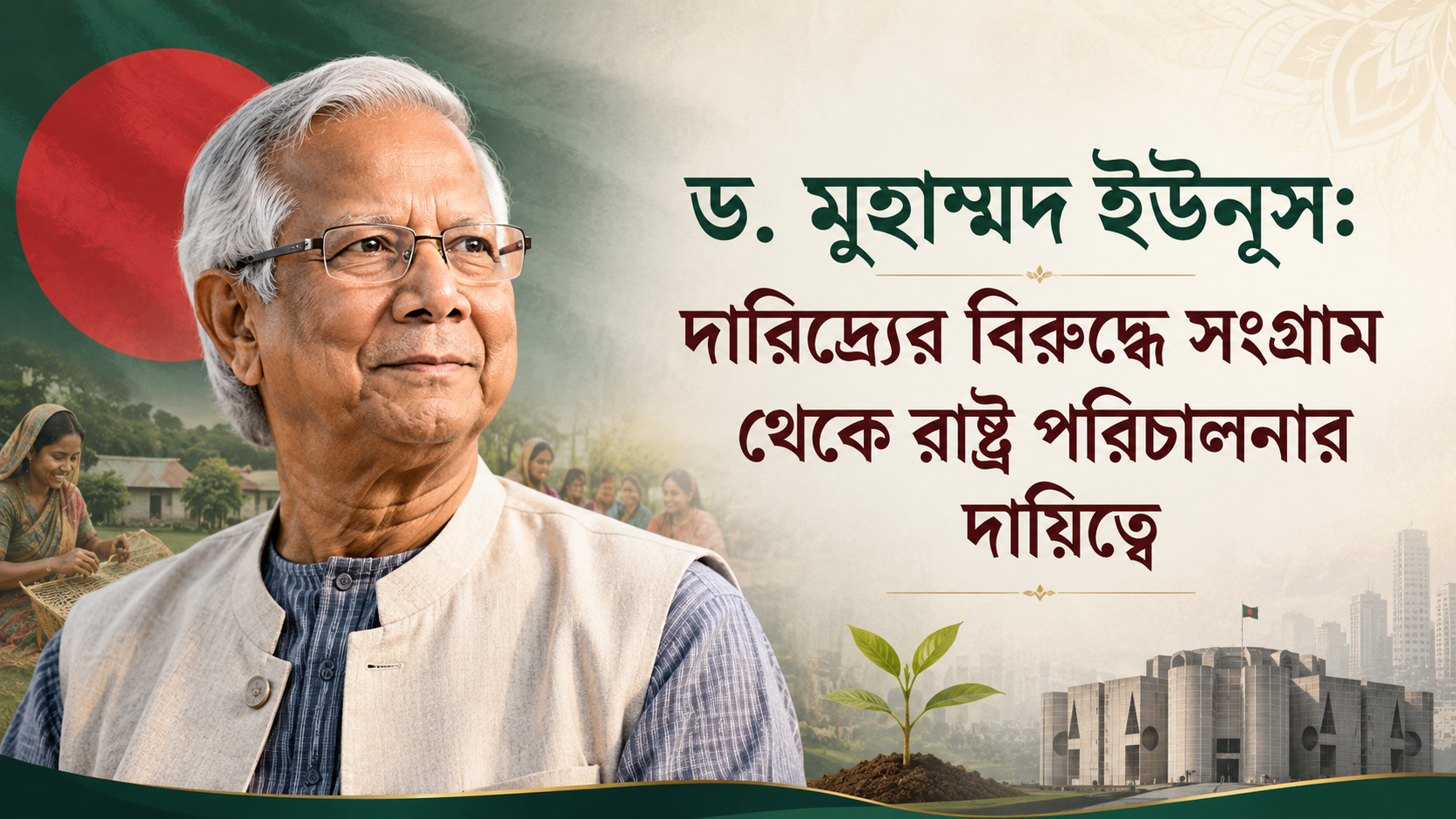
Dr. Muhammad Yunus: From the Fight Against Poverty to the Responsibility of Governing the State

Published: 07:26 19 July 2026
In the history of Bangladesh, Dr. Muhammad Yunus is a remarkable figure whose life has unfolded through several distinct chapters. He is a teacher and economist, a pioneer of microcredit, an advocate of social business, the founder of Grameen Bank, and Bangladesh’s first Nobel laureate. In the later stage of his life, he took on an entirely different responsibility: leading the country as the Chief Adviser of Bangladesh’s interim government following the student-led mass uprising of 2024.
His life story is not merely the story of one man’s personal success. It is a story of challenging conventional economic ideas, believing in the capabilities of poor people, and guiding a country through political change during a time of national crisis.
Birth and Childhood
Dr. Muhammad Yunus was born on 28 June 1940 in Chattogram district, then part of British India. He grew up in a business family in Chattogram. From an early age, he showed a strong interest in education, social activities, and leadership.
During his school years, he became involved in the Scout movement. Through scouting, he learned discipline, teamwork, leadership, and the importance of serving others.
These early experiences had a profound influence on his later thinking. He did not focus only on achieving personal success. Instead, he gradually became interested in finding ways to include disadvantaged people in economic activities and help them build better lives.
He studied economics at the University of Dhaka. Later, he travelled to the United States on a Fulbright Scholarship and earned a PhD in economics from Vanderbilt University.
While living in the United States, he taught economics at Middle Tennessee State University. His higher education and teaching experience gave him a broad understanding of modern economics, development policy, and international society.
The Liberation War and His Commitment to Independent Bangladesh
When the Bangladesh Liberation War began in 1971, Muhammad Yunus was living in the United States. During that period, he helped organise expatriate Bangladeshis, build public support for Bangladesh’s independence, and communicate the message of the Liberation War to the international community.
After independence, he returned to Bangladesh in 1972. He came back because he wanted to contribute directly to building the newly independent country.
At first, he became involved in government-related planning work. Later, he joined the University of Chittagong and became the head of its Department of Economics.
In the classroom, he taught development economics. However, he soon realised that there was a vast difference between the economic theories described in textbooks and the everyday realities of poor people living in rural communities.
The 1974 Famine and a Turning Point in His Life
The famine of 1974 deeply changed Muhammad Yunus’s way of thinking.
At the university, he taught theoretical ideas about economic development, production, growth, and poverty. Yet people living around the university were suffering from extreme hunger and financial hardship.
This harsh reality motivated him to leave the classroom and observe people’s lives more closely. He began visiting Jobra, a village near the University of Chittagong, where he spoke directly with poor villagers.
He discovered that many people were willing and able to work and produce goods. However, because they lacked even a small amount of capital, they were forced to depend on moneylenders and middlemen.
The experience of one woman in Jobra had a particularly strong impact on him. She made bamboo stools but did not have enough money to buy bamboo herself. As a result, she had to borrow money from a moneylender under unfair conditions.
She was also required to sell her finished products back to the same moneylender at a price that left her with almost no profit. Although she worked hard, she remained trapped in poverty because she did not have access to a small, affordable loan.
Yunus and his students investigated the situation and discovered that only about 27 US dollars was needed to free 42 poor families from this cycle of debt.
He lent them the money from his own pocket.
This small initiative eventually gave birth to an idea that later became known throughout the world as microcredit.
The Birth of Grameen Bank
Muhammad Yunus identified a fundamental weakness in the conventional banking system.
Banks usually provide loans to people who already have assets, income, property, or collateral. Therefore, those who own nothing are often excluded from formal banking services.
Yunus asked a simple but powerful question: Why should poor people automatically be considered untrustworthy?
Why should hardworking individuals be denied economic opportunities simply because they do not own property to offer as collateral?
In 1976, an experimental microcredit project was launched in Jobra village. At first, Yunus worked with existing banks to arrange loans for poor people.
However, traditional banks considered the model too risky. Yunus personally guaranteed some of the loans and attempted to prove that poor people could also be responsible borrowers.
Gradually, the project expanded from Jobra to other villages and eventually to different regions of Bangladesh.
In 1983, the project received official recognition as an independent bank. It was named Grameen Bank, meaning “the bank of the village” or “the bank for rural people.”
The Philosophy of Microcredit
At the centre of Muhammad Yunus’s microcredit philosophy was a belief in human potential.
According to him, poverty is not a personal failure of poor people. In many cases, social, financial, and institutional systems are structured in ways that prevent people from progressing, even when they have talent, determination, and a willingness to work.
Grameen Bank did not require borrowers to provide traditional property-based collateral.
Borrowers were organised into small groups. Through shared responsibility, mutual accountability, regular meetings, and scheduled instalments, they repaid their loans.
This system was especially important for rural women. It allowed many women to participate in economic activities, start small businesses, earn an income, and become more involved in financial decision-making within their families.
Microcredit was not only about giving people money.
It was also connected with saving, self-employment, women’s participation in household management, financial independence, and local economic decision-making.
Over time, similar microcredit models were introduced in many parts of Asia, Africa, Latin America, and even some developed countries.
However, microcredit is not universally regarded as the only solution to poverty.
There have been debates and criticisms regarding interest rates, the use of loans, repayment pressure, multiple borrowing, and the long-term impact of microfinance programmes.
Despite these criticisms, Yunus’s initiative created a global shift in thinking by bringing people who had previously been excluded from formal banking into the financial system.
The Nobel Peace Prize
In 2006, Muhammad Yunus and Grameen Bank jointly received the Nobel Peace Prize.
The Nobel Committee recognised them for their efforts to create economic and social development from the grassroots level.
The importance of this recognition was profound.
The Nobel Committee highlighted the connection between poverty and peace. Sustainable peace cannot be established unless people have economic dignity, livelihood opportunities, and the ability to improve their lives.
Yunus’s work demonstrated that even a small economic opportunity, when placed in the hands of a poor person, could help create the foundation for meaningful social change.
Through this award, Muhammad Yunus became the first Bangladeshi Nobel laureate.
At the same time, Bangladesh gained a new identity on the global stage as the country where an innovative approach to fighting poverty had emerged.
International Recognition
In addition to the Nobel Peace Prize, Muhammad Yunus received numerous international awards and honours.
In 2009, he received the United States Presidential Medal of Freedom.
He was later awarded the Congressional Gold Medal, one of the highest civilian honours in the United States, and formally received it in 2013.
These honours established him not only as an economist but also as a global representative of human development, social entrepreneurship, and poverty reduction.
Universities, development organisations, governments, non-profit institutions, and businesses around the world began studying and applying his ideas about microcredit and social business.
The Concept of Social Business
After popularising microcredit, Muhammad Yunus became a leading advocate of the concept of social business.
In a conventional business, the primary objective is generally to increase profits for owners or investors.
In a social business, the main purpose is to solve a specific social problem.
Such an organisation does not have to depend permanently on donations like a traditional charity. It sells products or services and generates enough revenue to cover its own operating expenses.
However, instead of distributing profits primarily for the personal enrichment of investors, the profits are reinvested into expanding the organisation’s social mission.
This model can be used to address issues such as poverty, healthcare, education, nutrition, renewable energy, agriculture, technology, housing, sanitation, and employment.
According to Yunus, human beings are not motivated only by personal profit.
People also have the capacity and desire to help others, solve social problems, and contribute to the wellbeing of society.
Conflict, Departure from Grameen Bank, and Legal Complications
Muhammad Yunus’s career was not free from controversy.
In 2007, he announced plans to form a political party called Nagorik Shakti, or Citizens’ Power. However, he abandoned the plan after a short period.
In 2011, he was removed from his position as Managing Director of Grameen Bank following a directive from Bangladesh Bank, which cited the official retirement age.
He challenged the decision in court, but his removal was ultimately upheld.
His supporters regarded the action as a result of political hostility. The government at the time presented it as an administrative and legal matter.
In the following years, several legal cases were filed involving Yunus and organisations associated with him.
In January 2024, he was sentenced to six months in prison in a case involving alleged violations of labour law.
He denied wrongdoing, and his lawyers and supporters described the cases as politically motivated harassment.
On 7 August 2024, Bangladesh’s Labour Appellate Tribunal overturned the conviction and acquitted Yunus and the other defendants.
The Beginning of the 2024 Student Movement
In July 2024, students from universities across Bangladesh began protesting against the quota system used in government recruitment.
The movement was organised under the banner of the Anti-Discrimination Student Movement.
Its initial demand was to reform the quota system and increase merit-based recruitment for government jobs.
From 1 July, the protests began expanding in an organised manner.
On 15 July, attacks on protesting students at the University of Dhaka and other locations intensified the situation.
Later, clashes spread among protesters, the police, security forces, and groups associated with the ruling party.
Internet shutdowns, curfews, mass arrests, deaths, and injuries transformed the quota reform movement into a broader anti-government movement.
A later investigation by the United Nations Human Rights Office found reasonable grounds to believe that serious human rights violations had occurred between 1 July and 15 August.
The investigation described allegations of extrajudicial killings, excessive use of force, arbitrary arrests, torture, and injuries suffered by thousands of people.
Dr. Yunus’s Position During the Movement
Muhammad Yunus was not a direct organiser of the 2024 movement.
He was outside Bangladesh at the time. However, he expressed support for the protesters and called for an end to the violence.
On 5 August 2024, Sheikh Hasina resigned as Prime Minister and left the country. Her departure created a political vacuum.
The leadership of the Anti-Discrimination Student Movement proposed Dr. Muhammad Yunus as the head of an interim government.
The student leaders argued that an internationally respected, politically neutral, and reform-oriented figure could help guide the country and translate the movement’s aspirations into institutional change.
Following discussions among the military leadership, the President, student representatives, and political stakeholders, it was decided that Yunus would serve as Chief Adviser.
At the time, he was in Paris receiving medical treatment.
He accepted the students’ request and decided to return to Bangladesh.
Chief Adviser of the Interim Government
On 8 August 2024, Muhammad Yunus took the oath of office as Chief Adviser of the interim government.
The oath was administered at Bangabhaban by President Mohammed Shahabuddin.
An advisory council was also formed. It included representatives from civil society, specialists, human rights activists, professionals, and student leaders associated with the movement.
Yunus was 84 years old when he took the oath.
After spending most of his life working in economics, education, microcredit, entrepreneurship, and social business, he accepted direct responsibility for governing the state for the first time.
After assuming office, he paid tribute to those who had been killed or injured during the movement.
He expressed the hope of building a new Bangladesh based on the path shown by the students and the sacrifices of ordinary citizens.
His immediate challenges included restoring law and order, making the administration fully functional, protecting minorities and ordinary citizens, managing economic uncertainty, rebuilding trust in institutions, and preparing the environment for a credible election.
The Three Main Responsibilities of the Government
The work of the interim government led by Yunus was generally understood through three major objectives: reform, justice, and elections.
First, the government aimed to introduce institutional reforms so that state institutions could not again come under the complete control of a single person or political party.
Second, it sought to investigate and ensure accountability for killings, torture, excessive use of force, and human rights violations committed during the July-August movement.
Third, it was expected to organise a free, fair, peaceful, and credible election and transfer power to an elected government.
To achieve these objectives, six major reform commissions were formed.
They were assigned to propose reforms in the electoral system, the Constitution, the judiciary, the police, public administration, and the Anti-Corruption Commission.
Later, reform initiatives were also introduced in several other sectors.
Accountability and the United Nations Investigation
One significant step taken by the interim government was its decision to welcome an international investigation into human rights violations committed during the July-August movement.
On 14 August 2024, Dr. Yunus requested the United Nations High Commissioner for Human Rights to conduct an independent investigation.
On 28 August, the government formally invited the UN investigation team through an official letter.
The UN team visited Bangladesh and interviewed victims, witnesses, doctors, government officials, members of civil society, and representatives of different institutions.
The investigation examined allegations involving killings, excessive use of force, torture, arbitrary detention, and violence against female protesters.
Through this initiative, the Yunus government sought to demonstrate that accountability would not depend only on political statements or partisan allegations.
Instead, it aimed to base the investigation on internationally recognised standards, verified evidence, and professional fact-finding procedures.
Achievements, Limitations, and Criticism
The responsibility of the interim government was extremely difficult.
It had to govern at a time when the police and administrative systems had become weakened, public confidence in political institutions had declined, and concerns had emerged regarding retaliatory violence and the security of minorities.
The Yunus government began discussions on institutional reform.
It also attempted to rebuild international cooperation, stabilise the country, and create a new framework for future elections.
However, the government also faced criticism.
Critics argued that it was unable to restore law and order quickly enough, delayed announcing a clear election schedule, remained distant from some political parties, provided insufficient representation for women and minorities, and failed to address every human rights concern effectively.
Supporters of the movement wanted rapid and far-reaching reform of the old system.
Major political parties, on the other hand, demanded an early national election.
As a result, the Yunus government had to balance two competing priorities: allowing enough time for meaningful reforms and restoring democratic legitimacy through elections.
Election and Transfer of Power
The final test of the interim government was the organisation of a national election.
Following extensive discussions, reform proposals, negotiations, and political pressure, a national election was held in February 2026.
The Bangladesh Nationalist Party, commonly known as the BNP, won a parliamentary majority.
On 17 February 2026, Tarique Rahman took the oath of office as Prime Minister, bringing the term of the interim government led by Muhammad Yunus to an end.
This transfer of power concluded approximately eighteen months of interim rule.
Guiding the country from the political vacuum created by the uprising to an elected government was one of the most important constitutional and political responsibilities of Yunus’s administration.
The Historical Significance of Dr. Muhammad Yunus
It is difficult to define Dr. Muhammad Yunus through a single identity.
As a professor, he taught economics.
As a researcher, he identified weaknesses in the traditional banking system.
As an entrepreneur, he founded Grameen Bank.
As a thinker, he presented social business as an alternative approach to solving social problems.
One of his greatest strengths was his ability to identify large structural problems within seemingly small everyday difficulties.
By observing the debt problems of a few villagers in Jobra, he challenged the logic of the entire banking system.
His work showed that people without property could still be financially responsible and that poverty should not be treated as a permanent identity.
In 2024, he faced an entirely different test.
This time, he was not responsible for managing a bank or a social organisation. He had to lead a divided and crisis-stricken state.
His knowledge of economics, his international reputation, and his experience in social business gave him a foundation of moral leadership.
However, the realities of governing a country were far more complicated.
He had to address law and order, political competition, justice, human rights, economic stability, institutional reform, and election-related questions at the same time.
Conclusion
The life of Dr. Muhammad Yunus reflects Bangladesh’s possibilities, crises, struggles, and transformations.
His journey began as a teacher.
He later became internationally known by opening the doors of banking to poor people who had previously been excluded from the financial system.
The Nobel Peace Prize brought him one of the highest levels of international recognition.
His appointment as Chief Adviser of the interim government following the student-led mass uprising of 2024 added an entirely new chapter to his life.
Not all his initiatives have been equally successful or free from controversy.
There are different opinions about the impact of microcredit, the management of Grameen Bank, his relationship with previous governments, and the decisions of the interim administration.
However, one point is difficult to deny: he introduced ideas from Bangladesh that influenced global thinking about poverty, financial dignity, social responsibility, and human potential.
From a 27-dollar initiative in Jobra village to the Nobel Peace Prize, and from there to the responsibility of leading an interim government, the life of Dr. Muhammad Yunus demonstrates that major historical changes sometimes begin with a very small question:
What can a person who has nothing achieve when given a genuine opportunity?
Advertisement
Most Readed - Biography

- Nasiruddin Patwary: From Student Politics to a New Post-July Political Movement
- Allegations of extremist activities under the guise of martial arts training, confessions of 2 accused
- Deepika in action scenes even while seven months pregnant
- Extortion and terrorism cannot be stopped without reforms: Nasiruddin Patwari
- Chinese cars are becoming popular in the UK market, the reasons behind it
- Golden Boot for Mbappe, Golden Ball for Spain, Silver Ball for Messi
- Putin thanks North Korea for cooperation in Ukraine war
- 4 arrested for joining Ministry of Public Administration, accused of giving viva with fake candidates
- Dr. Muhammad Yunus: From the Fight Against Poverty to the Responsibility of Governing the State
- Temporary outage on Facebook, login and usage problems
- Shamim Kaisar Lincoln: A People’s Representative and His Political Journey
- Dr. Shafiqur Rahman: Life, Medical Profession, and Political Journey
- Mosque imam arrested on charges of child rape in Trishal
- Once a street sleeper, now a World Cup hero
- Hollywood actor Giancarlo Esposito converts to Islam while filming in Saudi Arabia
- Ecuador knocks out Germany, declares national holiday in celebration
- Local government elections to be held in phases, may end in 2027
- Bangla QR payment to be mandatory across the country from July 1
- Yamal's ideal is Neymar, despite considering Messi the best in the world
- Bangladesh seeks Malaysian investment in oil and gas exploration