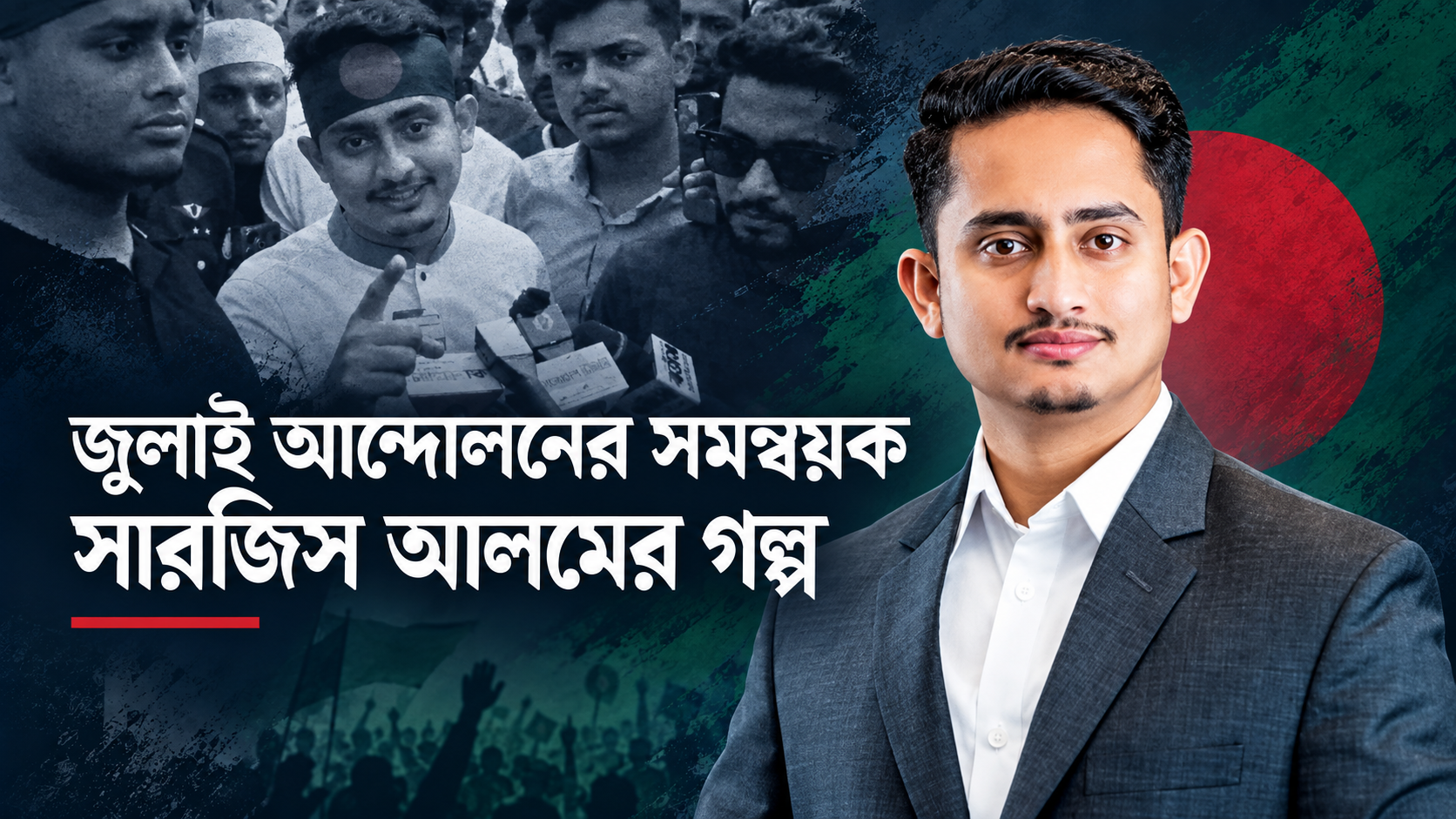
The story of Sarjis Alam, a coordinator of the July movement.

Published: 03:45 28 September 2026
Sarjis Alam is known as one of the coordinators of Bangladesh’s 2024 Students Against Discrimination movement. His public life, however, began before the July uprising. He grew up in Panchagarh, studied at the University of Dhaka, and was elected to a hall student council from a Bangladesh Chhatra League panel. He later left that organisation, became active in the quota reform movement, took on responsibilities after the uprising and entered electoral politics through the National Citizen Party (NCP).
His journey has drawn both support and scrutiny. His former involvement with Chhatra League, a large motorcade during a visit to Panchagarh, his father-in-law’s judicial appointment and a court petition concerning one of his Facebook posts have all generated discussion. Understanding his biography requires separating documented events, questions raised by others and Sarjis’s own explanations.
Who Is Sarjis Alam?
Sarjis Alam is a Bangladeshi politician and a former coordinator of the 2024 Students Against Discrimination movement. He has served as the NCP’s chief organiser for the northern region. Before joining the party, he was general secretary of the July Shaheed Smrity Foundation and chief organiser of the Jatiya Nagorik Committee. He contested the Panchagarh-1 constituency in the 2026 parliamentary election but was not elected.
These roles belong to different stages of his career. He was first a university student representative, then became nationally known during the 2024 movement. His work in post-uprising organisations came next, followed by party leadership and an election campaign. Keeping that sequence clear helps explain how his public role changed over time.
Birthplace and Family Background
Published biographical accounts place Sarjis Alam’s birth on 2 July 1998 in Atwari, Panchagarh. His father is Akhtaruzzaman Saju. Panchagarh remained central to his political journey: after taking responsibility for the NCP’s northern organisation, he chose to contest a parliamentary seat in his home district.
His father’s political past has also become a subject of discussion. In an interview with Bangladesh Sangbad Sangstha (BSS), Sarjis said his father had held a position in the Awami League at the local level. According to Sarjis, his father faced pressure and harassment during the 2024 movement because of his son’s role. That is Sarjis’s account of his family’s experience; a relative’s political history should not automatically be treated as his own position.
False claims about his family have circulated online as well. One viral video identified a man as Sarjis’s father, but a published fact-check found no evidence supporting that identification. The video should therefore not be presented as a verified event involving his family.
Education and Early University Life
Sarjis studied at BAF Shaheen College in Dhaka before joining the University of Dhaka’s Department of Zoology. Published accounts say he completed undergraduate and postgraduate studies there. He also listed a master’s degree as his educational qualification in the affidavit submitted before the 2026 parliamentary election.
At the university, he lived in Amar Ekushey Hall. In his BSS interview, he described spending time in a crowded dormitory room and encountering the difficulties of hall life firsthand. He linked those experiences to his growing interest in students’ everyday concerns, including accommodation and campus facilities.
How the 2018 Quota Movement Influenced Him
The 2018 quota reform movement was an early turning point in Sarjis’s account of his political development. He told BSS that he joined a procession at the University of Dhaka and chanted slogans. He described the experience as one that changed how he thought about student politics.
Sarjis also alleged that after he questioned the conduct of some Chhatra League leaders on Facebook, he was called to a hall guest room, questioned and pressured to remove his posts. These are his descriptions of what happened. The available account does not establish that he held the same kind of national coordinating role in 2018 that he later held in 2024. For his biography, 2018 is most clearly a period in which his views and relationship with established student politics began to change.
Election to the DU Hall Council and Departure from Chhatra League
Sarjis was involved in Chhatra League politics during his university years. In the 2019 Dhaka University Central Students’ Union elections, he ran from a Chhatra League panel and was elected as a student representative in Amar Ekushey Hall. In his BSS interview, he said he received 624 votes from an electorate of roughly 900. That vote figure comes from his own account.
He later moved away from Chhatra League. According to the BSS interview, he left the organisation in 2022. Sarjis has said the political practices he encountered in the hall did not match what he had hoped student representation would be. That is his explanation for leaving; his earlier election from a Chhatra League panel remains a relevant part of the record.
Both facts matter. Leaving out his Chhatra League past would make his political story incomplete. Treating that earlier affiliation as a full explanation of his actions years later would also ignore the intervening period and his public account of why he left.
His Role at the Beginning of the 2024 Movement
Sarjis has given a detailed account of how he became involved in the 2024 quota reform movement. In his BSS interview, he said a court decision concerning quotas on 5 June prompted him to become active. He described contacting other students about the following day’s programme, joining activities around the Central Shaheed Minar on 6 June and taking part as the movement developed into larger demonstrations in July.
According to Sarjis, an important organising goal was to bring students from different halls and universities under shared programmes. He has emphasised a coordinated structure over dependence on a single leader. His prominence during the movement does not make it the work of one person: many coordinators, students and members of the public took part.
From Quota Reform to a Demand for the Government’s Resignation
The movement began with demands concerning quotas in government jobs. As clashes, deaths and allegations of repression intensified in July, it grew into a broader mass movement. On 3 August, a one-point demand for Sheikh Hasina’s government to resign was announced at a gathering at the Central Shaheed Minar. Sheikh Hasina resigned on 5 August.
Sarjis has said the one-point demand did not arise solely from a decision by a few coordinators. In his view, it expressed a demand that had already grown among the public. This is his interpretation of how the movement changed. The fall of the government cannot accurately be credited to Sarjis, or to any other individual, alone.
DB Custody and the Dispute Over the Dining-Table Photograph
During the July movement, several coordinators were held at the Detective Branch office of Dhaka Metropolitan Police. A photograph showing them at a dining table became controversial, particularly as questions arose over whether statements about withdrawing the movement had been made freely.
In his later BSS interview, Sarjis alleged that the coordinators were kept apart from outside communication and pressured during the episode in which the dining-table photograph was taken. The publication of the photograph is one matter; the conditions in which it was taken and the freedom of those pictured to speak are matters described in Sarjis’s account. His allegations should be attributed to him.
He has also said that after leaving the DB office, the movement’s demand for the government’s resignation became more explicit. This period remains one of the most discussed episodes of his role in 2024.
Responsibilities After the Uprising
After the uprising, Sarjis became general secretary of the July Shaheed Smrity Foundation. He later worked as chief organiser of the Jatiya Nagorik Committee. When the National Citizen Party was launched on 28 February 2025, he was given responsibility as its chief organiser for the northern region.
These were different kinds of responsibilities. The foundation’s work concerned families affected by deaths and injuries during the uprising. The citizens’ committee provided an organisational platform. The NCP placed Sarjis within a political party. His public role consequently moved from protest coordination toward organisation building, party decisions and, eventually, elections.
Marriage and His Wife’s Identity
Sarjis Alam married Sharmin Akter Raita on 31 January 2025. Her father is Mohammad Lutfur Rahman. According to a public statement from Lutfur Rahman, the marriage ceremony took place in Gazipur on a limited scale with members of both families present. He later asked well-wishers to pray for the couple.
The marriage attracted public interest because of Sarjis’s prominence. The confirmed details of the marriage and his wife’s publicly reported identity are relevant to a biography. There is no basis here to assign Raita a political role of her own.
Questions About His Father-in-Law’s Judicial Appointment
In August 2025, Mohammad Lutfur Rahman was among 25 people appointed as additional judges of the High Court Division. His relationship to Sarjis led some people to question the appointment online. The existence of those questions does not, by itself, establish that the family relationship influenced the selection.
Sarjis responded that Lutfur Rahman had been established in the legal profession and had served as a deputy attorney general before they became related by marriage. He argued that Lutfur Rahman met the qualifications and passed the selection process, and that judging the appointment chiefly through their family connection was unfair. Those points are Sarjis’s defence of the appointment; the public questions and his response should be reported separately.
Why a Large Motorcade in Panchagarh Drew Criticism
A visit to Panchagarh in March 2025 brought a different kind of scrutiny. More than 100 vehicles accompanied Sarjis as he travelled through the district after taking on his northern-region role. The scale of the motorcade raised questions about its cost and whether such a display fitted the image of a new political party. NCP figure Tasnim Jara was among those who asked for a clear explanation.
Sarjis said family members, relatives, friends and supporters had brought more than half the vehicles at their own expense. He said around 50 other vehicles were hired at a cost of approximately Tk 300,000, which his family could afford. These are figures and explanations supplied by Sarjis, not an independently audited account of the spending.
The discussion extended beyond the number of cars. Critics questioned whether leaders who emerged from a movement promising political change should use familiar displays of strength. Sarjis argued that visible organisational capacity remained a reality of electoral politics. The disagreement reflected different views of how a new party should operate in the field.
What Happened After His Facebook Comment About the Court
A Facebook post by Sarjis concerning the higher judiciary led to a contempt-of-court application in 2025. According to BSS, a lawyer first sent him a notice and later filed an application with the High Court. On 20 July, the court disposed of the application with observations.
It would be inaccurate to write that Sarjis was found guilty of contempt on the basis of that account. A complaint was made and an application was filed; the reported court outcome was that the application was disposed of. The criticism of his wording and the court’s action are distinct parts of the episode.
What His Election Affidavit Disclosed
Before the 2026 parliamentary election, Sarjis submitted an affidavit containing information about his education, income and assets. A BSS report on the filing said he declared no house, car or building in his name. It also listed his declared cash, bank deposits and agricultural land received as a gift. He stated that he held a master’s degree.
An affidavit records declared information at a particular time. It should not be presented as an up-to-date account of his finances in September 2026. Nor do his personal declarations, by themselves, establish the finances of his relatives. That distinction matters when discussing his explanation for the Panchagarh motorcade.
The 2026 Panchagarh-1 Election Result
Sarjis contested Panchagarh-1 as an NCP candidate in the 13th parliamentary election. According to figures announced at an Election Commission briefing and reported by BSS, he received 168,049 votes. BNP candidate Muhammad Nawshad Zamir received 176,169 votes and was unofficially declared elected. The difference was 8,120 votes.
For Sarjis, the election was a test distinct from his role in the uprising or his work inside a party. It measured support in a constituency ballot. He received a substantial number of votes but did not win the seat.
After the result was announced, Sarjis congratulated Nawshad Zamir. BSS reported that he joined the winning candidate at the result-announcement venue and spoke of cooperating on work that would benefit Panchagarh. That response became another notable moment in his electoral journey.
Understanding Sarjis Alam’s Political Journey
Two different tests stand out in Sarjis’s public life. The first took place during the movement, when organising students and continuing programmes under pressure made him nationally known. The second came through party and electoral politics, where he had to present himself and the NCP directly to voters. Recognition from a national movement did not guarantee a parliamentary victory in Panchagarh-1.
His controversies also need to be read on their own terms. Election from a Chhatra League panel is a documented part of his past. The motorcade prompted questions that he answered with his own account of its financing. His father-in-law’s appointment drew scrutiny, which he challenged. The court episode involved an application that was later disposed of. Combining these very different matters into a single allegation would obscure what is actually known about each one.
Sarjis Alam at a Glance
| Topic | Information |
|---|---|
| Full name | Md. Sarjis Alam |
| Reported date of birth | 2 July 1998 |
| Birthplace | Atwari, Panchagarh |
| Higher education | Department of Zoology, University of Dhaka |
| Student leadership | Elected to the Amar Ekushey Hall student council in 2019 |
| National prominence | Coordinator of the 2024 Students Against Discrimination movement |
| Previous roles | General secretary, July Shaheed Smrity Foundation; chief organiser, Jatiya Nagorik Committee |
| Party role | NCP chief organiser for the northern region |
| Wife | Sharmin Akter Raita |
| 2026 election | Contested Panchagarh-1 and lost by 8,120 votes |
Frequently Asked Questions About Sarjis Alam
Was Sarjis Alam previously involved with Chhatra League?
Yes. He was elected to a University of Dhaka hall student council from a Chhatra League panel. He later said he left the organisation in 2022.
Did he have the same role in the 2018 and 2024 quota movements?
No. In his account, the 2018 movement influenced his political outlook and he joined a procession. He became nationally known as a coordinator during the 2024 movement.
Who is Sarjis Alam’s wife?
His wife is Sharmin Akter Raita. They married on 31 January 2025.
Is Sarjis Alam a member of parliament?
No. He contested Panchagarh-1 in the 2026 parliamentary election but was not elected.
Was he found guilty of contempt of court?
The reported outcome was that the High Court disposed of a contempt application with observations. The cited account does not say he was found guilty.
Advertisement
Most Readed - Biography


- The story of Sarjis Alam, a coordinator of the July movement.
- Rumeen Farhana's Facebook post regarding the BNP
- Ronaldo skips post-match celebration with teammates despite win over Norway
- Clashes Erupt Over Plan to Demolish Part of Shahi Mosque in Ujjain
- Mirpur’s Radda Clinic Declared Free from Occupation; Original Signboard Reinstalled
- ACC decides to issue notice to Biplab Kumar regarding source of assets exceeding Tk 1 crore
- Tasnim Zara questions police actions during the vandalism of a health center in Mirpur
- Mbappé injured after scoring against Turkey; questions raised over new boots
- Attack on Salman Muqtadir’s Studio: BNP Blamed Amidst Conflicting Police Account
- 6 US F-35s and Over 200 Air Force Personnel Arrive in India for 'Tarang Shakti' Exercise
- No Relief in Fish, Chicken and Egg Prices, Low-Income People Under Pressure
- Time has released a list of 100 influential people in the world of AI
- Police deny permission for Awami League-affiliated seminar in Delhi
- Price of Low-Tier Cigarettes Raised Again; 10 Sticks Now Cost Tk 65
- Hridoy unbeaten on 350 runs, new history in Bangladesh cricket
- US strikes again in Iran, 18 killed and 142 injured
- Bangladeshi development activist Runa Khan receives Ramon Magsaysay Award
- 500-year-old Sardar House damaged after Coke Studio shooting
- Prime Minister Tarique Rahman's 19th Release Day Today
- Jamaat Amir calls for release of Sifat, arrested for abusing PM