"The government will have to pay a price for enacting laws contrary to the Quran and Sunnah": Shafiqur Rahman

Published: 03:57 20 September 2026
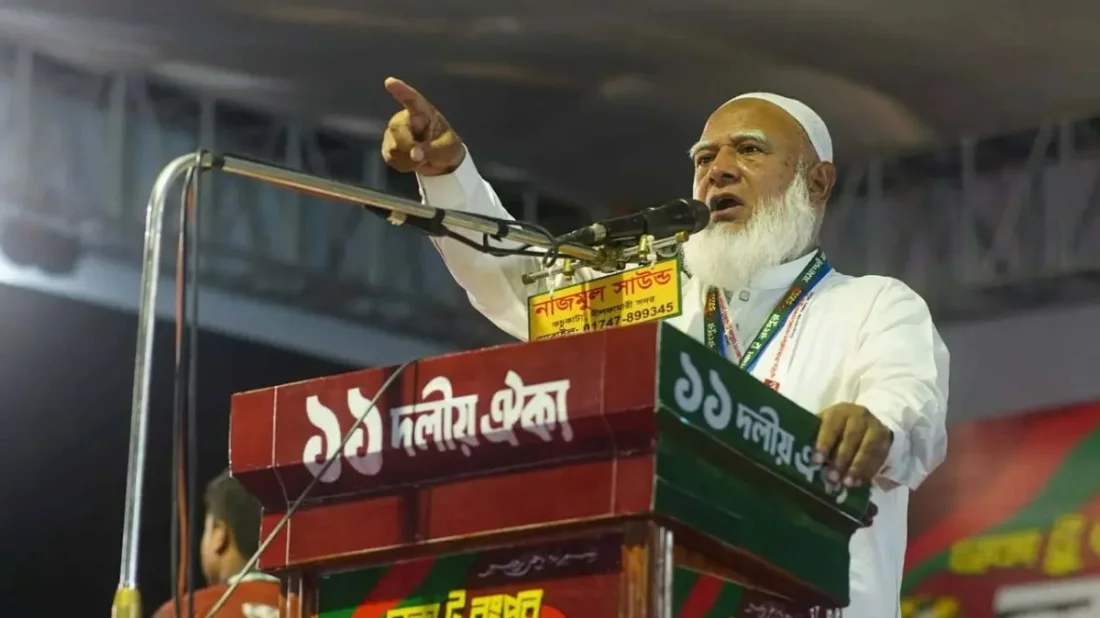
Dr. Shafiqur Rahman, the Ameer of Bangladesh Jamaat-e-Islami and Leader of the Opposition in the National Parliament, has sharply criticized the government regarding the Transfer of Property (Amendment) Bill 2026. Terming the law contrary to the Quran and Sunnah, he stated that the government would have to pay a price for enacting such legislation and demanded its withdrawal.
He made these remarks on Saturday night (September 19) while addressing the concluding rally of the 11-party alliance's Dhaka-Rangpur long march at the Rangpur Zilla School grounds.
Shafiqur Rahman asserted that the Transfer of Property (Amendment) Bill 2026 conflicts with religious tenets. He also expressed apprehension that the law could give rise to various problems within families across the country.
Criticizing the government regarding the implementation of referendum verdicts, the Jamaat Ameer stated that the public's mandate should not be ignored simply by arguing that the constitution lacks a provision for referendums. He claimed that the current government has reneged on many of the promises it made prior to the election.
Accusing the government of breaking promises, he explained that this is why the 11-party alliance is carrying out the long march program. He remarked that if the government took effective steps to implement their demands, such programs would not be necessary.
Shafiqur Rahman further stated that unless their eight-point demands are met, their movement will continue on the streets alongside parliamentary efforts. He warned that, if necessary, the eight-point demands could evolve into a single-point demand.
The Jamaat Ameer also criticized the government regarding the country's situation concerning electricity, gas, fertilizer, employment, and commodity prices. He alleged that ordinary people are suffering due to extortion and that the prices of essential commodities are rising.
Shafiqur Rahman also called for the implementation of the Teesta Master Plan. Referencing the pre-election pledge to implement this project, he stated that the Teesta Master Plan must be executed swiftly to foster the development of agriculture and rivers in the northern region.
He asserted that the 11-party alliance's eight-point demands are not specific to any single party but are instead linked to the various problems and rights of the general public. The demands include implementing the referendum verdict, ensuring justice for the killings that took place in July, resolving shortages of electricity, fuel, gas, and fertilizer, controlling commodity prices, curbing corruption and extortion, improving the law-and-order situation, and implementing the Teesta Master Plan.
Leaders from various parties within an 11-party alliance—including Jamaat-e-Islami, Jatiya Nagorik Party, Liberal Democratic Party, and Bangladesh Khelafat Majlish—addressed the rally.
The long march from Dhaka to Rangpur, organized around an eight-point charter of demands, began on Saturday morning from Manik Mia Avenue in Dhaka. Following roadside rallies in Gazipur, Tangail, Sirajganj, Bogura, and Gaibandha along the route, the concluding rally was held at the Rangpur Zilla School grounds.
Advertisement
Most Readed - Politics


- I’ve prayed a thousand times that men would get periods too: Shruti Haasan
- "The government will have to pay a price for enacting laws contrary to the Quran and Sunnah": Shafiqur Rahman
- NCL 'Second Eleven' Championship to be Held Across Five Venues
- Strait of Hormuz to Remain Closed Until Iran's Conditions Are Met: Ghalibaf
- Four Arrested in Opratim Murder Case; Home Minister Confirms Confession
- Baby Girl Born with 28 Digits in Phulbari
- Alia and Ranbir’s initiative to renovate 20 Mumbai schools on Modi’s birthday
- Rashed Khan terms Jamaat's long march 'illogical' but pledges cooperation
- Explosions in Saudi Capital Riyadh; Air Raid Alert Issued
- Real Madrid and Barcelona Eyeing Kavan Sullivan of Bangladeshi Descent
- 15 artists including Boga Taleb to sing in memory of Razzak Dewan
- Joining the Mecca Pact is Bangladesh's own matter: Jamaat Ameer
- Dr. Tasnim Zara: Education, Career and Politics
- Salman Shah, the evergreen hero of Bengali cinema, lost untimely
- AC explosion in Pakistani hospital, 15 newborns die
- Bangladeshi football will not change just by playing with Brazil, says Aminul
- Rain forecast for five more days across the country
- Australian captain impressed by Shariful's bowling
- Door-to-door health check-ups, ‘Health Hub’ to be set up in unions: Health Minister
- Tokyo, not Bangkok, is becoming the new center of sex tourism