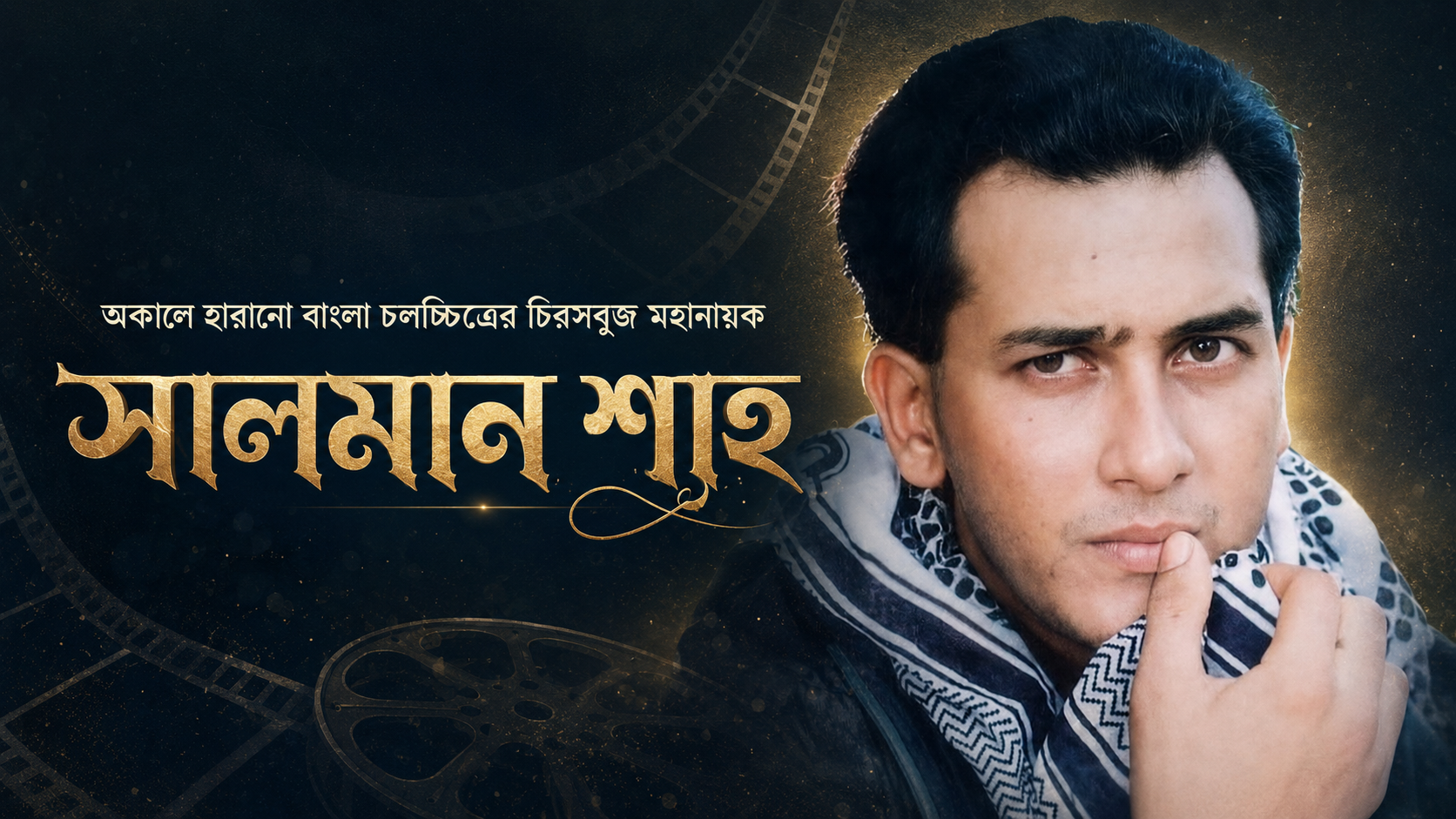
Salman Shah, the evergreen hero of Bengali cinema, lost untimely

Published: 04:13 27 August 2026
Salman Shah is one of the most iconic and beloved actors in the history of Bangladeshi cinema. Although his career lasted only a few years, his influence on the country's film industry, youth culture, fashion and popular entertainment remains strong decades after his death.
With his modern appearance, natural acting style, distinctive fashion sense, romantic screen presence and charismatic personality, Salman Shah introduced a fresh image of the Bangladeshi film hero in the 1990s.
He made his big-screen debut in 1993 with the filmKeyamat Theke Keyamat opposite Moushumi. The film became a major success and established him as a leading star almost overnight. During his short film career, he acted in approximately 27 films, many of which became highly popular among Bangladeshi audiences.
Even after his untimely death in 1996, several of his completed films were released, allowing audiences to continue seeing him on the big screen. His popularity has remained remarkably strong among both older fans and younger generations.
Who Was Salman Shah?
Salman Shah's real name was Shahriar Chowdhury Emon. He became popularly known as Salman Shah after entering the Bangladeshi entertainment industry.
He was born on September 19, 1971, in the Sylhet region of Bangladesh. He later became one of the most recognizable faces of Bangladeshi cinema during the 1990s.
His father was Qamar Uddin Chowdhury, while his mother was Neela Chowdhury. From an early age, Salman Shah showed a strong interest in music, acting and entertainment.
Before becoming a major film star, he worked in television dramas and advertisements. These early experiences helped him develop the screen presence that later became one of his greatest strengths as a film actor.
Salman Shah was not only an actor. He was also a television performer and model, and he had a deep interest in music.
Salman Shah's Childhood and Family Background
Salman Shah grew up in a family with connections to Bangladesh's cultural and entertainment world. His maternal grandfather, Abdul Haque Chowdhury, has also been mentioned in various biographical accounts in connection with the country's film history.
His family environment played an important role in developing his interest in artistic activities.
Music was particularly important to him from childhood. According to biographical accounts, he appeared on Bangladesh Television as a child and participated in a children's program in 1982, where he performed a song.
His early involvement with television, music and cultural activities eventually helped him move toward professional acting and modeling.
Education
Salman Shah's educational journey included several institutions.
According to various biographical sources, he began his schooling at Boyra Model High School in Khulna. He later studied at Dhanmondi Arabi Mission School in Dhaka and completed his secondary education in 1987.
He subsequently studied at Adamjee Cantonment College and later attended Maleka Science College, now known as Dr. Maleka University College, from where he completed his B.Com degree according to biographical reports.
Although he received a formal education, his passion for entertainment ultimately led him toward acting, modeling and the media industry.
The Beginning of His Acting Career
Before entering mainstream cinema, Salman Shah established himself through television drama and advertising.
His acting career is generally traced back to the television drama ‘Akash Chhowa’, in which he appeared in 1985.
He subsequently worked in several television productions and gradually became familiar to television audiences.
Among the television productions associated with Salman Shah are:
- Akash Chhowa
- Deyal
- Shob Pakhi Ghore Fire
- Saikote Sarosh
- Pathor Shomoy
- Itikotha
- Doyel
- Noyon
- Shopner Prithibi
He also appeared in television commercials and worked as a model for several well-known brands. His early modeling career helped him establish the stylish public image that later became a major part of his popularity.
‘Keyamat Theke Keyamat’: The Film That Changed His Life
The year 1993 became the turning point in Salman Shah's life.
Director Sohanur Rahman Sohan introduced him as the lead actor in the film ‘Keyamat Theke Keyamat’, opposite newcomer Moushumi.
Both Salman Shah and Moushumi were relatively new faces at the time. However, the film became a major success and their on-screen chemistry immediately attracted audiences.
Keyamat Theke Keyamat was a Bangladeshi adaptation of the Indian film Qayamat Se Qayamat Tak. The success of the Bangladeshi version transformed Salman Shah from a newcomer into a major film star.
His appearance, acting style, romantic screen presence and modern personality appealed particularly strongly to young audiences.
After the success of the film, Salman Shah quickly became one of the most talked-about young actors in Bangladesh.
Salman Shah and Moushumi: A Memorable Screen Pair
One of Salman Shah's earliest successful screen partnerships was with Moushumi.
Their chemistry in Keyamat Theke Keyamat became highly popular among audiences. Their combination of youthful appearance, romantic performances and natural screen presence made them one of the memorable pairs of early-1990s Bangladeshi cinema.
They appeared together in several films, including:
- Keyamat Theke Keyamat
- Antore Antore
- Sneho
- Denmohor
The popularity of Salman-Moushumi demonstrated how quickly Salman Shah had established himself as a leading romantic hero.
Salman Shah and Shabnur: One of Bangladesh's Most Popular Screen Couples
Salman Shah's most famous on-screen partnership was arguably with Shabnur.
Their collaboration began with ‘Tumi Amar’ in 1994. The film helped establish Salman-Shabnur as one of the most popular romantic pairs in Bangladeshi cinema.
They subsequently appeared together in several commercially successful and widely remembered films.
Some of their notable films include:
- Tumi Amar
- Sujon Sokhi
- Shopner Thikana
- Mohamilon
- Tomake Chai
- Jibon Shongshar
- Shopner Prithibi
- Anondo Oshru
The chemistry between Salman Shah and Shabnur became one of the defining features of Bangladeshi commercial cinema during the mid-1990s.
Their popularity continues to this day, and their films remain familiar to Bangladeshi audiences.
Salman Shah's Film Career
Salman Shah's film career was remarkably short but highly productive.
He is generally credited with appearing in approximately 27 films during his career. Several of his movies were released after his death because they had already been completed or were in production at the time of his death.
Notable Salman Shah Films
| Year | Film | Character |
|---|---|---|
| 1993 | Keyamat Theke Keyamat | Raj |
| 1994 | Tumi Amar | Akash |
| 1994 | Antore Antore | Shan |
| 1994 | Sujon Sokhi | Sujon |
| 1994 | Bikshov | Anik |
| 1994 | Sneho | Emon |
| 1994 | Prem Juddho | Raja |
| 1995 | Denmohor | Sarwar |
| 1995 | Konyadan | Shrabon |
| 1995 | Shopner Thikana | Sumon |
| 1995 | Anjuman | Salman |
| 1995 | Mohamilon | Shanto |
| 1995 | Asha Bhalobasha | Akash |
| 1996 | Bichar Hobe | Sujon |
| 1996 | Ei Ghor Ei Shongshar | Mintu |
| 1996 | Priyojon | Noyon/Jibon |
| 1996 | Tomake Chai | Sagor |
| 1996 | Shopner Prithibi | Masum |
| 1996 | Shotyer Mrittu Nei | Joy |
| 1996 | Jibon Shongshar | Shobuj |
| 1996 | Mayer Odhikar | Robin |
| 1996 | Chawa Theke Pawa | Sagor |
| 1997 | Prem Piyashi | Hridoy/Jibon |
| 1997 | Shopner Nayok | Raju/Russell |
| 1997 | Shudhu Tumi | Akash |
| 1997 | Anondo Oshru | Khasru |
| 1997 | Buker Vitor Agun | Agun |
The 1997 titles in the list were released after Salman Shah's death. Therefore, their release dates should not be confused with his date of death.
Salman Shah's Most Popular Films
Keyamat Theke Keyamat
Keyamat Theke Keyamat was Salman Shah's debut film and the project that established him as a major star.
His pairing with Moushumi became one of the major attractions of the film. The success of the movie created an immediate demand for Salman Shah as a leading actor.
Shopner Thikana
Shopner Thikana is one of Salman Shah and Shabnur's best-known films.
The film became highly popular among audiences during the 1990s and strengthened Salman Shah's position as a commercially successful romantic hero.
Sujon Sokhi
Sujon Sokhi is another memorable Salman-Shabnur film.
The movie showcased Salman Shah's romantic acting style and his chemistry with Shabnur, making it an important title in his filmography.
Tumi Amar
Tumi Amar played an important role in establishing the Salman-Shabnur pairing.
The film became popular with audiences and helped turn the two actors into one of the most recognizable screen couples of the decade.
Shotyer Mrittu Nei
Released in 1996, Shotyer Mrittu Nei became particularly significant because of the circumstances surrounding Salman Shah's death.
The film continued to attract audiences even after his death and became part of the enduring legacy of his career.
Anondo Oshru
Anondo Oshru was released after Salman Shah's death and remains one of the films associated with his posthumous legacy.
His performance and screen presence helped the movie remain memorable among his fans.
Salman Shah as a Fashion Icon
Salman Shah's influence extended far beyond acting.
He became one of the most influential fashion icons of Bangladeshi cinema during the 1990s.
His hairstyles, shirts, jeans, jackets, sunglasses and overall styling became extremely popular among young Bangladeshis.
At a time when male film stars often followed more traditional styles, Salman Shah introduced a distinctly modern and youthful appearance.
His fashion choices were closely followed by young audiences, and many of his styles were copied by fans.
Even today, when people discuss 1990s Bangladeshi fashion, Salman Shah's name frequently comes up.
His influence on men's fashion became so significant that his clothing and hairstyle are still referenced by fans and younger actors.
Salman Shah and His Love for Music
Music was another important part of Salman Shah's life.
His interest in music began during childhood. As mentioned in various biographical accounts, he participated in a Bangladesh Television children's program in 1982 and performed a song.
Later, music became an important component of many of his films.
Romantic songs, emotional sequences and musical storytelling contributed significantly to the appeal of his movies.
His combination of acting, music, fashion and personality made him more than just a conventional film actor.
Personal Life and Marriage
Salman Shah married Samira Haque on August 12, 1992, according to biographical reports.
Samira Haque was associated with the beauty and salon business.
Because Salman Shah became a major celebrity at a very young age, his personal life naturally attracted considerable public and media attention.
After his death, various discussions and claims concerning his personal relationships and family life appeared in the media and among the public.
However, claims made about a celebrity's private life should not automatically be treated as established facts unless supported by reliable evidence.
The Death of Salman Shah
On September 6, 1996, Salman Shah died at the age of only 24.
His death shocked Bangladesh's entertainment industry and millions of his fans.
He was found dead at his residence in Eskaton, Dhaka.
His death immediately became the subject of widespread discussion and controversy.
Initial investigations and subsequent investigations reached conclusions that treated his death as suicide. However, members of Salman Shah's family have repeatedly disputed that conclusion and have sought further investigation.
Because the matter has involved multiple investigations and later legal proceedings, it is important to distinguish between historical investigation findings, family allegations and final judicial determinations.
What Did the PBI Investigation Say?
In 2020, the Police Bureau of Investigation (PBI) concluded a long-running investigation into Salman Shah's death.
The PBI stated that it did not find evidence establishing that Salman Shah had been murdered and concluded that his death was a suicide.
The investigation reportedly involved questioning dozens of people and reviewing a substantial amount of evidence and testimony.
However, Salman Shah's family did not accept the conclusion.
As a result, the controversy surrounding the circumstances of his death continued.
Why Did Salman Shah's Death Case Return to the Headlines in 2025–2026?
Nearly three decades after his death, the case took a new legal turn in 2025.
In October 2025, a murder case was filed naming 11 people as accused, following renewed legal action concerning the circumstances of Salman Shah's death.
The case subsequently entered a new phase of legal investigation.
In May 2026, a court reportedly allowed the exhumation of Salman Shah's remains for a new inquest and post-mortem examination as part of the renewed investigation into the circumstances of his death.
Further legal developments subsequently arose concerning the exhumation order.
In July 2026, a Dhaka court reportedly set August 30, 2026 as the deadline for submitting the investigation report in the Salman Shah murder case.
In August 2026, actor Ashraful Haque Don was arrested in connection with the case and was subsequently sent to jail by the court.
Because the case remains part of an ongoing legal process, it would be inaccurate to state categorically that murder has been proven or that suicide has been legally established as the final answer.
The most responsible description is that Salman Shah's death remains the subject of a long-running controversy and renewed legal investigation.
Awards and Recognition
Salman Shah received recognition for his acting during his short career.
According to Bangladeshi film databases, he received a Best Actor award from the Bangladesh Film Producers and Distributors Association for his performance in Jibon Shongshar in 1996.
However, his greatest recognition came from the audience.
His enduring popularity demonstrates the extraordinary connection he created with Bangladeshi moviegoers during his brief career.
Even decades after his death, he continues to be remembered as one of the most beloved actors in the country's cinematic history.
Salman Shah's Legacy
Almost three decades after his death, Salman Shah remains a powerful cultural figure in Bangladesh.
His films continue to be watched, his photographs circulate widely on social media, and fans continue to remember him on his birthday and death anniversary.
His influence extends beyond cinema.
He changed the way the young male protagonist was presented in Bangladeshi commercial films. He combined romance, fashion, youthful energy and modernity in a way that was relatively new for the country's mainstream cinema of the period.
He demonstrated that a film hero could be stylish, emotionally expressive, romantic and modern while still connecting strongly with mass audiences.
This combination became one of the most important aspects of his legacy.
Why Is Salman Shah Still So Popular?
There are several reasons behind Salman Shah's extraordinary and lasting popularity.
Natural Acting
Salman Shah was known for presenting emotions in a relatively natural and accessible manner. His performances often connected directly with young audiences.
Modern Personality
His appearance and personality represented a modern generation of Bangladeshi youth.
Popular Screen Partnerships
His pairings with Moushumi and Shabnur became major attractions of Bangladeshi cinema.
Memorable Music
Songs from his movies contributed significantly to his popularity and helped create emotional connections between audiences and his characters.
Fashion Influence
His hairstyles and clothing became trends among young people and helped transform him into a fashion icon.
Untimely Death
His death at only 24, while his career was still developing, made his story particularly tragic and contributed to the enduring mythology surrounding his career.
Salman Shah: The Story of an Unfinished Career
Perhaps the most tragic aspect of Salman Shah's story is that his career ended when it was still at its beginning.
He was only 24 years old when he died.
In just a few years, he had already established himself as one of Bangladesh's leading film stars and had appeared in approximately 27 films.
Several movies were released after his death, meaning audiences continued to see new Salman Shah films even after he was gone.
His unfinished career has led generations of fans to wonder what he might have achieved had he lived longer.
Would he have become a director? A producer? A singer? Would he have continued acting for decades? Would he have transformed Bangladeshi cinema even further?
These questions remain unanswered.
Conclusion
Salman Shah was more than a film actor; he was a cultural phenomenon who represented the dreams, romance, style and aspirations of an entire generation.
His journey began with Keyamat Theke Keyamat in 1993 and quickly transformed him into one of Bangladesh's biggest young stars.
His partnerships with Moushumi and Shabnur, his performances in films such as Tumi Amar, Shopner Thikana, Sujon Sokhi, Denmohor, Jibon Shongshar, Shotyer Mrittu Nei and Anondo Oshru, and his distinctive fashion sense made him a unique figure in Bangladeshi popular culture.
His sudden death on September 6, 1996, created a void in the country's film industry that has never truly been filled.
The circumstances surrounding his death remain controversial. Earlier investigations reached conclusions treating the death as suicide, while his family disputed those findings. Renewed legal proceedings in 2025–2026 have once again brought the issue into public attention.
Therefore, until the current legal process reaches a final conclusion, claims about the exact cause of his death should be presented carefully and should not be described as legally proven facts.
But one fact remains undeniable: Salman Shah occupies a unique place in the history of Bangladeshi cinema.
He worked for only a few years, yet his impact has lasted for generations. His films continue to attract viewers, his fashion continues to inspire people, and his name remains deeply connected with the golden memories of 1990s Bangladeshi cinema.
Salman Shah may have left the world at a very young age, but his movies, performances, style and memories continue to live on in the hearts of millions of people.
Advertisement
Most Readed - Biography


- Dates Set for Appeal Hearings in 'Seven Murders', Major Sinha, and Abrar Murder Cases
- Nearly Half of Households in the Country Are in Debt; Expenses Exceed Income: BBS Survey
- Journalist Sued: Zahirul Calls for Impartial Investigation and End to Harassment
- Earning Crores from Flat Rentals: A Look at Ranbir Kapoor’s Real Estate Assets
- Opposition acting irresponsibly after securing votes with promises of 'paradise': State Minister
- 'Bringing in a foreign coach won't change everything; local coaches are also capable' – Taskin
- CJP Founder Abhijit Released; Two Other Leaders Remain in Custody
- "He is not 'Tarek Zia'; he is 'another Zia'" — Chief Whip Nurul Islam Moni
- Rumors of a Split in Sabila Nur’s Seven-Year Marriage; Allegations of a New Relationship Emerge
- A new innovation in football: ‘Electronic cards’ replace traditional yellow and red cards!
- Fuel for Rooppur Nuclear Power Plant Arriving in Bangladesh Today
- Cybercriminals Claim to Possess Data of 19 Million Pathao Users; $400,000 Ransom Demanded
- Jamuna Fertilizer Factory Shuts Down Again Just Two Days After Resuming Operations
- Ronaldo faces risk of 6-month ban for leaving national team camp
- Messi bids farewell with a goal and assists, showered with love by teammates
- Ronaldo shares emotional message upon Messi's retirement, expressing 'utmost respect'
- Hasnat Questions the Source of Salahuddin’s Wealth, Demands Transparent Accounting
- Countless Decembers will come and go, but Sheikh Hasina will not return to the country: Rashed Khan
- Three-Day Mosquito Eradication Drive Begins in Savar's Bongaon
- Hashmatullah leaves the field after injury while batting against Bangladesh