The Game of Confusion Over Geopolitics: Who Is Responsible for Misleading the People?
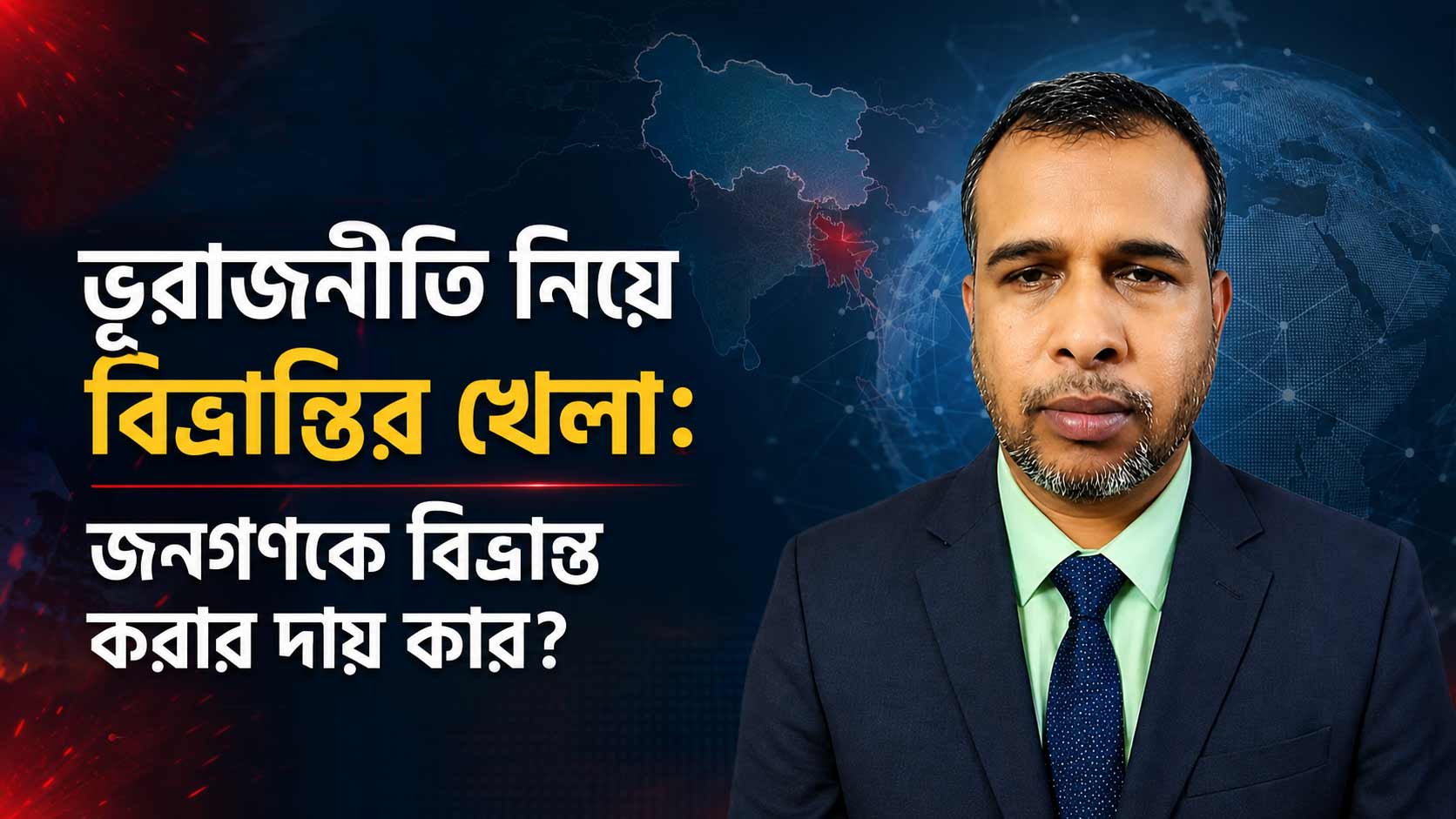
The Game of Confusion Over Geopolitics: Who Is Responsible for Misleading the People?
Published: 11:54 27 June 2026
The July mass uprising marked the beginning of an important chapter in Bangladesh’s political history. Through that movement, the people of the country did not merely expect a change of government; they wanted accountability in state governance, democratic values, the rule of law, good governance, and the development of a new political culture.
After a long period of political polarization, mistrust, conflict, and politics of revenge, the dream of a tolerant, participatory, and development-oriented Bangladesh has now found a place in the hearts of millions. The path to realizing this dream is not easy, but it is not impossible either—if the state, politics, media, and civil society can play their roles responsibly.
At such a time, Bangladesh’s geopolitical and economic importance has once again come into discussion in the international arena. In the context of connectivity between South and Southeast Asia, regional trade, supply systems, and infrastructural development, discussions have resumed around the China–Bangladesh–Myanmar Economic Corridor, known as the CBM Economic Corridor.
Many economic analysts believe that if this corridor is implemented, it may create opportunities for Bangladesh, such as the development of new industrial zones, increased exports, job creation, improved communication systems, and attraction of foreign investment. On the other hand, there are also discussions about the strategic and economic risks of such a large project. In other words, this is an issue that requires analysis based not on emotion, but on facts, research, and national interest.
Unfortunately, amid this important national discussion, some statements are being circulated on social media that are diverting public attention from the main issue and bringing confusion and controversy to the forefront. Recently, a post was published from a Facebook profile operated under the name of former Member of Parliament Golam Maula Rony. The post stated: “America wants the corridor. China also wanted it. India wants to buy Rangpur Division. What will the poor man’s sister-in-law do now?” After being published, the post quickly went viral and sparked widespread discussion on different social media platforms.
Some people interpreted the post as political satire, while others saw it as an attempt to mock the current political situation. However, a large section of people expressed concern because the post made a claim for which no official, diplomatic, or internationally acceptable information has so far been published. In particular, the statement that “India wants to buy Rangpur Division” is extremely sensitive and directly connected to the sovereignty of the state.
Until the writing of this editorial, no such information has been confirmed by the Government of Bangladesh, the Government of India, any international organization, or any reliable diplomatic source. Therefore, the claim is unverified and cannot be treated as established fact.
In the age of social media, a post is not merely a collection of a few sentences. It has the power to influence the thoughts, emotions, and attitudes of hundreds of thousands of people within moments. Especially when a former Member of Parliament, political leader, or well-known public figure makes a statement, ordinary people often perceive it as information. As a result, every comment they make carries a much greater social responsibility.
If the discussed post was truly published from the concerned person’s used or official Facebook account, then it certainly raises the need for more responsible language. Satire, metaphor, or political humor is not unusual in a democratic society. But when such a statement is related to sensitive issues such as territory, sovereignty, or international relations, its impact can spread far and wide.
After the July mass uprising, one of the foundations of the new Bangladesh that people dream of is a responsible political culture. Moving away from past divisions, rumors, propaganda, and revenge-driven politics, it is now necessary to establish the practice of fact-based discussion and constructive criticism.
Political differences will certainly exist. Government policies will also be criticized. But that criticism should be based on facts, logic, and reality. Because the faster an unverified statement spreads, the faster its harmful impact also spreads throughout society.
Bangladesh’s foreign policy has always emphasized balanced diplomacy. China is one of Bangladesh’s major development partners. India is its closest neighbor and an important trade partner. The United States is one of Bangladesh’s major export markets. The European Union has long been a development partner of Bangladesh.
In this reality, emotional or misleading statements centered on any one country do not only create internal political debate; they can also send the wrong message internationally. As a responsible state, Bangladesh’s interest lies in advancing relations with all partner countries on the basis of mutual respect, national interest, and balanced diplomacy.
The media also has a special responsibility at this time. The role of the media is not to become a vehicle for political propaganda, but to verify information, present relevant analysis, and inform the public with accurate facts. Similarly, citizens should also verify the source before sharing or believing any sensitive information circulated on social media. A rumor can sometimes cause damage that cannot be fully repaired even after the truth comes out.
Today, Bangladesh’s greatest needs are development, employment, investment, education, healthcare, and strong democratic institutions. The expectations of the people are also directed toward these goals. Therefore, nationally important issues should not be turned into tools for political mudslinging. Instead, they should be discussed responsibly, positively, and on the basis of research.
Whether the economic corridor should be built or not, and what its advantages and disadvantages may be—these issues should be debated widely. But that debate must be based on facts, not imagination or rumor.
Until the writing of this article, no official statement has been received from any relevant government authority or from India regarding the claim raised in the viral post. Therefore, before reaching any definite conclusion on the matter, maintaining caution, verifying information, and acting responsibly would be the most logical and democratic position.
The dream of a new Bangladesh is not merely the name of a political change; it is also the name of a mental transformation. Accepting the truth as truth, dealing with differences of opinion with tolerance, giving priority to facts over rumors, and placing national interest above party interest—these values can become the foundation of a new Bangladesh.
We must remember that the future of a state is not determined only by the policies of the government. Rather, that future is built through the responsible behavior of politicians, the media, civil society, and every conscious citizen.
Today, what is needed is not the politics of confusion, but fact-based discussion. What is needed is not excitement, but wisdom. What is needed is not propaganda, but responsible expression of opinion.
Because the greatest strength of a new Bangladesh will be its conscious citizens, fact-based public opinion, and a united position in the national interest.
— Md. Suruj Ali
Editor and Publisher
More News BD
Advertisement
- Chinmoy Krishna Das Wants to Perform His Mother’s First Death Anniversary Ritual in Jail
- Salman F Rahman to Step Down from Beximco Pharma Board
- Verdict Today in Case Against 7 Awami League Leaders, Including Quader and Saddam
- Fears of a rift in the France squad; tensions rise around Mbappé and Dembélé
- South Korean Woman Embraces Islam While Visiting Turkey
- Prime Minister Meets Families of Two Martyred Soldiers; Financial Aid Provided
- Akram Khan Biography: The Victory That Changed Bangladesh Cricket
- Asif joins the Jamaat alliance solely to escape charges: Rashed Khan
- Upon returning to the country, Badhon sends a message to the Awami League urging them not to engage in the politics of shame.
- Bangladesh Bank to provide up to Tk 20 lakh without collateral; here is which young entrepreneurs are eligible.
- 15 artists including Boga Taleb to sing in memory of Razzak Dewan
- Joining the Mecca Pact is Bangladesh's own matter: Jamaat Ameer
- 600 students leave hostel in India over 'ghost scare', doctors have different explanations
- Emraan Hashmi is coming back with 'Jannat', 'Jannat 3' is coming
- Dr. Tasnim Zara: Education, Career and Politics
- Iran is losing control of the Strait of Hormuz
- Sugarcane cultivation is changing the fate of farmers, opening up additional income avenues
- NBR to be split into two independent institutions: Finance Minister
- Jamaat has adopted the characteristics of Awami League: Rashed Khan
- AC explosion in Pakistani hospital, 15 newborns die